 Back
BackEpidemiology and Public Health Microbiology: Principles, Methods, and Applications
Study Guide - Smart Notes
 Tailored notes based on your materials, expanded with key definitions, examples, and context.
Epidemiology & Public Health Microbiology
Introduction to Epidemiology
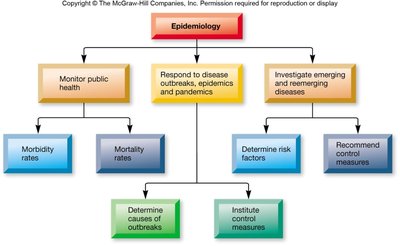
Epidemiology is the scientific discipline concerned with evaluating the occurrence, causes, distribution, and control of health and disease within defined human populations. It forms the foundation of public health by providing data-driven insights into disease patterns and informing strategies for prevention and control.
Epidemiology: The study of how diseases affect populations, including their frequency, distribution, and determinants.
Public Health Microbiology: Focuses on the microbial causes of disease and their impact on community health.
Surveillance and Reportable Diseases
Surveillance is a core activity in epidemiology, involving the systematic collection, analysis, and reporting of data on disease occurrence, mortality, morbidity, and transmission. Certain diseases, known as reportable or notifiable diseases, must be reported to public health authorities to facilitate timely intervention.
Surveillance: Monitoring disease trends through data collection and analysis.
Reportable Diseases: Diseases that are legally required to be reported, such as Salmonella infections.
Surveillance Methods
Epidemiologists employ various methods to track and investigate disease outbreaks. These include reviewing death certificates, conducting field investigations, and analyzing actual cases.
Review of death certificates
Field investigation of epidemics
Investigation of actual cases
Determining Disease Characteristics
The goals of epidemiological investigation are to identify the causative agent (microbe), source or reservoir, transmission mechanisms, host and environmental factors, and optimal control measures.
Causative Agent: The specific microbe responsible for the disease.
Source/Reservoir: Where the pathogen resides and multiplies.
Transmission Mechanism: How the disease spreads (e.g., airborne, contact).
Host/Environmental Factors: Conditions that facilitate disease development.
Control Measures: Strategies to prevent or limit disease spread.
Centers for Disease Control and Prevention (CDC) & World Health Organization (WHO)
The CDC, located in Atlanta, GA, is the principal U.S. government agency for tracking infectious diseases, developing prevention strategies, and promoting health. Its global counterpart is the WHO, based in Geneva, Switzerland.
CDC: Tracks infectious diseases, develops prevention and control strategies, and promotes health education.
WHO: Coordinates international public health efforts.
Frequency of Disease Cases
Prevalence and Incidence
Epidemiologists measure disease frequency using prevalence and incidence.
Prevalence: The proportion of existing cases in a population at a given time, often expressed as a percentage. Percentage of population that actually has the disease
Incidence: The number of new cases occurring over a specific time period, typically per 100,000 people.
Mortality and Morbidity Rates
Mortality Rate: The ratio of deaths due to a specific disease to the total number of cases.
Morbidity Rate: The number of people afflicted with a disease per 100,000 population.
Geographic Distribution of Disease
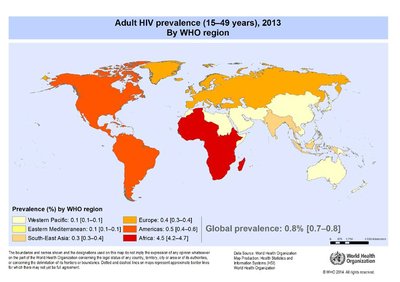
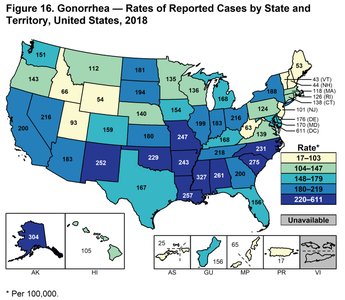
Disease rates can vary by region, as illustrated by maps showing the prevalence of HIV or rates of gonorrhea by state. Need to look at the number of diseases per population number - Morbidity
Example: Adult HIV prevalence varies significantly by WHO region.
Example: Gonorrhea rates differ across U.S. states.
Patterns of Disease Occurrence
Definitions of Disease Occurrence
Endemic: Disease with a steady frequency in a particular geographic locale.
Outbreak: Sudden, unexpected occurrence of disease, often localized.
Epidemic: Sudden increase in disease frequency above expected levels; the index case is the first identified case.
Pandemic: Epidemic that spreads across continents.
COVID-19: Started as outbreak in China then spread around world as pandemic. Now considered emerging diseased and an endemic
Control of Epidemics
Reducing or Eliminating Source/Reservoir
Effective control measures target the source or reservoir of infection.
Quarantine and isolation of cases and carriers (e.g., tuberculosis)
Destruction of animal reservoirs
Treatment of sewage
Therapy to reduce infectivity (e.g., antimicrobial drugs)
Breaking Connection Between Source and Susceptible Individuals
Preventing transmission involves interventions such as water chlorination, milk pasteurization, food inspection, and vector reduction.
Chlorination of water supplies
Pasteurization of milk
Supervision and inspection of food and food handlers
Reduction of insect vectors
Reducing Number of Susceptible Individuals
Vaccination and herd immunity are key strategies to decrease the number of individuals vulnerable to infection.
Vaccination: Administration of antigenic material to stimulate immunity.
Herd Immunity: Resistance of a population to infection due to immunity in a large percentage of individuals. As more people get a particular disease, develop a certain amount of immunity, it slows down the amount or people who will get sick and die
Emerging and Reemerging Infectious Diseases
Factors Contributing to Disease Emergence
The emergence and reemergence of infectious diseases are influenced by social, environmental, and biological factors.
Social unrest and wars
International travel
Microbial evolution and antibiotic resistance
Changes in human behavior
Inadequate public infrastructure
Medical practices leading to immunosuppression (e.g., steroid use for autoimmune diseases)
Ex: Reduced measles vaccinations
Key Epidemiological Formulas
Prevalence and Incidence Calculations
Prevalence Formula:
Incidence Formula:
Mortality Rate Formula:
Morbidity Rate Formula:
Summary Table: Types of Disease Occurrence
Term | Definition | Example |
|---|---|---|
Endemic | Steady frequency in a locale | Malaria in parts of Africa |
Outbreak | Sudden, localized occurrence | Foodborne illness in a community |
Epidemic | Increase above expected levels | Influenza in a country |
Pandemic | Global spread | COVID-19 |
Conclusion
Epidemiology is essential for understanding and controlling infectious diseases. Through surveillance, analysis, and intervention, public health professionals can reduce disease burden and improve population health.
