 Back
BackEssential Microbiology Lab Techniques: Micropipetting, Aseptic Transfer, and Streak Isolation
Study Guide - Smart Notes
 Tailored notes based on your materials, expanded with key definitions, examples, and context.
Micropipette Use and Technique
Introduction to Micropipettes
Micropipettes are precision instruments used to accurately measure and transfer small volumes of liquid, essential for microbiological experiments. Proper handling and technique are critical for ensuring experimental accuracy and reproducibility.
P100 and P1000 micropipettes are commonly used for volumes ranging from 10–1000 μL.
Micropipettes use disposable tips to prevent cross-contamination.
Operation and Volume Setting
Locking Mechanism: Some micropipettes have a locking mechanism to prevent accidental volume changes. To lock or unlock, follow the manufacturer's instructions, typically involving rotating a collar or pressing a button.
Minimum and Maximum Volumes: Each micropipette has a defined range. For example, a 10–200 μL pipette cannot accurately measure below 10 μL or above 200 μL.
Volume Display: The set volume is displayed on the pipette, often with three or four digits indicating hundreds, tens, and units of microliters.
Practical Steps for Accurate Pipetting
Set the desired volume using the adjustment dial.
Attach a clean tip before aspirating liquid.
Press the plunger to the first stop, immerse the tip in the liquid, and slowly release the plunger to aspirate.
Dispense by pressing the plunger to the second stop.
Discard the tip into a waste container after use.
Sources of Error in Pipetting
Inconsistent technique among users (e.g., speed of plunger depression, angle of pipette).
Improper tip attachment or incomplete aspiration/dispensing.
Air bubbles or residual liquid in the tip.
Example: When multiple users pipette 20 μL or 100 μL into a 96-well plate, differences in liquid volume may indicate technique errors or instrument calibration issues.
Aseptic Transfer Technique
Purpose and Importance
Aseptic transfer is a fundamental microbiological technique used to move microorganisms without introducing contaminants. This ensures the purity of cultures and the safety of laboratory personnel.
Broth cultures allow for the growth of large quantities of bacteria.
Aseptic technique prevents contamination from the environment or other samples.
Stepwise Protocol
Label the sterile broth tube with relevant information (name, date, media type, organism).
Sterilize the inoculating loop by heating until red-hot in an incinerator; allow to cool before use.
Transfer a small amount of bacteria from an agar slant to the sterile broth using the cooled loop.
Flame sterilize the loop after transfer to prevent contamination.
Example: Transferring Escherichia coli from a TSA slant to Tryptic Soy Broth (TSB) for further cultivation.
Streak Isolation Technique
Purpose and Principle
Streak isolation is used to separate individual bacterial cells on an agar plate, allowing for the growth of single colonies. This is essential for obtaining pure cultures from mixed populations.
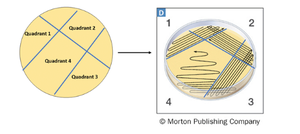
Quadrant streak method is commonly used for isolation.
Each quadrant reduces the number of bacteria, increasing the likelihood of single colony formation.
Stepwise Protocol
Draw a quadrant pattern on the agar side of the plate for reference.
Label the plate with name, date, media type, and organism around the edge.
Sterilize the inoculating loop and allow it to cool.
Obtain a small amount of bacterial culture and streak across quadrant 1.
Sterilize the loop, cool, and streak quadrant 2 by crossing into quadrant 1 once or twice.
Repeat sterilization and streaking for quadrants 3 and 4, each time crossing into the previous quadrant only once or twice.
Incubate the plate to allow colony growth.
Example: Isolating E. coli from a mixed broth culture using the quadrant streak method.
Key Points for Success
Always flame sterilize the loop between quadrants to prevent carryover of too many cells.
Keep the agar plate covered as much as possible to avoid airborne contamination.
Write small and at the edge of the plate to avoid obscuring bacterial growth.
Summary Table: Comparison of Key Techniques
Technique | Purpose | Key Steps | Common Errors |
|---|---|---|---|
Micropipetting | Accurate liquid measurement and transfer | Set volume, attach tip, aspirate, dispense, discard tip | Inconsistent technique, air bubbles, improper tip use |
Aseptic Transfer | Transfer bacteria without contamination | Sterilize loop, transfer, re-sterilize | Insufficient sterilization, not cooling loop |
Streak Isolation | Obtain single colonies from mixed culture | Quadrant streaking, sterilize loop between quadrants | Not sterilizing loop, crossing sectors too many times |
