 Back
BackEukaryotic Microorganisms: Fungi, Algae, Protozoa, and Helminths
Study Guide - Smart Notes
 Tailored notes based on your materials, expanded with key definitions, examples, and context.
Kingdom Fungi
General Characteristics of Fungi
Fungi are a diverse group of eukaryotic organisms that play essential roles in ecosystems as decomposers, pathogens, and sources of antibiotics and food products. Mycology is the study of fungi.
Nutritional Type: Chemoheterotrophs (obtain nutrients by absorption)
Multicellularity: All fungi except yeasts are multicellular
Cellular Arrangement: Unicellular (yeasts), filamentous (molds), or fleshy (mushrooms)
Food Acquisition: Absorptive
Characteristic Features: Sexual and asexual spores
Why study fungi? Some fungi are pathogenic, making their identification, treatment, and prevention important in medical microbiology.
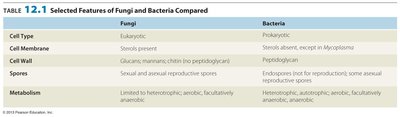
Table 12.1 compares selected features of fungi and bacteria, highlighting differences in cell type, cell wall composition, spore formation, and metabolism.
Vegetative Growth and Structure
Fungi exhibit various forms of vegetative growth, which is the phase of active metabolism and growth.
Molds and Fleshy Fungi: The fungal body (thallus) consists of long filaments called hyphae; a mass of hyphae is termed a mycelium.
Unicellular Fungi: Yeasts are nonfilamentous and can divide by fission (symmetrically) or budding (asymmetrically).
Dimorphism: Some fungi can exist in two forms, yeast-like at 37°C and mold-like at 25°C.
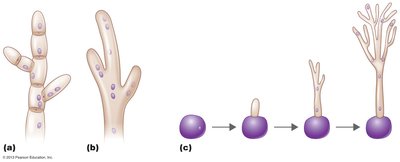
This image illustrates the structure of septate and coenocytic hyphae, and the process of hyphal growth from a spore.
Types of Hyphae
Septate Hyphae: Contain cross-walls (septa) that divide hyphae into distinct, uninucleate cell-like units.
Coenocytic Hyphae: Lack septa and consist of a continuous cytoplasmic mass with multiple nuclei.
Yeasts and Pseudohyphae
Yeasts are unicellular fungi that reproduce by budding or fission. Some, like Candida albicans, can form chains of buds called pseudohyphae.
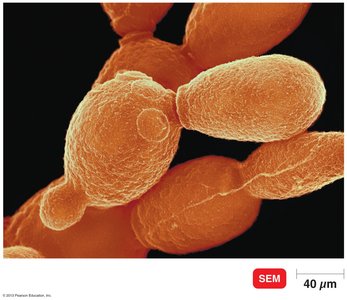
SEM of budding yeast (Saccharomyces cerevisiae), showing parent cell, bud, and bud scar.
Fungal Dimorphism
Dimorphic fungi can switch between yeast-like and mold-like forms, often in response to temperature or CO2 concentration.
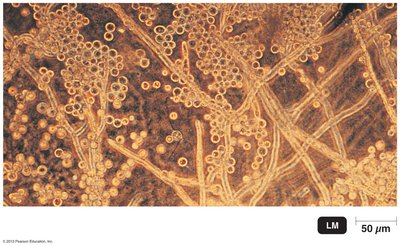
Dimorphic fungi exhibit yeastlike growth at 37°C and moldlike growth at 25°C.
Fungal Life Cycle
Fungi reproduce both sexually and asexually through the formation of spores. These spores are important for identification and classification.
Asexual Spores: Produced by mitosis; types include conidiospores, arthroconidia, blastoconidia, chlamydoconidia, and sporangiospores.
Sexual Spores: Result from the fusion of nuclei from two opposite mating strains, involving plasmogamy, karyogamy, and meiosis.
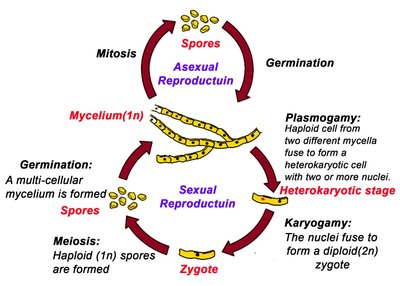
The fungal life cycle includes both asexual and sexual reproduction, with distinct phases for spore formation and germination.
Representative Asexual Spores
Conidiospore: Not enclosed in a sac; produced in chains at the end of a conidiophore.
Arthroconidia: Formed by fragmentation of septate hyphae.
Blastoconidia: Buds of the parent cell.
Chlamydoconidium: Thick-walled, rounded spore within a hyphal segment.
Sporangiospore: Enclosed in a sac (sporangium).
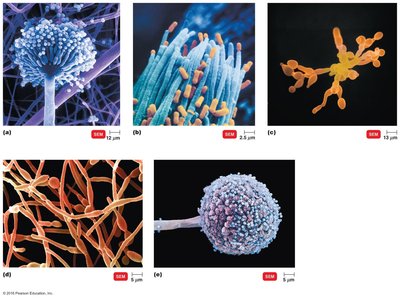
SEM images of different types of asexual spores, including conidia, arthroconidia, blastoconidia, chlamydoconidia, and sporangiospores.
Nutritional Adaptations of Fungi
Grow best at acidic pH (around 5)
Resistant to high sugar and salt concentrations (osmotic pressure)
Can grow in low moisture environments
Capable of metabolizing complex carbohydrates
Molds are aerobic; yeasts are facultative anaerobes
Ecological and Economic Importance
Decomposers: Main decomposers of organic materials such as lignin and cellulose
Pathogenic Fungi: Some cause diseases (mycoses) in humans, especially in immunocompromised individuals
Industrial Uses: Saccharomyces cerevisiae (bread, wine, HBV vaccine), Trichoderma (cellulase), Penicillium chrysogenum (antibiotics), Taxomyces (taxol, anticancer drug)
Fungal Diseases (Mycoses)
Systemic Mycoses: Deep within the body
Subcutaneous Mycoses: Beneath the skin
Cutaneous Mycoses: Affect hair, skin, and nails
Superficial Mycoses: Localized, e.g., hair shafts
Opportunistic Mycoses: Caused by normal microbiota or environmental fungi
Kingdom Protista: Algae
General Characteristics of Algae
Algae are simple, mostly aquatic, eukaryotic organisms that can be unicellular, colonial, or multicellular. They are important primary producers in aquatic ecosystems.
Nutritional Type: Photoautotrophs (most), some are chemoheterotrophs (e.g., oomycotes)
Cellular Arrangement: Unicellular, colonial, filamentous, or tissue-like
Food Acquisition: Diffusion
Characteristic Features: Photosynthetic pigments; some produce toxins
Algal Habitats and Adaptations
Algae are found in the photic zones of aquatic environments, where light is available for photosynthesis. They lack true roots, stems, and leaves, and absorb nutrients directly from water.
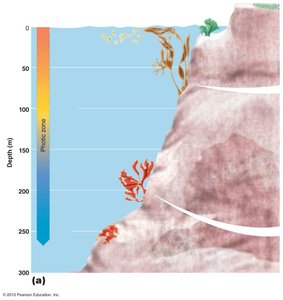
This diagram shows the distribution of different algae types by depth in aquatic environments, reflecting their adaptation to light availability.
Diatoms
Diatoms are unicellular algae with complex cell walls made of pectin and silica. They are important primary producers but can produce toxins harmful to humans and animals.
Cell Wall: Composed of two halves that fit together like a petri dish
Toxins: Some produce domoic acid, a neurotoxin that can accumulate in shellfish
Reproduction: Mainly asexual by binary fission
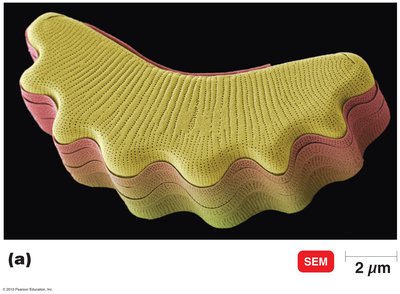
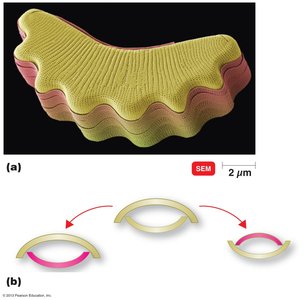
SEM images and diagrams show the structure and asexual reproduction of diatoms.
Dinoflagellates
Dinoflagellates are unicellular algae that are major components of plankton. Some species produce potent neurotoxins that can cause paralytic shellfish poisoning (PSP) in humans.
Red Tides: Large blooms of dinoflagellates (e.g., Alexandrium) can discolor water and cause fish kills.
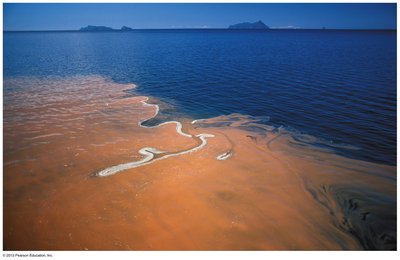
Red tides are caused by blooms of toxin-producing dinoflagellates.
Oomycota (Water Molds)
Oomycetes are fungus-like algae with cellulose cell walls. They are important as decomposers and plant pathogens (e.g., Phytophthora infestans, the cause of Irish potato blight).
Ecological and Economic Importance of Algae
Primary Producers: Fix CO2 into biomass and generate molecular oxygen (up to 80% of Earth's oxygen)
Industrial Uses: Algin (food thickener), agar, and carrageenan (gelatinous products)
Kingdom Protista: Protozoa
General Characteristics of Protozoa
Protozoa are unicellular, chemoheterotrophic eukaryotes, often called "first animals." They are highly diverse in form and function.
Vegetative Form: Trophozoite
Reproduction: Asexual (fission, budding, schizogony); sexual (conjugation in some)
Cysts: Some form protective cysts for survival in harsh conditions
Nutrition: Most are aerobic heterotrophs; some intestinal protozoa are anaerobic
Medically Important Protozoa
Diplomonads: Lack mitochondria, multiple flagella (e.g., Giardia lamblia)
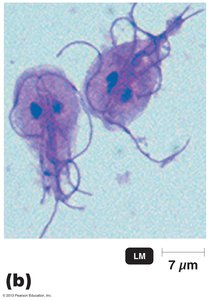
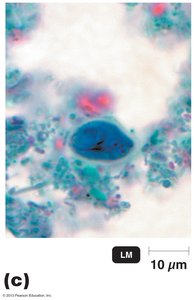
Images show the trophozoite and cyst forms of Giardia lamblia, a cause of gastrointestinal disease.
Parabasalids: No mitochondria, multiple flagella, no cyst stage (e.g., Trichomonas vaginalis)
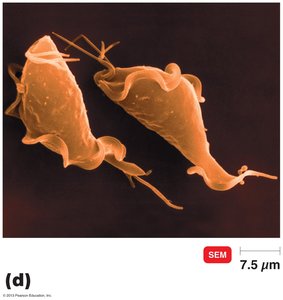
SEM of Trichomonas vaginalis, a protozoan causing sexually transmitted infections.
Amebae: Move by pseudopods (e.g., Entamoeba histolytica, Acanthamoeba)
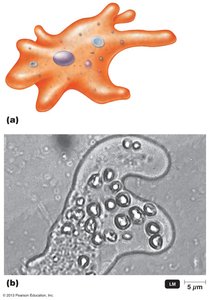
Illustration and micrograph of amebae, showing pseudopods and food vacuoles.
Apicomplexa: Nonmotile, obligate intracellular parasites with complex life cycles (e.g., Plasmodium, Toxoplasma)
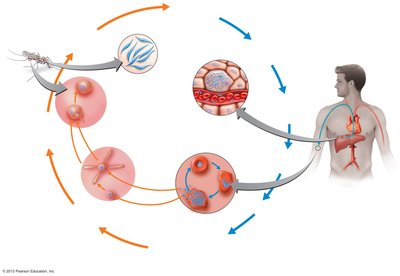
Life cycle of Plasmodium vivax, the causative agent of malaria, showing both sexual and asexual stages in mosquito and human hosts.
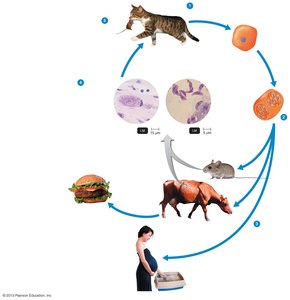
Life cycle of Toxoplasma gondii, showing transmission between cats, intermediate hosts, and humans.
Kingdom Animalia: Helminths (Parasitic Worms)
General Characteristics of Helminths
Helminths are multicellular, chemoheterotrophic animals, some of which are parasitic in humans. They are identified by their eggs and have complex life cycles involving one or more hosts.
Phyla: Platyhelminthes (flatworms: trematodes/flukes, cestodes/tapeworms), Nematoda (roundworms)
Life Cycle: May be monoecious (hermaphroditic) or dioecious (separate sexes); involves egg, larva(e), and adult stages
Flukes (Trematodes)
Flukes are flatworms with leaf-shaped bodies and suckers for attachment. They have complex life cycles with snails as intermediate hosts and vertebrates as definitive hosts.
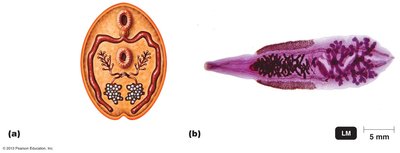
Diagram and micrograph of fluke anatomy, showing oral sucker, ventral sucker, intestine, ovary, and testes.
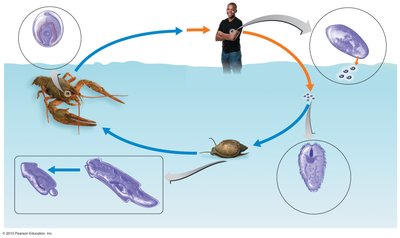
Life cycle of the lung fluke (Paragonimus spp.), involving snails, crayfish, and humans.
Nematodes (Roundworms)
Nematodes are cylindrical, tapered worms with a complete digestive system. Most are dioecious and can be free-living or parasitic.
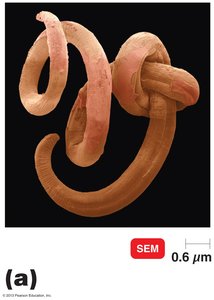
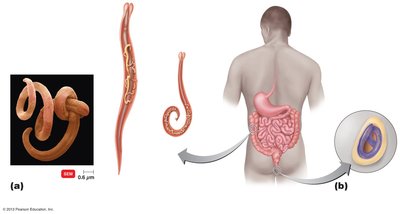
SEM and diagram of the pinworm (Enterobius vermicularis), a common intestinal parasite in humans.
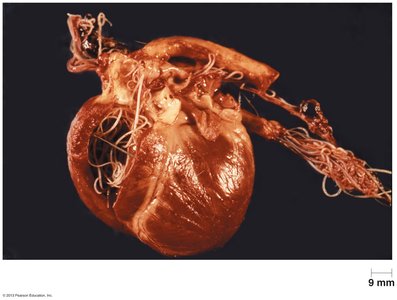
Heartworm (Dirofilaria immitis) infestation in a heart, primarily affecting dogs and cats.
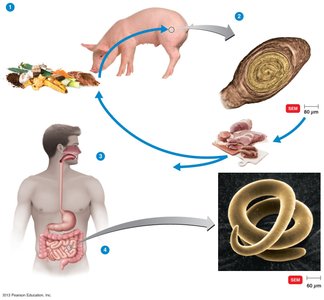
Life cycle of Trichinella spiralis, showing transmission through undercooked pork and encystment in muscle tissue.
Tapeworms (Cestodes)
Tapeworms are flat, ribbon-shaped worms that absorb nutrients across their body surface. The head (scolex) attaches to the host's intestine, and the body is made of segments (proglottids) containing reproductive organs.
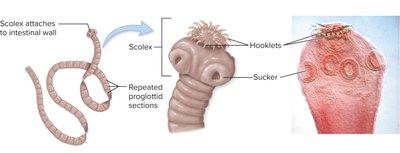
Diagram of a tapeworm, showing scolex (head) and repeated proglottid sections.
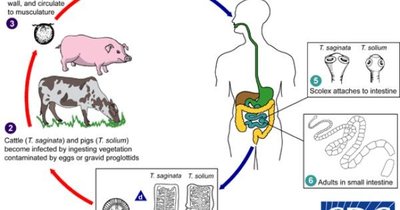
Life cycle of tapeworms, showing transmission between humans and livestock.
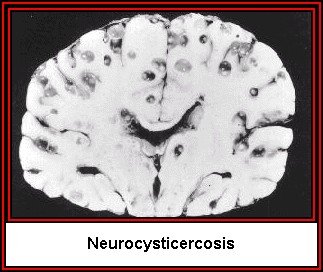
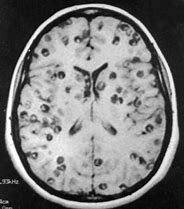
MRI images of neurocysticercosis, a condition caused by tapeworm larvae infecting the human brain.
Summary Table: Selected Features of Fungi and Bacteria
Fungi | Bacteria | |
|---|---|---|
Cell Type | Eukaryotic | Prokaryotic |
Cell Membrane | Sterols present | Sterols absent, except in Mycoplasma |
Cell Wall | Glucans, mannans, chitin (no peptidoglycan) | Peptidoglycan |
Spores | Sexual and asexual reproductive spores | Endospores (not for reproduction), some asexual reproductive spores |
Metabolism | Limited to heterotrophic, aerobic, facultatively anaerobic | Heterotrophic, autotrophic, aerobic, facultatively anaerobic, anaerobic |
