 Back
BackChapter 6
Study Guide - Smart Notes
 Tailored notes based on your materials, expanded with key definitions, examples, and context.
Eukaryotic Microorganisms
Overview
Eukaryotic microorganisms include a diverse group of organisms such as fungi, algae, protozoans, and helminths. These organisms are distinguished from prokaryotes by the presence of a true nucleus and membrane-bound organelles. Understanding their characteristics, reproduction, and medical importance is essential in microbiology.
Fungi
Defining Characteristics
Heterotrophic: Obtain nutrients by absorbing organic matter.
Cell Structure: May be unicellular (yeasts) or multicellular (molds, mushrooms).
Cell Wall: Composed of chitin.
Plasma Membrane: Contains ergosterol.
Growth Forms: Filamentous hyphae (molds), single cells (yeasts), or large fruiting bodies (mushrooms).
Dimorphism: Some fungi can exist as either yeast or mold depending on environmental conditions.
Mycology is the study of fungi. Although there are over 100,000 species, only about 200 are pathogenic to humans, with hospital-acquired infections on the rise.
Important Definitions
Hyphae: Threadlike filaments forming the body of multicellular fungi.
Mycelium: A mass of hyphae.
Dimorphism: Ability to exist in two different forms (yeast and mold).
Heterotroph: Organism that uses organic compounds as a carbon source.
Fungi vs. Bacteria
Fungi prefer acidic environments (pH ~5), which are too acidic for most bacteria.
Fungi are more resistant to osmotic pressure and can grow in high salt or sugar environments.
Fungi can metabolize more complex carbohydrates than bacteria.
Fungi vs. Plants
Fungi have cell walls made of chitin, not cellulose.
Fungi lack chlorophyll and do not perform photosynthesis.
Fungi have ribosomes similar to those of animals, not plants.
Types of Fungi
Yeasts: Unicellular, reproduce by budding, may be aerobic or anaerobic, do not require light.
Molds: Multicellular, form hyphae, can be septate (with cross walls) or coenocytic (without cross walls).
Dimorphic Fungi: Exist as molds in the environment and as yeasts in human tissues; spores can be inhaled and cause lung infections.

Reproduction in Fungi
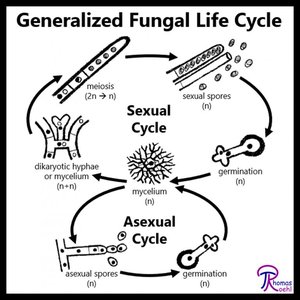
Asexual Reproduction
Yeasts reproduce by budding (similar to binary fission in bacteria).
Filamentous fungi can fragment hyphae and form spores.
Asexual reproduction produces sporangia, which release spores into the environment.
Sexual Reproduction
Introduces genetic diversity, enhancing survival under unfavorable conditions.
Occurs when haploid cells (+, -) fuse to form a dikaryon, followed by nuclear fusion (diploid), meiosis, and spore formation.

Medically Important Fungi
Pathogenic fungi are of increasing concern, especially in immunocompromised patients and hospital settings.
Examples include Candida (yeast infections), Aspergillus (lung infections), and Histoplasma (dimorphic fungus causing lung disease).
Algae
Defining Characteristics and Classification
Microscopic, photosynthetic organisms found in aquatic environments.
Main component of plankton; rarely infectious to humans.
Major concern is food poisoning from toxins (e.g., red tides).
Algae are classified into several groups based on pigment and structure:
Chlorophyta: Green algae
Phaeophyta: Brown algae
Rhodophyta: Red algae
Chrysophyta: Includes diatoms, major oxygen producers
Classification is difficult due to diversity in structure and pigment composition.
Reproduction in Algae
All algae can reproduce asexually (mitosis in unicellular forms, fragmentation in multicellular forms).
Sexual reproduction involves gamete fusion to form a zygote, followed by meiosis to restore the haploid state.
Some algae alternate between sexual and asexual reproduction.
Protozoans
Defining and Common Characteristics
Eukaryotic, unicellular, lack a cell wall.
Motile via cilia, flagella, or pseudopodia.
Most are chemoheterotrophs, obtaining nutrients by phagocytosis.
Some are free-living, others are parasitic (especially dangerous to immunocompromised individuals).
Life Cycle and Nuclear Features
Exist in active (trophozoite) and dormant (cyst) stages.
Some are intracellular parasites (infecting blood, tissues), others are extracellular (affecting intestines, urogenital system).
Contain a macronucleus (growth and metabolism) and a micronucleus (conjugation and genetic exchange).
Asexual reproduction by budding, fission, or schizogony (multiple fission).
Sexual reproduction by conjugation (exchange of genetic material between cells).
Slime Molds
Cellular vs. Plasmodial Slime Molds
Cellular Slime Molds: Exist as single amoeba-like cells, aggregate under stress to form a "slug" and release spores.
Plasmodial Slime Molds: Large masses of protoplasm with many nuclei (plasmodium), move as a giant amoeba, form spores under stress.
Slime molds are not pathogenic to humans and share characteristics with both fungi and amoebas.
Helminths
Parasitic Helminths: Main Characteristics
Multicellular eukaryotic worms, not true microorganisms but have microscopic diagnostic stages (eggs, larvae).
Life cycle often involves mammalian hosts; dominant reproductive systems.
May be dioecious (separate male and female worms) or monoecious (both organs in one worm, rarely self-fertilize).
Classification and Life Cycles
Platyhelminths (Flatworms):
Trematodes (Flukes): Flat, leaf-shaped, with oral and ventral suckers; named for their location (e.g., lung fluke).
Cestodes (Tapeworms): Intestinal parasites with a head (scolex), neck, and segments (proglottids); mature segments released in feces.
Nematodes (Roundworms):
Cylindrical, tapered at both ends; most numerous multicellular animals.
Pathogens classified by whether eggs or larvae are infective.
Examples: Pinworms (eggs ingested, hatch in intestine), Hookworms (larvae penetrate skin, migrate through body).
General Helminth Life Cycle
Stages: Fertilized egg (embryo) → larva → adult.
May involve intermediate and definitive hosts.
Comparison Table: Fungi, Algae, Protozoans, and Helminths
Group | Cellularity | Nutrition | Motility | Cell Wall | Reproduction | Medical Importance |
|---|---|---|---|---|---|---|
Fungi | Uni- or multicellular | Heterotrophic | Non-motile | Chitin | Asexual & Sexual | Pathogenic species (e.g., Candida) |
Algae | Uni- or multicellular | Photoautotrophic | Some motile (flagella) | Cellulose (varies) | Asexual & Sexual | Toxins (e.g., red tides) |
Protozoans | Unicellular | Chemoheterotrophic | Cilia, flagella, pseudopodia | None | Asexual & Sexual | Parasitic diseases (e.g., malaria) |
Helminths | Multicellular | Heterotrophic | Non-motile (adults) | None | Sexual (mainly) | Parasitic infections (e.g., pinworm, hookworm) |
