Back
Fundamental Characteristics and Morphology of Fungi
Study Guide - Smart Notes
 Tailored notes based on your materials, expanded with key definitions, examples, and context.
Basic Fungal Characteristics
Overview of Fungi
Fungi are a diverse group of eukaryotic organisms that play essential roles in ecology, industry, and human health. They are found in a wide range of environments and are increasingly relevant due to rising numbers of immunocompromised individuals.
Eukaryotic: Possess membrane-bound organelles and a true nucleus.
Chemoheterotrophic: Obtain nutrients by absorption, often secreting enzymes to digest extracellularly.
Strict aerobes or facultative anaerobes: Most require oxygen, but some can survive in low-oxygen environments.
Saprophytes: Many fungi feed on dead and decaying organic matter.
Parasites: Some fungi obtain nutrients from living hosts.
Facultative saprobes: Parasitic fungi that can also live as saprobes.
Achlorophyllous: Lack chlorophyll and do not perform photosynthesis.
Cell wall contains chitin: Provides structural support.
Ergosterol in cell membrane: Unique sterol used as a target for antifungal drugs.
Ubiquitous distribution: Found in air, water, soil, plants, and animals.
Fungi are important for:
Ecology: Major contributors to nutrient recycling (biogeochemical cycles).
Gastronomy: Used in the production of foods such as bread, beer, cheese, and mushrooms.
Medical Mycology: Increasingly causing human disease, especially in immunocompromised populations.
Examples of Fungi in Food:
Yeast in beer production
Yeast in bread making
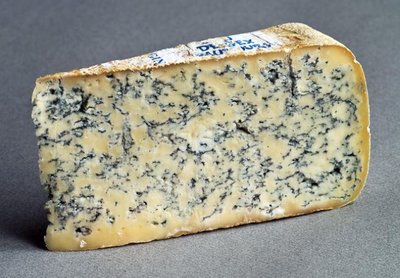
Molds in cheese production
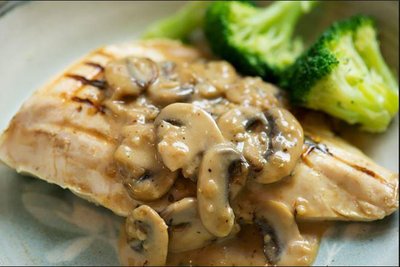
Mushrooms as food


Fungal Morphology
Forms of Fungi
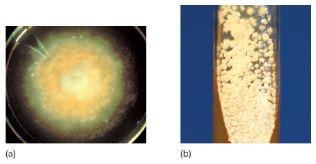
Fungi exhibit a variety of morphological forms, which are important for their identification and classification. The two main forms are molds and yeasts, with some fungi capable of dimorphism.
Monomorphic: Exist in only one form (either mold or yeast).
Dimorphic: Can switch between mold and yeast forms depending on environmental conditions, such as temperature (thermal dimorphism: 37°C = yeast, <30°C = mold).

Fungal Cell Structure
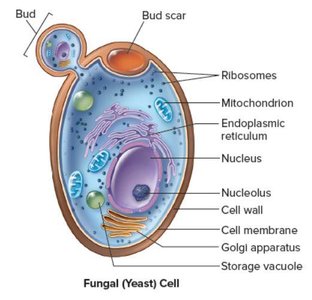
Fungal cells are eukaryotic and possess specialized structures that distinguish them from other microorganisms.
Cell wall: Composed primarily of chitin, glucans, and mannoproteins.
Cell membrane: Contains ergosterol, a unique sterol.
Organelles: Includes nucleus, mitochondria, endoplasmic reticulum, Golgi apparatus, and storage vacuoles.
Fungal Cell Wall Composition
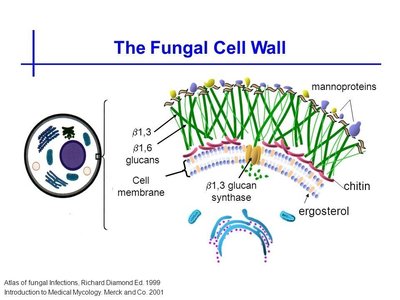
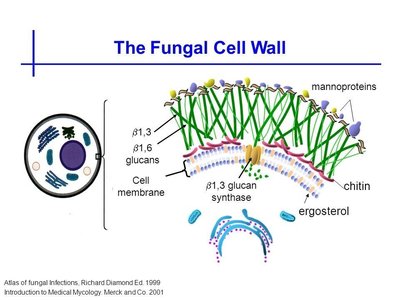
The fungal cell wall is a complex structure that provides rigidity and protection. It is a key target for antifungal drugs.
Chitin: Provides structural strength.
Glucans: β1,3 and β1,6 glucans are polysaccharides important for cell wall integrity.
Mannoproteins: Contribute to cell wall structure and host interactions.
Ergosterol: Found in the cell membrane, not the wall, but is a distinguishing feature of fungi.
Yeasts: Structure and Reproduction
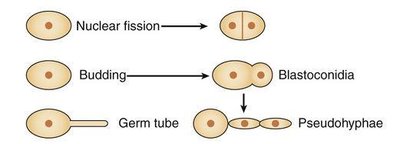
Yeasts are unicellular fungi that reproduce by budding or fission. They are important in both medical and industrial contexts.
Spherical or oval shape
Nonfilamentous and unicellular
Reproduction:
Fission: Even division to produce two new cells.
Budding: Uneven division, producing a new cell from the parent.
Pseudohyphae: Chains of yeast cells formed when buds do not detach.
Germ tube: Outgrowth during germination to form hyphae.
Molds: Structure and Types of Hyphae
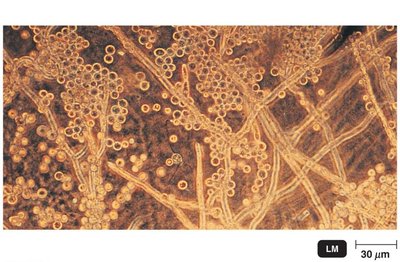
Molds are multicellular fungi composed of hyphae, which form a mycelium. Hyphae can be classified based on the presence or absence of septa.
Mycelium: A network of hyphae forming the body of the mold.
Hyphae:
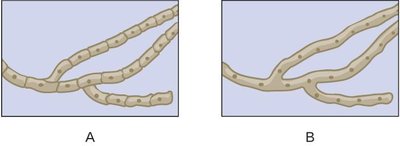
Septate hyphae: Have cross-walls (septa) dividing the hyphae into distinct cells.
Aseptate (coenocytic) hyphae: Lack septa, forming continuous cells with multiple nuclei.
Septa and Communication in Hyphae
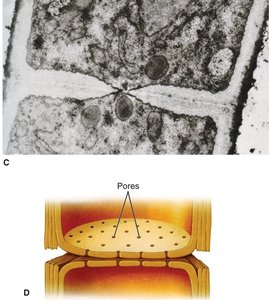
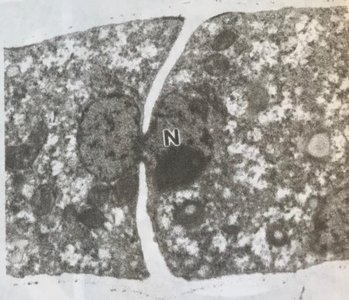
Septa in hyphae allow communication and sharing of nutrients and organelles between cells. Pores in septa facilitate the migration of nuclei and cytoplasmic components.
Septa: Cross-walls with pores for intercellular communication.
Nucleus migration: Nuclei can move through septal pores during growth and reproduction.