 Back
Fundamentals of Microbial Growth and Control
Study Guide - Smart Notes
 Tailored notes based on your materials, expanded with key definitions, examples, and context.
Microbial Growth
Definition and Overview
Microbial growth refers to the increase in the number of cells in a microbial population, not just an increase in cell size. When nutritional requirements are met, microbes enlarge and divide, producing daughter cells and increasing the total population.
Binary fission: Most prokaryotes divide by binary fission, an asexual process where a single cell splits into two genetically identical cells.
Budding: Some bacteria and fungi reproduce by budding, where a small outgrowth forms on the parent cell, receives a copy of the chromosome, and eventually separates.
Spore formation: Certain bacteria and fungi form spores, which can be sexual or asexual in fungi and asexual in bacteria. Bacterial endospores are highly resistant, thick-walled structures.
Biofilm Formation
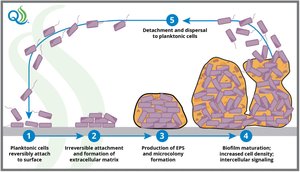
Biofilms are structured communities of microbes attached to surfaces and embedded in a self-produced extracellular matrix. Biofilms are medically significant because they are highly resistant to antimicrobial agents and contribute to persistent infections.
Biofilm formation begins when planktonic (free-floating) bacteria adhere to a surface.
Cells produce a sticky polysaccharide matrix, allowing other microbes to join and form a complex community.
Channels develop within the biofilm for nutrient and waste exchange.
Biofilm fragments can detach and colonize new locations.
Phases of Bacterial Growth Curve
Growth Curve Phases
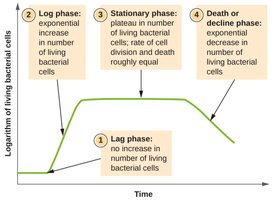
Bacterial populations in batch culture exhibit a characteristic growth curve with four distinct phases:
Lag phase: Cells adjust to their environment; little or no cell division occurs.
Log (exponential) phase: Rapid cell division and population growth; cells are most metabolically active.
Stationary phase: Growth rate slows as nutrient depletion and waste accumulation occur; cell division rate equals death rate.
Death (decline) phase: Exponential decrease in viable cells due to adverse conditions.
Environmental Factors Affecting Microbial Growth
Temperature
Psychrophiles: Thrive at −20°C to 10°C (cold environments).
Psychrotrophs: Grow at 0–30°C; associated with food spoilage.
Mesophiles: Grow best at 10–50°C; most human pathogens are mesophiles.
Thermophiles: Grow at 40–75°C; found in compost and hot springs.
Extreme thermophiles: Grow at 65–120°C; inhabit boiling water and volcanic vents.
pH
Acidophiles: Grow at pH < 5; found in acidic environments.
Neutralophiles: Grow best at pH 5–8; most human pathogens.
Alkaliphiles: Grow at pH 9–11; found in alkaline lakes.
Salt and Osmotic Pressure
Halophiles: Thrive in high-salt environments (up to 35% NaCl).
Facultative halophiles: Tolerate higher salt but do not require it (e.g., Staphylococcus aureus).
Oxygen Requirements
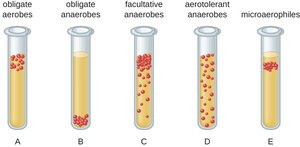
Obligate aerobes: Require oxygen for growth.
Obligate anaerobes: Cannot tolerate oxygen; oxygen is toxic.
Facultative anaerobes: Grow with or without oxygen but prefer oxygen.
Aerotolerant anaerobes: Tolerate oxygen but do not use it.
Microaerophiles: Require low levels of oxygen.
Microbial Nutrition and Growth Requirements
Essential Nutrients
Major elements: Carbon, hydrogen, oxygen, nitrogen (CHON).
Other elements: Sulfur, phosphorus, potassium, sodium, calcium, magnesium, chlorine, and trace metals (e.g., iron, zinc, copper).
Macronutrients: Required in large amounts (e.g., carbon).
Micronutrients: Required in trace amounts (e.g., iron).
Growth Factors
Essential organic compounds that microbes cannot synthesize (e.g., amino acids, vitamins).
Fastidious organisms: Require multiple growth factors and special media.
Energy and Carbon Sources
Phototrophs: Use light energy to make ATP.
Chemotrophs: Obtain energy from chemical compounds.
Heterotrophs: Require organic carbon sources.
Autotrophs: Use CO2 as a carbon source via carbon fixation.
Laboratory Cultivation and Enumeration of Microbes
Culture Media Types
Broth media: Liquid; used for growing large batches.
Solid media: Contains agar; used for isolating colonies.
Semisolid media: Low agar; used for motility testing.
Defined media: Precisely known composition.
Complex media: Contains complex ingredients; exact composition unknown.
Selective media: Favors growth of specific microbes while inhibiting others.
Differential media: Distinguishes microbes based on metabolic properties (e.g., blood agar).
Enumeration Methods
Direct methods: Plate counts (CFU), direct microscopic counts, flow cytometry, Coulter counter.
Indirect methods: Turbidity (spectrophotometry), dry weight, metabolic activity.
Physical and Chemical Control of Microbial Growth
Physical Methods
Heat: Autoclaving (121°C, 15 psi, 15 min), boiling, pasteurization, dry heat (incineration, hot-air ovens).
Radiation: Ionizing (gamma, X-rays) and non-ionizing (UV) radiation.
Filtration: HEPA filters for air, membrane filters for liquids.
Chemical Methods
Disinfectants: Used on inanimate objects (e.g., bleach, phenols).
Antiseptics: Used on living tissue (e.g., iodine, alcohol).
Germicides: Microbiocidal (kill) or microbiostatic (inhibit growth).
High-level agents: Destroy all microbes and endospores.
Intermediate-level agents: Destroy most microbes, not endospores.
Low-level agents: Destroy some microbes, not endospores or M. tuberculosis.
Special Considerations
Endospores: Highly resistant; require autoclaving or sporicidal agents.
Prions: Require combined chemical and physical treatments for inactivation.
Biofilms: More resistant to antimicrobials due to protective matrix and slow-growing cells.
