 Back
Fundamentals of Microbial Growth and Decontamination
Study Guide - Smart Notes
 Tailored notes based on your materials, expanded with key definitions, examples, and context.
Fundamentals of Microbial Growth
Microbial Growth and Biofilms
Microbial growth refers to the increase in cell number through cell division, resulting in new daughter cells and a larger population. Most laboratory studies focus on culturable species, but in nature, microbes often form complex communities called biofilms. - Biofilms: Structured communities of microbes adhering to surfaces and communicating for survival. - Clinical relevance: Biofilms are difficult to treat and contribute to persistent infections, especially on indwelling medical devices (e.g., catheters, heart valves).
Modes of Microbial Cell Division
Microbes reproduce primarily by binary fission, but some use budding or spore formation. - Binary fission: Chromosome replication, cell pinching, septum formation, and production of two genetically identical daughter cells. - Budding: Cell elongates, forms a bud, duplicates chromosome, and separates. Seen in some bacteria (e.g., Hyphomicrobium) and fungi. - Spore formation: Some bacteria and fungi produce spores for survival; bacterial endospores are thick-walled and resistant.
Exponential Growth and Generation Time
Bacterial populations grow exponentially during cell division. - Generation time: The time required for a cell to divide; varies by species and environmental conditions (e.g., E. coli: 20 min, Mycobacterium tuberculosis: 15–20 hours).
Bacterial Growth Phases in Batch Culture
When cultured in a closed system, bacteria exhibit four distinct growth phases: - Lag phase: Cells adjust to new environment. - Log phase: Rapid exponential growth. - Stationary phase: Nutrient depletion and waste accumulation; growth rate levels off. - Death phase: Exponential cell death due to waste buildup and decreasing nutrients.
Microbial Adaptation to Environmental Conditions
Temperature
Temperature affects enzymatic reactions and growth rates. - Maximum, minimum, and optimal temperatures: Define the range for microbial growth. - Barophiles: Microbes adapted to high-pressure environments (e.g., deep sea thermal vents).
pH
Microbes have specific pH ranges for growth. - Acidophiles: Grow at pH 1–5; found in sulfur springs and volcanic vents. - Neutralophiles: Grow best at pH 5–8; majority of microorganisms. - Alkaliphiles: Grow at pH 9–11; associated with soda lakes.
High-Salt Conditions
- Halophiles: Thrive in high-salt environments (up to 35%). - Facultative halophiles: Tolerate higher salt but may not grow optimally (e.g., Staphylococcus aureus).
Oxygen Requirements
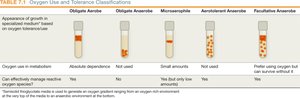
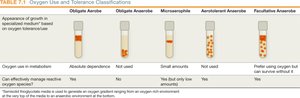
Oxygen tolerance varies among microbes, affecting their growth and metabolism. - Reactive oxygen species (ROS): Byproducts of oxygen metabolism that can damage cellular components. - Detoxification: Enzymes like superoxide dismutase and catalase neutralize ROS.
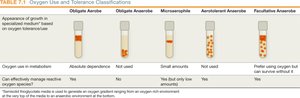
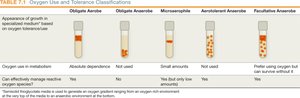
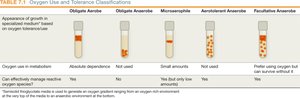
Oxygen Use and Tolerance Classifications
Type | Growth Appearance | Oxygen Use | Can Detoxify ROS? |
|---|---|---|---|
Obligate Aerobe | Top of tube | Absolute dependence | Yes |
Obligate Anaerobe | Bottom of tube | Not used | No |
Microaerophile | Middle of tube | Small amounts | Only small amounts |
Aerotolerant Anaerobe | Evenly throughout | Not used | Yes |
Facultative Anaerobe | Throughout, mostly top | Prefer using oxygen but can survive without it | Yes |
Microbial Nutrition and Energy Sources
Essential Nutrients
Microbes require macronutrients (e.g., carbon, nitrogen) and micronutrients (e.g., iron) for growth. - Heterotrophs: Require external organic carbon sources. - Autotrophs: Use carbon fixation to convert inorganic carbon to organic forms.
Growth Factors
Some microbes cannot synthesize all organic precursors and must import them. - Growth factors: Essential substances (e.g., amino acids, vitamins) that must be supplied externally. - Fastidious organisms: Require multiple growth factors for growth.
Energy Sources
- Phototrophs: Use light energy. - Chemotrophs: Obtain energy by breaking down chemical compounds.
Microbial Culture Media
Physical State of Media
- Liquid media: Used for growing large batches. - Solid media: Useful for isolating colonies. - Semisolid media: Used for motility testing.
Chemical Composition
- Defined media: Precisely known composition; useful for certain autotrophs and heterotrophs. - Complex media: Contains a mixture of nutrients; used for fastidious organisms.
Function: Differential and Selective Media
- Differential media: Distinguish microbes visually (e.g., blood agar for hemolysis types). - Selective media: Foster growth of specific bacteria while suppressing others (e.g., mannitol salt agar).
Anaerobic Media
Specialized media and equipment are used to culture anaerobes. - Thioglycolate: Reducing agent to remove oxygen. - Anaerobic jar/chamber: Creates oxygen-free conditions for handling and culturing anaerobes. 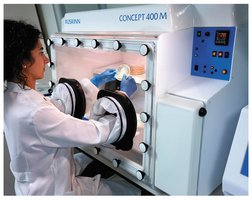
Microbial Collection, Isolation, and Enumeration
Aseptic Techniques
Methods to prevent contamination during sample collection and handling.
Sample Collection
- Use sterile materials and containers. - Consider properties of suspected pathogens (e.g., refrigeration, dry ice).
Isolation: Streak Plate Technique
- Dilutes culture on agar plate to isolate individual colonies. - Each colony represents a pure population.
Counting Microbes
Direct Methods
- Manual cell counting: Uses microscope and counting chamber. - Flow cytometry: Laser-based detection of fluorescently labeled cells. - Viable plate count: Serial dilution and colony counting; results in colony-forming units (CFU) per mL or gram.
Indirect Methods
- Turbidity: Measured by spectrophotometer; more cells = higher optical density. - Other methods: Total dry weight, metabolic activity assays.
Microbial Identification
Physical, Biochemical, and Genetic Analysis
- Physical: Staining and microscopy for morphology. - Biochemical: Media to assess metabolic properties. - Genetic: PCR, DNA fingerprinting, electrophoresis.
Decontamination and Microbial Control
Definitions
- Decontamination: Removes or reduces microbial populations. - Sterilization: Eliminates all microbes, including endospores. - Disinfection: Reduces microbial numbers; used for surfaces and equipment.
Physical Methods
Temperature
- Refrigeration/freezing: Slows microbial growth. - Heat: Used for sterilization and decontamination. - Decimal reduction time (D value): Time to kill 90% of microbes at a set temperature. - Thermal death time: Shortest time to kill all microbes at a certain temperature. - Thermal death point: Minimum temperature to kill all microbes in 10 minutes.
Autoclaving
- Steam heat and pressure; sterilizes media and equipment.
Boiling
- Reduces microbial numbers; not effective against endospores.
Pasteurization
- Moderate heat to eliminate pathogens and reduce spoilage microbes.
Dry Heat
- Incineration and hot-air ovens for sterilization.
Radiation
- Ionizing: Gamma rays, X-rays; damages nucleic acids, sterilizes medical supplies. - Nonionizing: UV light; causes DNA mutations, disinfects surfaces and water.
Filtration
- Microbe-capturing filters for liquids and air; HEPA filters remove 99.97% of airborne substances.
Chemical Methods: Germicides
Germicide Classification
- Microbiocidal: Kill microbes. - Microbiostatic: Inhibit growth.
Germicide Tiers
- Low-level: Destroy bacteria (not M. tuberculosis), fungi, some viruses. - Intermediate-level: Destroy all bacteria (including M. tuberculosis), fungi, viruses. - High-level: Destroy all microbes and endospores.
Medical Equipment Tiers
- Critical: Contact sterile sites; must be sterilized. - Semicritical: Contact mucous membranes or non-intact skin; should be free of most microbes. - Noncritical: Contact intact skin; require less stringent disinfection.
Types of Germicides
- Alcohols: Intermediate-level; denature proteins, disrupt membranes. - Aldehydes: High/intermediate-level; react with proteins and nucleic acids. - Phenols: Intermediate-level; destroy cell walls, interact with proteins. - Halogens: Oxidize cell components (e.g., chlorine, iodine). - Peroxygens: High-level; strong oxidizers (e.g., hydrogen peroxide). - Ethylene oxide: Sterilant; damages proteins and nucleic acids. - Detergents: Cleaning agents; disrupt membranes, classified as anionic or cationic.
Factors in Germicide Selection
- Item use, reactivity, concentration, treatment time, infectious agent type, presence of organic/inorganic matter, residue impact, toxicity.
Microbial Control for Specific Microbes
Mycobacterium Control
- Target airborne particles; cell walls rich in mycolic acids.
Endospore Control
- Autoclaving, hydrogen peroxide vapor, sporicides.
Viral Control
- Lipid envelope viruses: sensitive to heat, drying, detergents. - Naked viruses: inactivated by chlorine-based agents.
Protozoan Control
- Filtration, carbon dioxide, UV, ozone treatments.
Prion Control
- Combination of chemical treatments and increased temperature/pressure during autoclaving.
Summary Table: Oxygen Use and Tolerance Classifications
Summary Table: Anaerobic Chamber
