 Back
BackFundamentals of Microbial Growth: Physical and Chemical Requirements, Culture Methods, and Growth Measurement
Study Guide - Smart Notes
 Tailored notes based on your materials, expanded with key definitions, examples, and context.
Fundamentals of Microbial Growth
Physical Requirements for Microbial Growth
Microbial growth is influenced by several physical factors, including temperature, pH, and osmotic pressure. Each microorganism has specific requirements for optimal growth, which are critical for laboratory cultivation and understanding microbial ecology.
Temperature: Microorganisms are classified based on their preferred temperature ranges:
Psychrophiles: Cold-loving microbes, optimal growth at 15°C or lower.
Psychrotrophs: Grow between 0°C and 20–30°C; important in food spoilage.
Mesophiles: Moderate-temperature-loving, optimal at 25–40°C; includes most pathogens.
Thermophiles: Heat-loving, optimal at 50–60°C; found in hot springs and compost.
Hyperthermophiles: Optimal growth above 80°C; often found in oceanic thermal vents.
pH: Most bacteria grow best between pH 6.5 and 7.5. Molds and yeasts prefer slightly acidic conditions (pH 5–6). Acidophiles thrive in acidic environments.
Osmotic Pressure: High solute concentrations (hypertonic environments) can cause plasmolysis, inhibiting growth. Halophiles require or tolerate high salt concentrations.
Chemical Requirements for Microbial Growth
Microorganisms require various chemical elements for growth, which serve as building blocks for cellular components and as energy sources.
Carbon: Backbone of organic molecules. Chemoheterotrophs use organic carbon; autotrophs use CO2.
Nitrogen: Essential for proteins, DNA, and ATP. Sources include protein decomposition, NH4+, NO3–, and N2 (nitrogen fixation).
Sulfur: Found in amino acids, thiamine, and biotin. Sources include protein decomposition, SO42–, and H2S.
Phosphorus: Component of nucleic acids, ATP, and membranes. Supplied as PO43–.
Trace Elements: Required in small amounts, usually as enzyme cofactors (e.g., iron, copper, zinc).
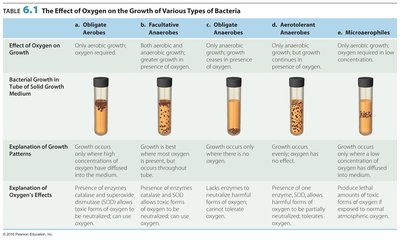
Oxygen: Microbes vary in their oxygen requirements:
Obligate aerobes: Require oxygen.
Facultative anaerobes: Can grow with or without oxygen.
Obligate anaerobes: Harmed by oxygen.
Aerotolerant anaerobes: Tolerate but do not use oxygen.
Microaerophiles: Require low oxygen concentrations.
Type | Effect of Oxygen on Growth | Growth Pattern in Tube | Explanation |
|---|---|---|---|
Obligate Aerobes | Only aerobic growth; oxygen required | Growth at top | Growth occurs where high concentrations of oxygen have diffused into the medium |
Facultative Anaerobes | Aerobic and anaerobic growth; greater growth in presence of oxygen | Growth throughout, more at top | Growth is best where most oxygen is present, but occurs throughout tube |
Obligate Anaerobes | Only anaerobic growth; ceases in presence of oxygen | Growth at bottom | Growth occurs only where there is no oxygen |
Aerotolerant Anaerobes | Only anaerobic growth; but continues in presence of oxygen | Growth evenly throughout | Growth occurs evenly; oxygen has no effect |
Microaerophiles | Only aerobic growth; oxygen required in low concentration | Growth in middle | Growth occurs only where a low concentration of oxygen has diffused into medium |
Biofilms
Biofilms are complex microbial communities that adhere to surfaces and are embedded in a self-produced matrix. They are important in natural environments, industry, and medicine due to their resistance to antimicrobial agents and involvement in persistent infections.
Form slime or hydrogels on surfaces.
Enable cell-to-cell communication (quorum sensing).
Provide protection from environmental threats and facilitate nutrient sharing.
Common in medical devices (catheters, heart valves), dental plaque, and water systems.
Culture Media and Methods
Microbiologists use various types of culture media to grow, isolate, and identify microorganisms. The choice of medium depends on the nutritional requirements of the microbe and the experimental purpose.
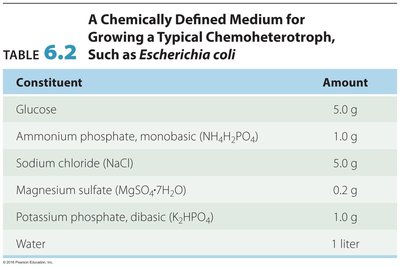
Chemically Defined Media: Exact chemical composition is known; used for fastidious organisms.
Complex Media: Contains extracts of yeasts, meat, or plants; composition varies.
Reducing Media: Used for cultivating anaerobes; contains agents that remove oxygen.
Selective Media: Suppress unwanted microbes and encourage desired ones.
Differential Media: Distinguish between different microbes based on colony appearance or biochemical reactions.
Enrichment Culture: Increases the number of desired microbes to detectable levels.
Type | Purpose |
|---|---|
Chemically Defined | Growth of chemoautotrophs and photoautotrophs; microbiological assays |
Complex | Growth of most chemoheterotrophic organisms |
Reducing | Growth of obligate anaerobes |
Selective | Suppression of unwanted microbes; encouraging desired microbes |
Differential | Differentiation of colonies of desired microbes from others |
Enrichment | Similar to selective media but designed to increase numbers of desired microbes to detectable levels |
Obtaining and Preserving Pure Cultures
Pure cultures are essential for studying the properties of individual microbial species. The streak plate method is commonly used to isolate pure colonies from a mixed sample.
Colony: A population of cells arising from a single cell or group of attached cells (colony-forming unit, CFU).
Streak Plate Method: Used to isolate pure cultures by spreading cells over the surface of an agar plate.
Preservation: Cultures can be preserved by deep-freezing or lyophilization (freeze-drying).
Bacterial Division and Growth
Bacterial growth refers to an increase in the number of cells, primarily through binary fission. The generation time is the time required for a cell to divide, which can range from 20 minutes to several hours.
Binary Fission: The most common method of bacterial reproduction, resulting in two identical daughter cells.
Other Methods: Budding, conidiospore formation, and fragmentation (less common).
Generation Time: The time required for a population to double in number.
Growth Curve: Bacterial populations exhibit four phases: lag, log (exponential), stationary, and death.
Equation for Total Number of Cells:
Measuring Microbial Growth
Microbial growth can be measured directly by counting cells or indirectly by estimating cell mass or metabolic activity.
Direct Methods:
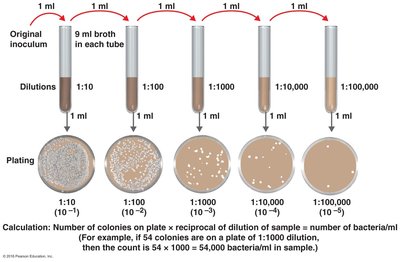
Plate count (CFU counting after serial dilution)
Filtration (for small numbers of bacteria in large volumes)
Most Probable Number (MPN) method (statistical estimation)
Direct microscopic count (using a Petroff-Hausser cell counter)
Indirect Methods:
Turbidity (spectrophotometric measurement of culture cloudiness)
Metabolic activity (measuring products such as CO2 or acids)
Dry weight (for filamentous organisms)
Additional info: Understanding microbial growth and its measurement is essential for applications in clinical diagnostics, food safety, biotechnology, and environmental microbiology.
