 Back
BackFundamentals of Microbial Growth: Structured Study Notes ch. 7
Study Guide - Smart Notes
 Tailored notes based on your materials, expanded with key definitions, examples, and context.
Fundamentals of Microbial Growth
Microbial Growth in Nature and Biofilms
Microbial growth refers to the increase in cell number through cell division, resulting in new daughter cells and a larger population. In natural environments, bacteria coexist with archaea and eukaryotes, and environmental factors significantly influence their metabolism and structure. For example, Escherichia coli can change its morphology during urinary tract infections. Biofilms are communities where cells communicate and collaborate for survival, posing challenges in healthcare due to their resistance to treatment and contribution to persistent infections. Biofilm formation begins when planktonic bacteria adhere to surfaces, such as catheters and heart valves.
Bacterial Cell Division: Binary Fission
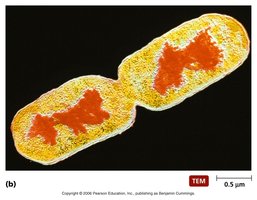
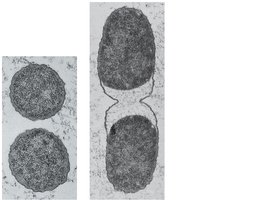
Most prokaryotes divide by binary fission, an asexual process where a single cell splits into two genetically identical daughter cells. Before division, the chromosome is replicated, and the parent cell pinches at the middle, forming a septum that separates the two new cells.
Binary Fission: Main method of division in bacteria.
Chromosome Replication: Ensures genetic identity in daughter cells.
Septum Formation: Physical partition between cells.
Budding in Microorganisms
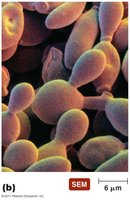
Budding is another form of asexual reproduction seen in some microbes, such as yeasts. The original cell elongates and forms a small outgrowth (bud), where the chromosome is duplicated and placed. The bud eventually separates from the mother cell.
Budding: Common in yeasts and some bacteria.
Chromosome Duplication: Ensures genetic material in the bud.
Spore Formation
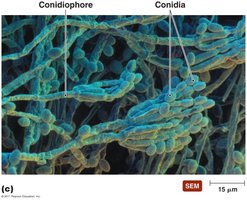
Spore formation is a reproductive strategy used by some fungi and bacteria. In fungi, it can be sexual or asexual, while in bacteria, it is always asexual. Bacterial endospores are thick-walled, nongrowing structures that allow survival in harsh conditions.
Endospores: Resistant structures formed by bacteria.
Conidia: Asexual spores produced by fungi.
Generation Time and Exponential Growth
Generation time is the period required for a cell to complete binary fission. Most bacteria have short generation times, such as E. coli (20 minutes), while others, like Mycobacterium tuberculosis, are slower. Bacterial populations grow exponentially under optimal conditions.
Generation Time Formula:
Exponential Growth: Population doubles with each generation.
Bacterial Growth Phases in Batch Culture
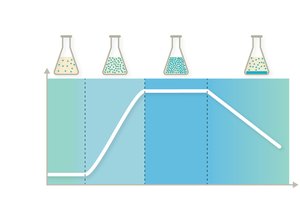
When bacteria are cultured in a closed system, they progress through four distinct growth phases: lag, log (exponential), stationary, and death. These phases are characterized by changes in cell division, nutrient availability, and waste accumulation.
Lag Phase: Cells adjust to new environment; little division.
Log Phase: Rapid exponential growth; cells are sensitive to stress.
Stationary Phase: Growth rate levels off as nutrients decrease and waste increases.
Death Phase: Cells die due to nutrient depletion and toxic waste.
Maintaining Growth Phases: Chemostat
In industrial microbiology, maintaining cells at a specific growth phase is crucial. A chemostat is used to continuously supply fresh medium and remove waste, keeping cells in the desired phase.
Adaptation to Environmental Conditions
Microbes adapt to various environmental factors, including temperature, pH, salinity, oxygen levels, and nutrient availability. Each microbe has minimum, optimum, and maximum growth conditions.
Temperature Classification of Microbes
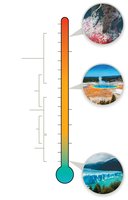
Temperature is a key factor in microbial growth and classification. Microbes are grouped based on their preferred temperature ranges:
Psychrophiles: -20 to 10°C
Psychrotrophs: 0–30°C
Mesophiles: 10–50°C (includes most human pathogens)
Thermophiles: 40–75°C
Extreme Thermophiles: 65–120°C
pH Preferences
Microbes are also classified by their pH tolerance:
Acidophiles: pH 1–5 (e.g., sulfur hot springs)
Neutralophiles: pH 5–8 (majority of microorganisms)
Alkaliphiles: pH 9–11 (e.g., soda lakes)
High-Salt Conditions
Halophiles thrive in environments with high salt concentrations (up to 35%), such as the Dead Sea. Facultative halophiles tolerate higher salt but may not grow optimally. Bacterial cytoplasm is mostly water, and normal cells undergo plasmolysis in hypertonic environments.
Halophiles: Require high salt for growth.
Facultative Halophiles: Can tolerate but do not require high salt.
Oxygen Requirements
Microbes vary in their oxygen requirements and tolerance. Oxygen can be toxic due to reactive oxygen species (ROS), which damage proteins and DNA. Aerobic microbes possess enzymes like superoxide dismutase and catalase to detoxify ROS.
Obligate Aerobes: Require oxygen.
Obligate Anaerobes: Cannot tolerate oxygen.
Microaerophiles: Require small amounts of oxygen.
Aerotolerant Anaerobes: Tolerate oxygen but do not use it.
Facultative Anaerobes: Can use oxygen but also grow without it.
Classification | Growth in Tube | Oxygen Use | ROS Detoxification |
|---|---|---|---|
Obligate Aerobe | Top of tube | Yes | Yes |
Obligate Anaerobe | Bottom of tube | No | No |
Microaerophile | Just below surface | Small amounts | Only low amounts |
Aerotolerant Anaerobe | Evenly throughout | No | Yes |
Facultative Anaerobe | Throughout, mostly top | Yes, prefers | Yes |

Pathogen Examples and Oxygen Tolerance
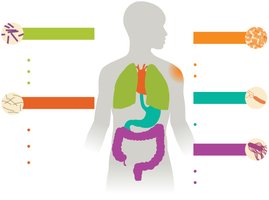
Different pathogens exhibit varying oxygen requirements depending on their niche in the human body. For example, Bordetella pertussis is an obligate aerobe found in the lungs, while Clostridioides difficile is an obligate anaerobe in the large intestine.
Nutrients and Microbial Growth
Microbes require nutrients from their environment to grow and build cellular components. Macronutrients (carbon, lipids, proteins) are needed in large amounts, while micronutrients (minerals, vitamins) are required in small quantities. All organisms need a source of carbon and energy.
Macronutrients: Carbon, lipids, proteins
Micronutrients: Minerals, vitamins
Carbon and Energy Sources
Organisms are classified based on their carbon and energy sources:
Heterotrophs: Require external organic carbon (e.g., sugars, lipids, proteins)
Autotrophs: Use carbon fixation to convert inorganic carbon into organic carbon
Phototrophs: Use light energy
Chemotrophs: Break down chemical compounds for energy
Combined Nutritional Categories: Organisms can be classified as photoautotrophs, chemoautotrophs, photoheterotrophs, or chemoheterotrophs based on their carbon and energy sources.
