Back
BackFungi and Protozoa: Structure, Taxonomy, and Key Characteristics
Study Guide - Smart Notes
 Tailored notes based on your materials, expanded with key definitions, examples, and context.
Fungi
General Characteristics of Fungi
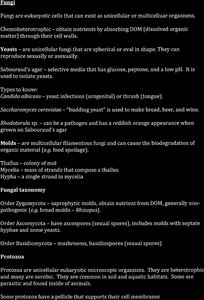
Fungi are eukaryotic cells that can exist as unicellular or multicellular organisms. They play essential roles in ecosystems as decomposers and pathogens.
Chemolithotrophic: Fungi obtain nutrients by absorbing DOM (dissolved organic matter) through their cell walls.
Yeasts: Unicellular fungi that are spherical or oval in shape. Yeasts reproduce sexually or asexually.
Saccharomyces yeast: Grows on selective media that has glucose, peptone, and a low pH. Used to isolate yeast.
Types of Yeast Infections
Candida albicans: Causes yeast infections (vaginal) or thrush (tongue).
Saccharomyces cerevisiae: "Budding yeast" used to make bread, beer, and wine.
Molds
Molds are multicellular filamentous fungi and can cause the biodegradation of materials and food spoilage.
Rhizopus: Can be a pathogen and has a reddish-orange appearance when sporulating.
Truffles: Edible fungi that compose a sclerotium (mass of mycelial strands).
Fungal Taxonomy
Order Zygomycetes: Saprophytic molds, obtain nutrients from DOM, generally non-pathogenic (e.g., bread molds - Rhizopus).
Order Basidiomycetes: Have basidiospores (sexual spores), includes molds with septate hyphae and mushrooms.
Example: Edible mushrooms, basidiospores (sexual spores).
Protozoa
General Characteristics of Protozoa
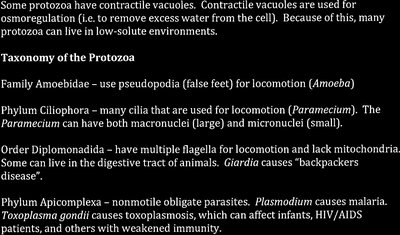
Protozoa are unicellular eukaryotic microscopic organisms. They are heterotrophic and obtain nutrients by engulfing bacteria and organic matter. Some are free-living, while others are parasitic.
Some protozoa have a pellicle that supports their cell membranes.
Contractile vacuoles are used for osmoregulation (removing excess water from the cell), allowing protozoa to live in low-solute environments.
Taxonomy of the Protozoa
Family Amoebidae: Use pseudopodia (false feet) for locomotion (Amoeba).
Phylum Ciliophora: Many cilia used for locomotion (Paramecium). Paramecium can have both macronuclei (large) and micronuclei (small).
Order Diplomonadida: Multiple flagella for locomotion and lack mitochondria. Some live in the digestive tract of animals. Giardia causes "backpackers disease".
Phylum Apicomplexa: Nonmotile obligate parasites. Plasmodium causes malaria. Toxoplasma gondii causes toxoplasmosis, which can affect infants, HIV/AIDS patients, and others with weakened immunity.
Example: Plasmodium (malaria), Giardia (digestive tract infection), Paramecium (cilia-based movement).