 Back
BackFungi: Structure, Characteristics, and Reproduction (Chapter 12 Study Notes)
Study Guide - Smart Notes
 Tailored notes based on your materials, expanded with key definitions, examples, and context.
Fungi: Structure, Characteristics, and Reproduction
Overview of Fungi
Fungi are a diverse group of eukaryotic organisms that play essential roles in ecosystems as decomposers, pathogens, and symbionts. They are classified in their own kingdom and are distinct from plants, animals, and bacteria.
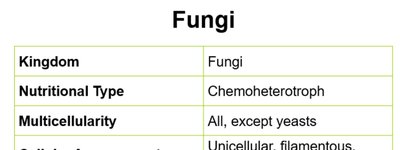
Kingdom | Fungi |
|---|---|
Nutritional Type | Chemoheterotroph |
Multicellularity | All, except yeasts |
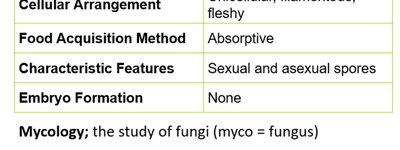
Cellular Arrangement | Unicellular, filamentous, fleshy |
Food Acquisition Method | Absorptive |
Characteristic Features | Sexual and asexual spores |
Embryo Formation | None |
Mycology: The study of fungi (myco = fungus).
General Characteristics of Fungi
Fungi exhibit a range of forms and life cycles, but share several defining characteristics:
Types: Yeasts, molds, and mushrooms
Cell Type: All are eukaryotic
Oxygen Requirements: Aerobic or facultatively anaerobic (a few are anaerobic)
Pathogenicity: Out of approximately 100,000 fungal species, only about 200 are pathogenic to humans
Reproduction: By means of spores, usually wind-disseminated
Spore Types: Both sexual (meiotic) and asexual (mitotic) spores may be produced, depending on species and conditions
Motility: Typically non-motile, although a few (e.g., Chytrids) have a motile phase
Life Cycle: Many fungi have an alternation of generations

Vegetative Structures of Molds
The vegetative structure of a fungus is called the thallus, which consists of long filaments of cells known as hyphae. These hyphae can branch and intertwine to form a mass called mycelium.
Thallus: The entire vegetative structure or body of a fungus
Hypha: A long filament of cells in fungi; each fragment of hypha is capable of growth
Mycelium: A mass of long filaments of cells that branch and intertwine

Analogy Example
For understanding: If the hand is the thallus, each finger is a hypha. Each finger (hypha) can function independently, but together they form the whole hand (thallus).


Types of Hyphae
Hyphae can be classified based on their structure and function:
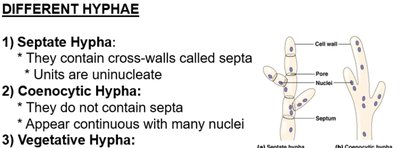
Septate Hypha: Contain cross-walls called septa; units are uninucleate
Coenocytic Hypha: Do not contain septa; appear continuous with many nuclei
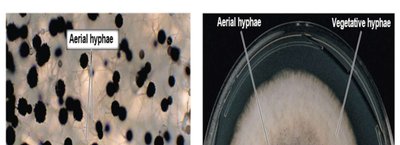
Vegetative Hypha: Portion of hypha that obtains nutrients
Reproductive or Aerial Hypha: Portion concerned with reproduction; projects above the surface and often bears reproductive spores
Pseudohypha: Found in some budding yeasts; short chain of buds that is unable to detach (e.g., Candida albicans requires this to invade deeper epithelial tissue)


Fungal Spores
Fungi reproduce sexually and asexually via the formation of spores that detach from the parent and germinate into a new mold. Unlike bacterial spores, fungal spores are true reproductive structures and are less tolerant to dry or hot environments than bacterial spores. Fungal spores are formed from aerial hyphae and can be either asexual or sexual.
Asexual Spores
The most common method of asexual reproduction in fungi is by means of spores. Fungal spores exhibit a wide variability in coloration, surface sculpturing, size, shape, number of cells, and the manner in which they are borne on the mycelium. These features are used for identification of genera and species. Asexual spores are formed by the hyphae of one organism and are produced by individual fungus through mitosis and subsequent cell divisions.

Types of Asexual Spores
Conidiospore (Conidium): Unicellular or multicellular spore not enclosed in a sac; produced in a chain at the end of a conidiophore (e.g., Aspergillus)
Arthrospore: A type of conidiospore formed by fragmentation of hyphae
Blastoconidia: A type of conidiospore formed by budding
Chlamydospore: Thick-walled spore formed within a hyphal segment
Sporangiospore: Formed within a sac (sporangium) at the end of an aerial hypha
Clinical identification of fungi is often based on microscopic examination of asexual spores.

Summary Table: Types of Fungal Spores
Spore Type | Formation | Example |
|---|---|---|
Conidiospore | Not enclosed in a sac; produced in chains | Aspergillus |
Arthrospore | Fragmentation of hyphae | Coccidioides |
Blastoconidia | Budding from parent cell | Yeasts |
Chlamydospore | Thick-walled, within hypha | Candida |
Sporangiospore | Formed within a sac | Rhizopus |
Additional info: Fungi are essential for nutrient cycling in ecosystems, and some are important pathogens in humans, animals, and plants. Their identification in clinical settings relies heavily on microscopic and macroscopic examination of their reproductive structures.
