 Back
BackFungi: Structure, Life Cycle, and Medical Importance
Study Guide - Smart Notes
 Tailored notes based on your materials, expanded with key definitions, examples, and context.
Fungi: Overview and Characteristics
Defining Characteristics of Fungi
Fungi are a diverse group of eukaryotic organisms with over 100,000 known species. They play essential roles in ecosystems as decomposers, symbionts, and pathogens. Mycology is the study of fungi.
Chemoheterotrophs: Obtain energy and carbon from organic compounds.
Saprobes: Decompose dead organic matter.
Osmotic Pressure: More resistant than bacteria.
Extracellular Digestion: Secrete enzymes to break down food outside their cells.
Optimum pH: Around 5; prefer acidic environments.
Cell Walls: Usually contain chitin, never peptidoglycan.
Growth: Best on carbohydrates.
Fungi are beneficial in food production, antibiotics, and recycling elements, but some cause diseases in humans, animals, and plants.
Fungal Structure
Vegetative Structures: Molds and Fleshy Fungi
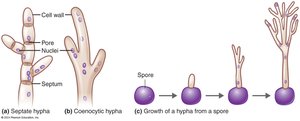
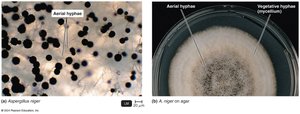
The main body of a fungus, called the thallus, consists of hyphae filaments. A mass of hyphae is called a mycelium. Hyphae can be:
Septate hyphae: Contain cross-walls (septa).
Coenocytic hyphae: Lack septa, forming a continuous cytoplasmic mass.
Vegetative hyphae: Obtain nutrients.
Aerial hyphae: Involved in reproduction.
Yeasts and Dimorphic Fungi
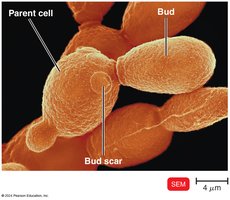
Yeasts are unicellular, nonfilamentous fungi. They reproduce by:
Budding: Uneven division (common in Saccharomyces).
Fission: Even division.
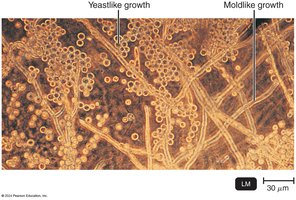
Dimorphic fungi can switch between yeast-like and mold-like forms depending on environmental conditions.
Fungal Reproduction and Life Cycle
Asexual Reproduction
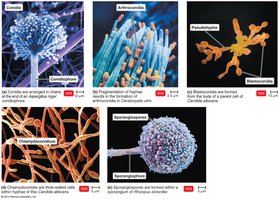
Fungi reproduce asexually via spores formed by mitosis. Types of asexual spores include:
Conidiospore: Not enclosed in a sac.
Arthroconidia: Fragmentation of septate hyphae.
Blastoconidia: Buds of the parent cell.
Chlamydoconidium: Spore within a hyphal segment.
Sporangiospore: Enclosed in a sac.
Sexual Reproduction
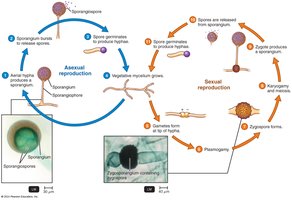
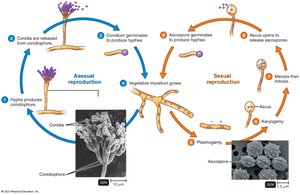
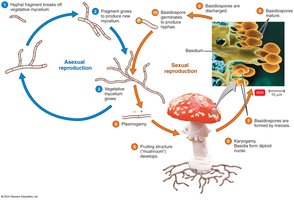
Sexual reproduction involves the fusion of nuclei from two opposite mating strains, proceeding through three phases:
Plasmogamy: Haploid donor cell nucleus (+) penetrates recipient cell.
Karyogamy: Nuclei fuse to form a diploid zygote.
Meiosis: Diploid nucleus produces haploid nuclei (sexual spores).
Types of sexual spores:
Zygospores
Ascospores
Basidiospores
Classification of Fungi: Four Main Phyla
Mucoromycota (Conjugation Fungi)
These fungi have coenocytic hyphae and reproduce asexually via sporangiospores and sexually via zygospores. Example: Rhizopus stolonifer (black bread mold).
Microsporidia
Obligate intracellular parasites, lacking mitochondria. Sexual reproduction is not observed but likely occurs in a host. Cause diseases such as chronic diarrhea and keratoconjunctivitis.
Ascomycota (Sac Fungi)
These fungi have septate hyphae and produce both sexual (ascospores) and asexual (conidiospores) spores. Some are anamorphic, having lost the ability to sexually reproduce. Sexual spores are formed in a saclike ascus.
Basidiomycota (Club Fungi)
These fungi have septate hyphae and produce asexual conidiospores and sexual basidiospores, which are formed externally on a basidium.
Fungal Diseases (Mycoses)
Types of Mycoses
Fungal infections are classified based on the site and severity:
Systemic mycoses: Deep within the body, affecting multiple organs.
Subcutaneous mycoses: Beneath the skin.
Cutaneous mycoses: Affect hair, skin, and nails; produce keratinase (e.g., Tineas).
Superficial mycoses: Localized, such as on hair shafts.
Opportunistic mycoses: Normally harmless fungi become pathogenic in compromised hosts (e.g., Candidiasis).
Examples of Mycoses
Superficial: Piedras (hair shaft).
Cutaneous: Tinea capitis (head), Tinea corporis (ringworm), Tinea pedis (athlete’s foot).
Subcutaneous: Sporotrichosis (rose gardener’s disease), Madura Foot.
Systemic: Coccidioidomycosis (Coccidioides immitis), Histoplasmosis (Histoplasma capsulatum), Cryptococcosis (Cryptococcus neoformans).
Opportunistic: Candidiasis.
Economic Effects of Fungi
Beneficial Effects
Decomposers: Recycle nutrients in ecosystems.
Food Source: Mushrooms, yeast.
Fermentation: Bread, beer, wine production.
Antibiotics: Penicillin and other drugs.
Symbiotic Relationships: Mycorrhizae with plants.
Detrimental Effects
Pathogens: Cause diseases in plants, animals, and humans.
Food Spoilage: Mold growth on food products.
----------------------------------------
