 Back
BackGene Expression: Transcription and Translation in Microbiology
Study Guide - Smart Notes
 Tailored notes based on your materials, expanded with key definitions, examples, and context.
Gene Expression: The Central Dogma of Biology
Overview of the Central Dogma
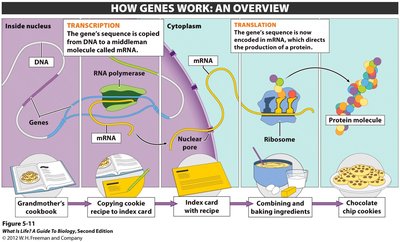
The central dogma of molecular biology describes the flow of genetic information within a biological system. It explains how genetic information stored in DNA is transcribed into RNA and then translated into proteins, which perform essential cellular functions.
DNA stores genetic information in the form of nucleotide sequences.
Transcription is the process by which a segment of DNA is copied into messenger RNA (mRNA).
Translation is the process by which the sequence of the mRNA is decoded to synthesize a specific protein.
Structure and Function of DNA and RNA
Nucleotide Structure
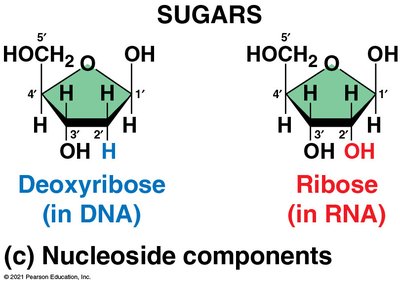
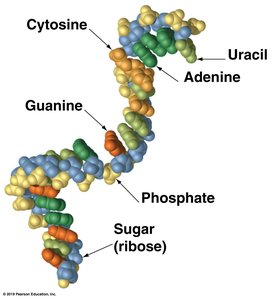
Both DNA and RNA are polymers of nucleotides, but they differ in their sugar and base composition.
DNA contains deoxyribose sugar and the bases adenine (A), thymine (T), cytosine (C), and guanine (G).
RNA contains ribose sugar and the bases adenine (A), uracil (U), cytosine (C), and guanine (G).
Transcription: DNA to RNA
Initiation of Transcription
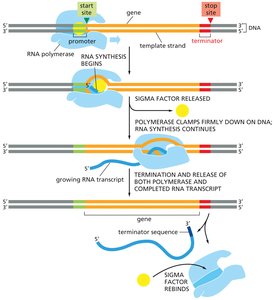
Transcription begins when the enzyme RNA polymerase binds to a specific DNA sequence called the promoter, which signals the start of a gene.
The promoter is a DNA sequence that defines where transcription of a gene by RNA polymerase begins.
Sigma factor (in bacteria) helps RNA polymerase recognize the promoter.
Elongation and Termination
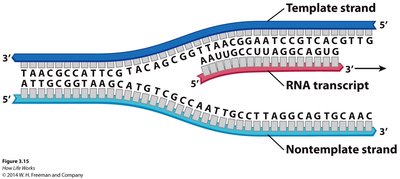
During elongation, RNA polymerase synthesizes a complementary RNA strand in the 5' to 3' direction using the DNA template strand. Transcription ends when the polymerase encounters a terminator sequence, which causes the release of the newly made mRNA.
RNA is synthesized in the 5' to 3' direction.
The template strand of DNA is used to make the RNA copy.
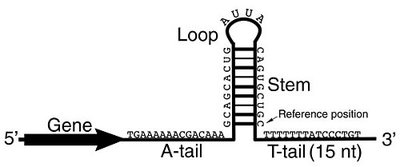
Termination can involve the formation of a hairpin loop in the RNA, which helps release the RNA polymerase and the mRNA transcript.
Translation: RNA to Protein
Genetic Code and Codons
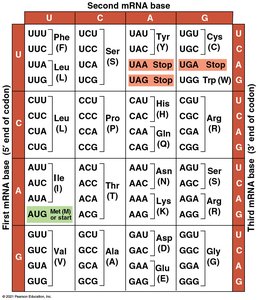
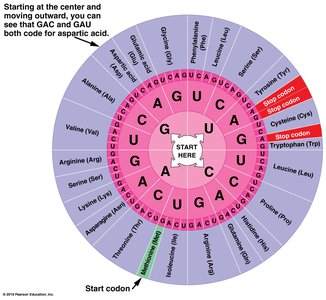
The genetic code is a set of rules by which information encoded in mRNA is translated into proteins. Each group of three nucleotides (codon) in mRNA specifies a particular amino acid.
The code is redundant: multiple codons can code for the same amino acid.
The code is not ambiguous: each codon specifies only one amino acid.
There are start codons (AUG, coding for methionine) and stop codons (UAA, UAG, UGA) that signal the beginning and end of translation.

Translation Machinery: Ribosomes and tRNA
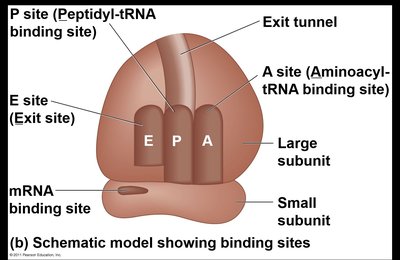
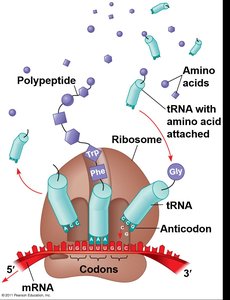
Translation occurs in the ribosome, a complex molecular machine composed of a large and small subunit. Transfer RNA (tRNA) molecules bring amino acids to the ribosome, matching their anticodon with the codon on the mRNA.
Ribosomes have three binding sites for tRNA: the A (aminoacyl), P (peptidyl), and E (exit) sites.
tRNA molecules have an anticodon region that pairs with the mRNA codon and an attached specific amino acid.
Stages of Translation
Initiation
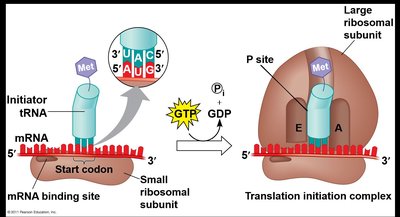
Translation begins when the small ribosomal subunit binds to the mRNA near the start codon. The initiator tRNA carrying methionine binds to the start codon, and the large ribosomal subunit completes the initiation complex.
Elongation
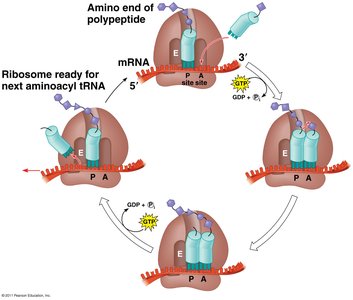
During elongation, amino acids are added one by one to the growing polypeptide chain. The ribosome moves along the mRNA, and tRNAs bring the appropriate amino acids.
Codon recognition: tRNA with the correct anticodon binds to the A site.
Peptide bond formation: The ribosome catalyzes the formation of a peptide bond between the polypeptide chain and the new amino acid.
Translocation: The ribosome shifts, moving the tRNA from the A site to the P site, and the empty tRNA exits from the E site.
Termination
When a stop codon is reached, a release factor binds to the ribosome, causing the release of the completed polypeptide chain and dissociation of the translation complex.
Polyribosomes and Efficiency
Multiple ribosomes can simultaneously translate a single mRNA molecule, forming a structure called a polyribosome or polysome. This allows for rapid and efficient protein synthesis.
Gene Expression in Bacteria
In bacteria, gene expression is highly efficient. Transcription and translation can occur simultaneously because there is no nuclear membrane separating the processes. This allows bacteria to rapidly respond to environmental changes.
Misfolded Proteins as Infectious Agents: Prions
Prion Diseases
Prions are infectious proteins that can cause neurodegenerative diseases in animals and humans. They are misfolded forms of normal proteins that induce other normal proteins to misfold, leading to disease.
Examples in animals: Mad cow disease, scrapie
Examples in humans: Kuru, Creutzfeldt-Jakob disease (CJD), Gerstmann-Sträussler-Scheinker syndrome
Prion accumulation in the brain forms plaques, which are used for diagnosis.
Note: The exact mechanism by which prions cause cellular damage is not fully understood, but the accumulation of misfolded proteins is a hallmark of prion diseases.
Summary Table: Key Differences Between DNA and RNA
Feature | DNA | RNA |
|---|---|---|
Sugar | Deoxyribose | Ribose |
Bases | A, T, C, G | A, U, C, G |
Strands | Double-stranded | Single-stranded |
Function | Genetic information storage | Information transfer and protein synthesis |
Key Equations and Concepts
Transcription direction:
Peptide bond formation:
