 Back
BackGene Regulation and Mutation in Bacteria: Operons, Mutations, and DNA Repair
Study Guide - Smart Notes
 Tailored notes based on your materials, expanded with key definitions, examples, and context.
Regulation of Bacterial Gene Expression
Operon Structure and Function
Bacterial gene expression is tightly regulated to ensure that proteins are produced only when needed. The operon model explains how groups of genes are controlled together in prokaryotes.
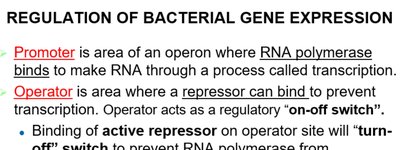
Promoter: The DNA region where RNA polymerase binds to initiate transcription of downstream genes.
Operator: The DNA segment where a repressor protein can bind, acting as an "on-off switch" for transcription.
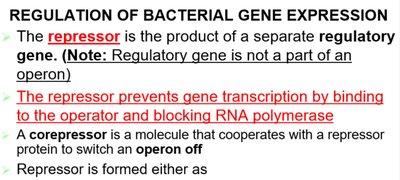
Regulatory gene: Encodes the repressor protein but is not part of the operon itself.
Repressor: A protein that binds to the operator to block RNA polymerase, preventing transcription.
Inducer: A molecule that inactivates the repressor, allowing transcription to proceed.
Corepressor: A molecule that activates the repressor, shutting off transcription.

Mechanisms of Gene Regulation
Active repressor: Binds to the operator, blocking transcription. An inducer can inactivate the repressor, turning the gene "on."
Inactive repressor: Cannot bind the operator, so transcription proceeds. A corepressor can activate the repressor, turning the gene "off."
Repressible and Inducible Operons
Repressible Operons (e.g., trp Operon)
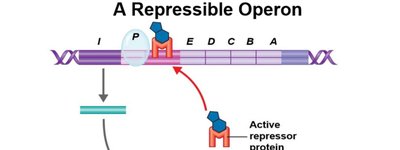
Repressible operons are typically "on" but can be turned "off" when a specific molecule (corepressor) is present. The trp operon in E. coli is a classic example, controlling tryptophan biosynthesis.
When tryptophan is absent, the repressor is inactive, and genes for tryptophan synthesis are transcribed.
When tryptophan is present, it acts as a corepressor, activating the repressor, which binds the operator and blocks transcription.

Inducible Operons (e.g., lac Operon)
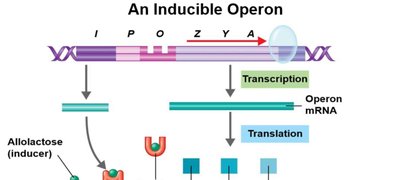
Inducible operons are usually "off" but can be turned "on" by an inducer. The lac operon in E. coli controls the breakdown of lactose.
By default, the lac repressor is active and blocks transcription.
When lactose (specifically allolactose) is present, it acts as an inducer, inactivating the repressor and allowing transcription of genes needed for lactose metabolism.
Types of Enzyme Regulation
Inducible enzymes: Usually function in catabolic pathways; their synthesis is induced by a chemical signal.
Repressible enzymes: Usually function in anabolic pathways; their synthesis is repressed by high levels of the end product.
Constitutive enzymes: Not regulated; produced at a fixed rate (e.g., glycolytic enzymes).
Catabolite Repression
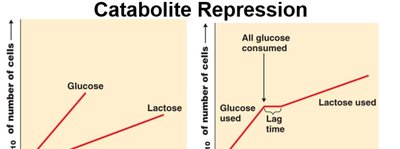
Catabolite repression ensures that bacteria use the most efficient energy source available. For example, E. coli will use glucose before lactose if both are present, leading to a diauxic growth curve.
Mutation: Types and Effects
Definition and Consequences
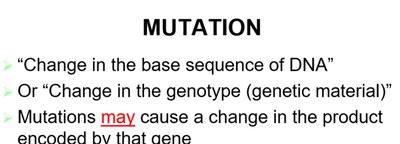
A mutation is a change in the base sequence of DNA, which may alter the genotype and potentially the phenotype of an organism. Mutations can be disadvantageous, lethal, or beneficial.
Types of Mutations
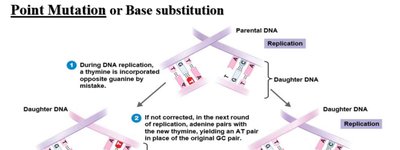
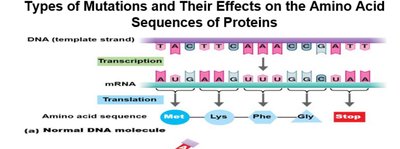
Point Mutation (Base Substitution): A single nucleotide is replaced by another. Can result in:
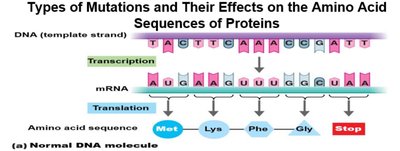
Missense mutation: Changes one amino acid in the protein (e.g., sickle cell disease).
Nonsense mutation: Introduces a stop codon, leading to a truncated protein.
Frameshift Mutation: Insertion or deletion of one or more nucleotides, altering the reading frame and usually resulting in a nonfunctional protein.
Silent and Neutral Mutations
Some mutations do not affect protein function:
Silent mutation: Alters a codon but does not change the amino acid due to the degeneracy of the genetic code (often at the third codon position).
Neutral mutation: Changes an amino acid, but the substitution does not affect protein function (e.g., occurs in a non-vital region).
DNA Damage and Repair
Thymine Dimers and Repair Mechanisms
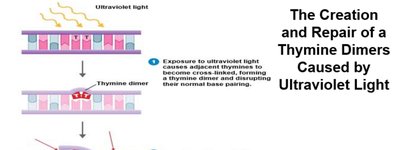
Ultraviolet (UV) light can cause adjacent thymine bases to form dimers, disrupting DNA replication and transcription. Cells have repair mechanisms to correct such damage:
Nucleoside excision repair: Enzymes remove the damaged DNA segment, DNA polymerase fills the gap, and DNA ligase seals the strand.
Photolyase (light repair enzyme): Uses visible light energy to separate thymine dimers back to normal thymines.
Mutagens
Mutagens are environmental agents (such as chemicals or radiation) that increase the mutation rate by directly or indirectly altering DNA sequences.
