 Back
BackGene Regulation in Microorganisms: Mechanisms and Examples
Study Guide - Smart Notes
 Tailored notes based on your materials, expanded with key definitions, examples, and context.
Regulation of Genes and Proteins
Introduction to Gene Regulation
Gene regulation is essential for microorganisms to adapt to changing environments, conserve energy, and maintain cellular function. It involves controlling the expression of genes and the activity of proteins to ensure that cellular resources are used efficiently.
Constitutive genes: Also known as housekeeping genes, these are expressed continuously to maintain basic cellular functions.
Inducible genes: Genes that are expressed only under certain environmental conditions, such as the presence of specific substrates (e.g., β-galactosidase for lactose metabolism).
Major Approaches to Regulation
Levels of Regulation
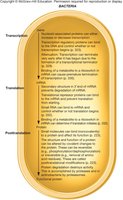
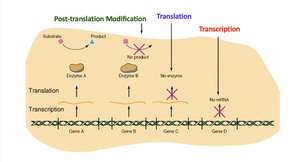
Gene expression can be regulated at multiple levels, including transcription, translation, and posttranslational modification. Each level provides a unique mechanism for controlling protein production and activity.
Transcriptional regulation: Controls whether a gene is transcribed into mRNA.
Translational regulation: Controls whether an mRNA is translated into protein.
Posttranslational regulation: Modifies proteins after synthesis to alter their activity.
Regulation of Enzyme Activity
Allosteric Regulation
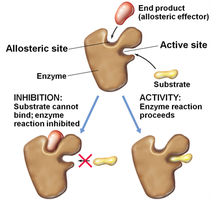
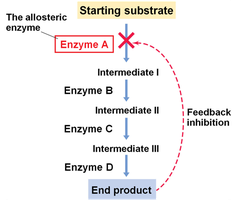
Allosteric regulation involves effector molecules binding to sites other than the enzyme's active site (allosteric sites), causing conformational changes that alter enzyme activity. This is a rapid and reversible way to regulate metabolic pathways.
Allosteric site: A site on the enzyme where an effector molecule binds, distinct from the active site.
Effector molecules: Can be inhibitors or activators, changing the enzyme's conformation and activity.
Covalent Modification
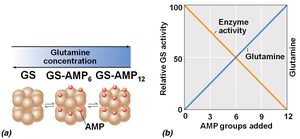
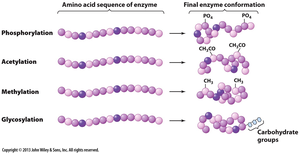
Enzyme activity can also be regulated by covalent attachment or removal of small chemical groups, such as phosphorylation, acetylation, methylation, or glycosylation. These modifications cause conformational changes that affect enzyme function.
Common modifications: AMP, ADP, phosphorylation, acetylation, methylation, glycosylation.
Example: Regulation of glutamine synthetase by AMP groups.
Regulation of Gene Expression
Induction and Repression
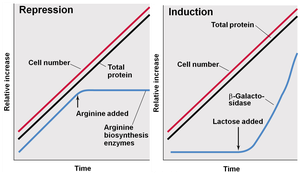
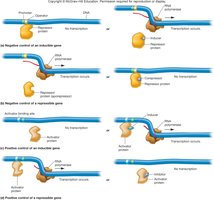
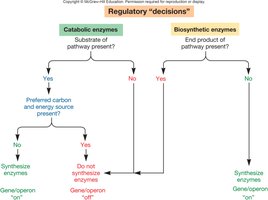
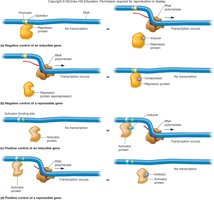
Gene expression is regulated by proteins that bind to DNA and either inhibit (negative control) or promote (positive control) transcription. Inducible and repressible systems allow cells to respond to environmental changes.
Inducible genes: Expressed only in the presence of an inducer (e.g., lactose for β-galactosidase).
Repressible genes: Expression is inhibited by a corepressor when the end product is abundant.
Negative and Positive Transcriptional Control
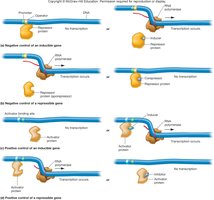
Transcriptional control involves regulatory proteins that bind to specific DNA sequences to control the initiation of transcription.
Negative control: Repressor proteins bind to operators, blocking RNA polymerase and inhibiting transcription.
Positive control: Activator proteins bind to DNA, enhancing the binding of RNA polymerase and promoting transcription.
Operons and the lac Operon
Structure and Function of the lac Operon
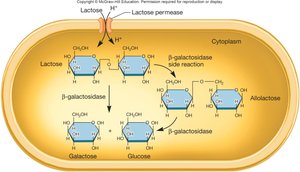
The lac operon is a classic example of gene regulation in bacteria. It contains genes required for lactose uptake and metabolism, and is regulated by both repressors and activators.
lacI: Encodes the lac repressor protein.
Operator: DNA sequence where the repressor binds.
CAP site: Binding site for the catabolite activator protein (CAP).

Regulation by the lac Repressor and CAP
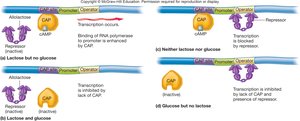
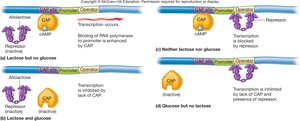
The lac operon is regulated by the lac repressor (negative control) and the catabolite activator protein (CAP, positive control). The operon is only fully active when lactose is present and glucose is absent.
lac repressor: Binds to the operator to block transcription in the absence of lactose.
CAP: Binds to the CAP site when activated by cAMP, enhancing transcription when glucose is low.
Regulation of cAMP and Catabolite Repression
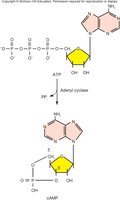
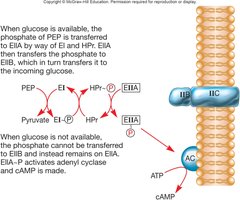
cAMP levels are controlled by adenyl cyclase, which is active only when glucose is scarce. High cAMP activates CAP, allowing transcription of catabolic operons. This mechanism ensures that the cell uses the most efficient energy source first (catabolite repression).
Catabolite repression: Prevents the expression of operons for alternative sugars when glucose is present.
Diauxic growth: Biphasic growth pattern due to sequential use of carbon sources.
Global Regulatory Systems
Regulons and Modulons
Global regulatory systems coordinate the expression of multiple genes and operons in response to environmental changes. This ensures efficient use of resources and prioritization of energy sources.
Regulon: A group of genes or operons controlled by a common regulatory protein.
Modulon: A network of operons under the control of a global regulator, with individual operons also regulated by their own specific regulators.
Alternate Sigma Factors
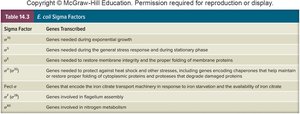
Sigma factors are proteins that direct RNA polymerase to specific promoters. Alternate sigma factors allow bacteria to rapidly change gene expression in response to stress or environmental changes.
Sigma Factor | Genes Regulated |
|---|---|
σ70 | Genes needed during exponential growth |
σS | Genes needed during general stress response and stationary phase |
σE | Genes needed to maintain membrane integrity and respond to misfolded proteins |
σH | Genes needed for heat shock response |
σF | Genes involved in flagellum assembly |
σN | Genes involved in nitrogen metabolism |
Summary
Gene regulation in microorganisms is a complex, multi-level process that allows cells to adapt to environmental changes, conserve energy, and coordinate cellular activities. Key mechanisms include allosteric and covalent regulation of enzymes, transcriptional control via repressors and activators, operon systems such as the lac operon, catabolite repression, and global regulatory systems involving sigma factors.
