 Back
BackGene Transfer in Bacteria and Archaea: Mechanisms and Applications
Study Guide - Smart Notes
 Tailored notes based on your materials, expanded with key definitions, examples, and context.
Gene Transfer in Bacteria and Archaea
Overview of Bacterial and Archaeal Genetics
Bacteria and archaea possess unique mechanisms for exchanging genetic material, which contribute to their adaptability and evolution. These processes are central to microbial genetics and are crucial for understanding antibiotic resistance, metabolic diversity, and microbial evolution.
Horizontal gene transfer (HGT): The movement of genetic material between organisms, bypassing traditional parent-to-offspring inheritance.
Key mechanisms: Transformation, transduction, and conjugation.
Importance: Facilitates rapid acquisition of new traits, such as antibiotic resistance.
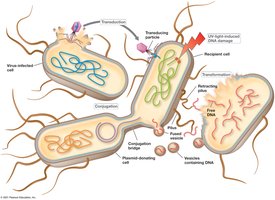
Mechanisms of Gene Transfer
Transformation
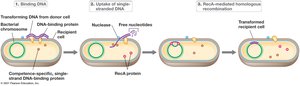
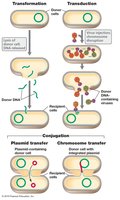
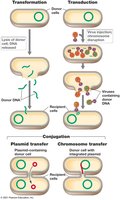
Transformation is the uptake of free DNA from the environment by a bacterial cell. This process can result in the acquisition of new genetic traits, such as antibiotic resistance.
Process: DNA released from a lysed cell is taken up by a competent recipient cell.
Competence: The physiological state enabling a cell to take up DNA.
Homologous recombination: Incorporated DNA must be similar to recipient DNA for stable integration.
Example: Acquisition of antibiotic resistance genes from environmental DNA.
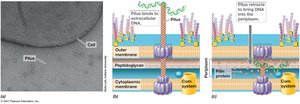
Vibrio Pilus and DNA Uptake
Some bacteria, such as Vibrio species, utilize specialized pili to facilitate DNA uptake during transformation. The pilus binds extracellular DNA and retracts to bring DNA into the cell.
Pilus: A proteinaceous appendage used for DNA binding and uptake.
DNA uptake: Pilus-mediated transport of DNA across the cell envelope.
Transduction
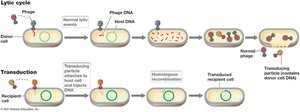
Transduction is the transfer of bacterial genes by viruses (bacteriophages). This process can move any gene (generalized transduction) or specific genes (specialized transduction) from one cell to another.
Generalized transduction: Any gene from the donor can be transferred via a phage.
Mechanism: Phage infects donor cell, packages bacterial DNA, and injects it into recipient cell.
Homologous recombination: Recipient cell incorporates donor DNA.
Example: Transfer of antibiotic resistance genes via phages.
Conjugation
Conjugation is the direct transfer of DNA from one bacterial cell to another via cell-to-cell contact, typically mediated by plasmids such as the F (fertility) plasmid in Escherichia coli.
F plasmid: A self-transmissible plasmid encoding genes for pilus formation and DNA transfer.
R plasmid: Plasmid conferring antibiotic resistance.
Mechanism: Donor cell forms a conjugation bridge (pilus) with recipient, transfers plasmid or chromosomal DNA.
Example: Spread of antibiotic resistance via R plasmids.
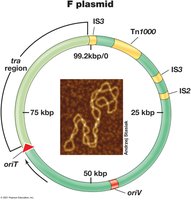
Genetic Map of the F (Fertility) Plasmid
The F plasmid is a circular DNA molecule containing genes for conjugation and replication. It is essential for the transfer of genetic material during conjugation.
Key regions: tra (transfer), oriT (origin of transfer), oriV (origin of replication), and insertion sequences (IS).
Size: Approximately 99.2 kbp.
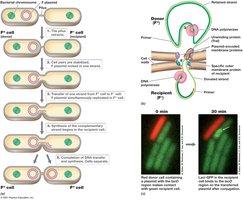
Transfer of Plasmid DNA by Conjugation
During conjugation, plasmid DNA is transferred from a donor (F+) cell to a recipient (F-) cell. The process involves pilus formation, DNA nicking, and synthesis of complementary strands.
Steps: 1. Pilus formation; 2. DNA nicking; 3. Transfer of single strand; 4. Synthesis of complementary strand in recipient.
Result: Both cells become F+.
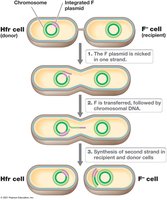
Transfer of Chromosomal DNA by Conjugation
High-frequency recombination (Hfr) cells can transfer chromosomal DNA to recipient cells during conjugation. The F plasmid integrates into the chromosome, allowing transfer of adjacent chromosomal genes.
Hfr cell: Donor cell with integrated F plasmid.
Mechanism: Transfer begins at F plasmid, continues into chromosomal DNA.
Result: Recipient may acquire new chromosomal genes.
Summary Table: Processes of DNA Transfer
The following table summarizes the main processes by which DNA is transferred from donor to recipient bacterial cells.
Process | Mechanism | Key Features |
|---|---|---|
Transformation | Uptake of free DNA from environment | Requires competence; DNA from lysed cells |
Transduction | Transfer via bacteriophage | Generalized or specialized; phage-mediated |
Conjugation (Plasmid) | Direct cell-to-cell transfer of plasmid | Requires F plasmid; pilus formation |
Conjugation (Chromosome) | Transfer of chromosomal DNA via Hfr cell | F plasmid integrated; transfer of chromosomal genes |
Applications and Implications
Antibiotic Resistance
Gene transfer mechanisms are major contributors to the spread of antibiotic resistance among bacterial populations. Plasmids carrying resistance genes can be rapidly disseminated via conjugation, transformation, or transduction.
Example: Transfer of R plasmids conferring resistance to multiple antibiotics.
Public health impact: Increased prevalence of multidrug-resistant pathogens.
Microbial Evolution and Diversity
Horizontal gene transfer accelerates microbial evolution, enabling bacteria and archaea to adapt to new environments and acquire novel metabolic capabilities.
Genetic diversity: Introduction of new genes and functions.
Evolutionary significance: Rapid adaptation and speciation.
Key Terms and Definitions
Horizontal gene transfer (HGT): Movement of genetic material between organisms other than by descent.
Transformation: Uptake of free DNA by a cell.
Transduction: Transfer of DNA via bacteriophage.
Conjugation: Direct transfer of DNA between cells via contact.
Plasmid: Circular, extrachromosomal DNA molecule.
F plasmid: Fertility plasmid enabling conjugation.
Hfr cell: Cell with F plasmid integrated into chromosome.
Equations and Genetic Concepts
Homologous recombination: The process by which DNA sequences are exchanged between similar or identical molecules.
Plasmid replication:
