 Back
BackGenomes and Chromosomes: Structure, Function, and Replication in Microbiology
Study Guide - Smart Notes
 Tailored notes based on your materials, expanded with key definitions, examples, and context.
Genomes and Chromosomes
Introduction to Genomes and Chromosomes
Microbial genetics explores how genetic material is organized, transmitted, and expressed at the molecular level. Bacteria and bacteriophages serve as model systems due to their rapid reproduction, haploid genomes, and relatively small genome sizes, which facilitate genetic analysis and manipulation.
Genome: The complete set of genetic material in an organism.
Chromosome: A DNA molecule containing part or all of the genetic material.
Model organisms: Escherichia coli (E. coli) is commonly used due to its 4 x 10⁶ base pair genome.
Genetic mapping: Techniques such as conjugation and transduction have enabled the mapping of bacterial genomes.
Discovery of DNA as Genetic Material
Key Experiments Establishing DNA as the Hereditary Material
The identification of DNA as the genetic material was established through a series of landmark experiments:
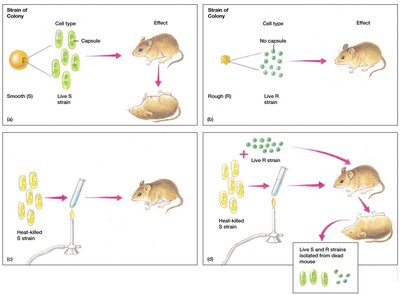
Griffith's Transformation Experiment (1928): Demonstrated the existence of a "transforming principle" that could transfer genetic traits between bacteria.
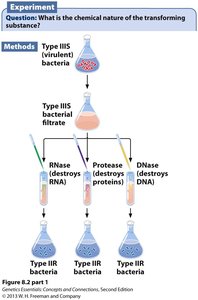
Avery, MacLeod, and McCarty (1944): Identified DNA as the "transforming principle" responsible for heredity.
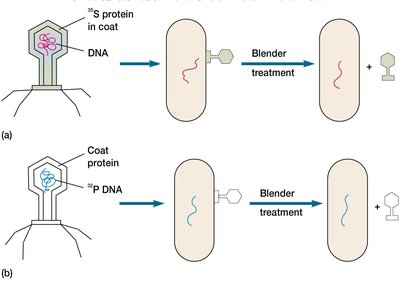
Hershey-Chase Experiment (1952): Confirmed that DNA, not protein, is the hereditary material in viruses.
Chemical Structure of Nucleic Acids
Nucleotides and Nucleic Acid Structure
Nucleic acids are polymers of nucleotides, which consist of a sugar, a phosphate group, and a nitrogenous base. DNA and RNA differ in their sugar and base composition.
DNA: Contains 2'-deoxyribose sugar; bases are adenine (A), guanine (G), cytosine (C), and thymine (T).
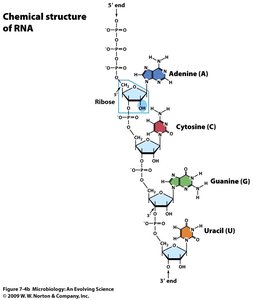
RNA: Contains ribose sugar; bases are adenine (A), guanine (G), cytosine (C), and uracil (U).
Purines: Adenine and guanine.
Pyrimidines: Cytosine, thymine (DNA), and uracil (RNA).
DNA Double Helix
The DNA molecule forms a double helix, with two antiparallel strands held together by hydrogen bonds between complementary bases (A-T and G-C). Each strand has polarity, with a 5' and 3' end.
Phosphodiester bonds: Covalently link nucleotide monomers.
Base pairing: A pairs with T, G pairs with C (Watson-Crick rules).
Antiparallel orientation: The two strands run in opposite directions.
RNA Structure and tRNA
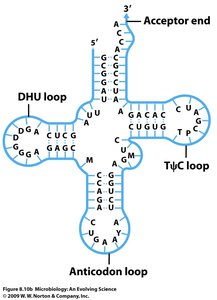
RNA molecules can form complex secondary structures. Transfer RNA (tRNA) is a key adaptor molecule in translation, with a cloverleaf structure containing an anticodon loop and an acceptor end for amino acid attachment.
Genome Organization and Compaction
Genome Size and Compaction
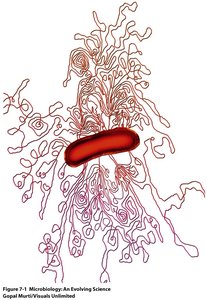
Genomes are much larger than the cells that house them, requiring efficient compaction mechanisms.
E. coli chromosome: ~4 x 10⁶ bp, compacted 1400-fold to fit inside the cell.
Human genome: ~4 x 10⁹ bp per cell, with total DNA in the body stretching far beyond the Earth-Sun distance if laid end to end.
Genome Organization in Prokaryotes and Eukaryotes
Genome organization differs between prokaryotes and eukaryotes:
Eukaryotes: DNA is compacted with histone proteins into chromatin.
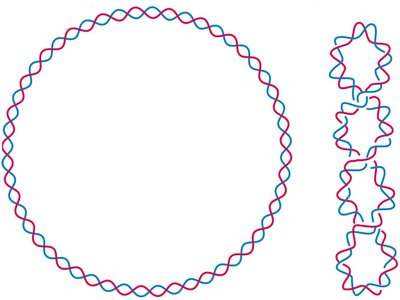
Prokaryotes: DNA is supercoiled with the help of topoisomerase enzymes.
Central Dogma of Molecular Biology
Flow of Genetic Information
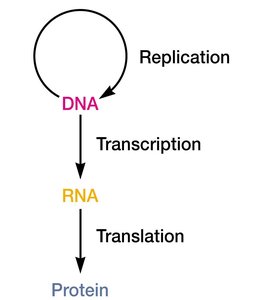
The central dogma describes the flow of genetic information from DNA to RNA to protein. This process involves three major steps: replication, transcription, and translation.
Replication: Copying DNA to produce identical genomes for cell division.
Transcription: Synthesis of RNA from a DNA template.
Translation: Synthesis of proteins from an mRNA template.
DNA Replication
Mechanism and Enzymes of DNA Replication
DNA replication is a highly coordinated process involving multiple enzymes and steps. It is semi-conservative, meaning each daughter DNA molecule contains one parental and one newly synthesized strand.
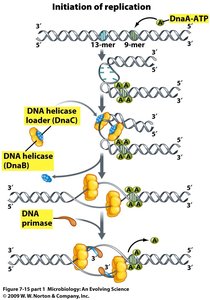
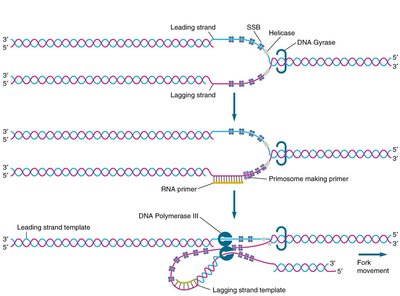
Initiation: Begins at a specific origin (oriC in E. coli), involving DNA helicase, primase, and DNA polymerase.
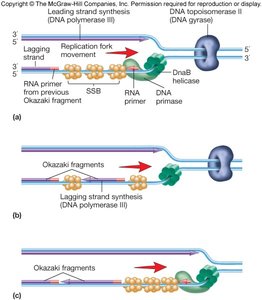
Elongation: DNA polymerase synthesizes new DNA in the 5' to 3' direction. The leading strand is synthesized continuously, while the lagging strand is synthesized discontinuously as Okazaki fragments.
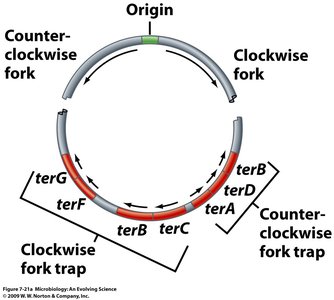
Termination: Replication ends at specific termination sequences (Ter sites) bound by Tus protein, which traps replication forks.
Proofreading: DNA polymerases have proofreading activity to ensure high fidelity (error rate ~1 in 109 bp).
Patterns of DNA Replication
Replication patterns differ between prokaryotes and eukaryotes:
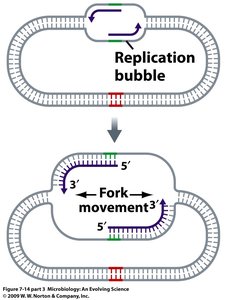
Prokaryotes: Single origin of replication, bidirectional replication.
Eukaryotes: Multiple origins of replication, bidirectional replication.
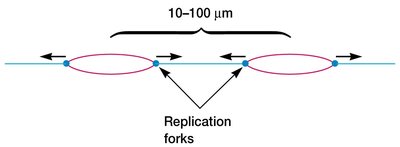
Termination of DNA Replication
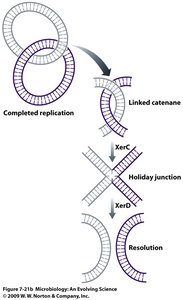
Termination involves specific DNA sequences (Ter sites) and proteins (Tus) that halt replication forks. In circular chromosomes, additional enzymes resolve linked DNA molecules (catenanes) after replication.
Summary Table: Key Differences in Genome Organization
Feature | Prokaryotes | Eukaryotes |
|---|---|---|
Genome size | Small (e.g., 4 x 10⁶ bp in E. coli) | Large (e.g., 4 x 10⁹ bp in humans) |
Chromosome structure | Circular, single | Linear, multiple |
DNA compaction | Supercoiling (topoisomerases) | Histones (chromatin) |
Origin of replication | Single | Multiple |
Additional info: The study of microbial genetics provides foundational knowledge for biotechnology, antibiotic development, and understanding mechanisms of disease and immunity.
