 Back
Genomes, Genes, and Transcription in Microbiology
Study Guide - Smart Notes
 Tailored notes based on your materials, expanded with key definitions, examples, and context.
Genomes and Genes
Overview of Genomes
The genome of an organism encompasses all of its genetic material, including both chromosomal DNA and any extrachromosomal elements such as plasmids. In bacteria, the genome is typically a single, circular DNA molecule located in the nucleoid region of the cell. Plasmids are smaller, circular DNA molecules that can carry genes beneficial for survival, such as antibiotic resistance.
Genome: The complete set of genetic instructions in a cell.
Plasmid: An auxiliary genetic element, often circular, that replicates independently of the chromosome.
Nucleoid: The region in a bacterial cell where the chromosome is located.
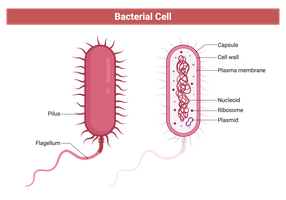
Example: Escherichia coli contains a single circular chromosome and may harbor several plasmids.
Genome Content and Structure
Bacterial Gene Structure
Bacterial genes are organized in a way that allows efficient regulation and expression. Genes may be found individually or grouped into operons, which are clusters of genes transcribed together as a single mRNA molecule (polycistronic mRNA). This arrangement is unique to prokaryotes and allows coordinated expression of genes involved in the same pathway.
Operon: A group of genes under the control of a single promoter, transcribed as one mRNA.
Polycistronic mRNA: An mRNA molecule that encodes multiple proteins.
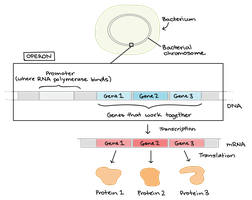
Example: The lac operon in E. coli encodes proteins for lactose metabolism.
DNA Sequencing Technologies
Sanger Sequencing and Next Generation Sequencing (NGS)
DNA sequencing allows scientists to determine the precise order of nucleotides in a DNA molecule. Sanger sequencing uses dideoxynucleotide triphosphates (ddNTPs) to terminate DNA synthesis at specific bases, enabling the determination of sequence by fragment size. Next Generation Sequencing (NGS) technologies have revolutionized genomics by allowing millions of DNA fragments to be sequenced in parallel, greatly increasing speed and throughput.
Sanger Sequencing: Relies on chain-terminating nucleotides to generate DNA fragments of varying lengths.
NGS: High-throughput sequencing that enables large-scale genomic studies.
Application: Sequencing the E. coli genome has enabled detailed studies of gene function and regulation.
Gene Expression: Transcription
Central Dogma of Molecular Biology
The central dogma describes the flow of genetic information: DNA is transcribed into RNA, which is then translated into protein. Transcription is the process by which RNA is synthesized from a DNA template.
Transcription: Synthesis of RNA from a DNA template.
Translation: Synthesis of protein from an mRNA template.
DNA vs. RNA Structure
RNA differs from DNA in several key ways: RNA contains ribose sugar (with a 2' hydroxyl group), uses uracil instead of thymine, and is typically single-stranded. RNA molecules can fold into secondary structures, such as stem-loops, which are important for their function.
Ribose vs. Deoxyribose: RNA has an -OH group at the 2' position; DNA does not.
Uracil vs. Thymine: RNA uses uracil (U) in place of thymine (T).
Single-stranded: Most RNA molecules are single-stranded but can form secondary structures.
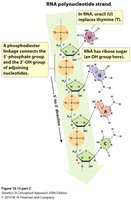
Example: mRNA, tRNA, and rRNA are all types of RNA transcribed from DNA.
RNA Secondary Structure
Although RNA is usually single-stranded, it can form secondary structures such as stem-loops (hairpins) through complementary base pairing. These structures are critical for RNA function, including regulation of gene expression and termination of transcription.
Stem-loop: A structure formed when a single RNA strand folds back on itself and forms base pairs.
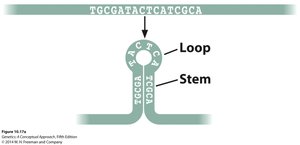
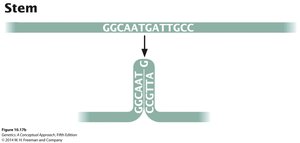
Example: Stem-loops are involved in intrinsic termination of transcription in bacteria.
Bacterial Transcription Machinery
RNA Polymerase and Sigma Factors
Bacterial RNA polymerase is a multi-subunit enzyme responsible for synthesizing RNA from a DNA template. The holoenzyme includes a sigma (σ) factor, which recognizes promoter sequences and initiates transcription. Once initiation occurs, the sigma factor dissociates, and the core enzyme continues RNA synthesis.
RNA Polymerase: Enzyme that synthesizes RNA in the 5' to 3' direction.
Sigma Factor: Protein subunit that directs RNA polymerase to specific promoter sequences.
Promoter: DNA sequence recognized by sigma factor to initiate transcription.
Example: Different sigma factors recognize different sets of promoters, allowing bacteria to respond to environmental changes.
Transcription Initiation and Elongation
Transcription begins when RNA polymerase binds to the promoter region with the help of a sigma factor. The enzyme unwinds the DNA and begins synthesizing RNA complementary to the template strand, moving in the 5' to 3' direction.
Template Strand: The DNA strand used as a template for RNA synthesis (read 3' to 5').
mRNA Sequence: Complementary to the DNA template, with uracil replacing thymine.
Example: For the DNA sequence 3'-ATCGGCTAGTG-5', the mRNA sequence would be 5'-UAGCCGAUCAC-3'.
Transcription-Translation Coupling
In bacteria, transcription and translation are coupled processes. Ribosomes can begin translating an mRNA while it is still being synthesized by RNA polymerase. This allows for rapid and efficient gene expression.
Cotranslation: Simultaneous transcription and translation of mRNA.
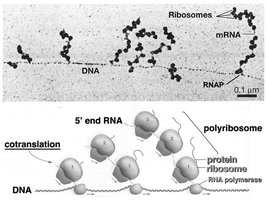
Example: Multiple ribosomes (polyribosomes) can translate a single mRNA molecule as it is being transcribed.
Transcription Termination
Intrinsic (Rho-independent) Termination
Intrinsic termination occurs when RNA polymerase encounters a GC-rich inverted repeat followed by a stretch of adenines in the DNA. The resulting RNA forms a stem-loop structure, causing the polymerase to pause and dissociate from the DNA.
Stem-loop: Causes RNA polymerase to pause.
Poly-U Tail: Weak RNA-DNA hybrid leads to dissociation.
Example: Many bacterial genes use intrinsic termination to end transcription.
Rho-dependent Termination
Rho-dependent termination requires the Rho protein, which binds to a specific sequence (rut site) on the nascent RNA. Rho moves along the RNA, using ATP hydrolysis, and disrupts the RNA-DNA hybrid, releasing the RNA polymerase.
Rho Factor: Helicase protein that terminates transcription at specific sites.
Rut Site: Sequence on RNA recognized by Rho.
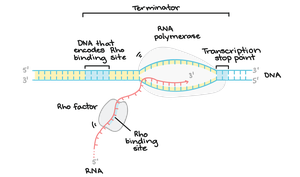
Example: Rho-dependent termination is used for genes lacking strong intrinsic terminators.
Transcription in Archaea and Eukarya
Archaeal and Eukaryotic Transcription Machinery
Archaea and eukaryotes share similarities in their transcription machinery, which is more complex than that of bacteria. Both use multiple transcription factors and have more elaborate promoter structures, such as the TATA box and BRE (B recognition element).
TATA Box: A conserved promoter sequence recognized by the TATA-binding protein (TBP).
BRE: B recognition element, upstream of the TATA box, recognized by transcription factor B (TFB).
RNA Polymerases: Archaea and bacteria have one; eukaryotes have three (I, II, III).
Example: Eukaryotic RNA polymerase II transcribes mRNA, while I and III transcribe rRNA and tRNA, respectively.
Transcription Termination in Archaea
Termination mechanisms in Archaea are less well understood. Some archaeal genes use inverted repeats and AT-rich sequences similar to bacterial intrinsic terminators. Others use unique proteins, such as the Eta factor, to terminate transcription.
Eta Protein: Found in Euryarchaeota, binds upstream of the transcription bubble and dislodges RNA polymerase.
Example: Archaeal transcription termination can involve both intrinsic and protein-dependent mechanisms.
RNA Processing in Archaea and Eukarya
Eukaryotic genes contain exons (coding regions) and introns (noncoding regions). The primary RNA transcript must be processed to remove introns (splicing) and join exons. In eukaryotes, this occurs in the nucleus via the spliceosome. In Archaea, introns are rare in protein-coding genes but are found in tRNA and rRNA genes, where they are removed by specialized ribonucleases.
Exon: Coding sequence in a gene.
Intron: Noncoding sequence that is removed during RNA processing.
Splicing: Removal of introns and joining of exons to produce mature RNA.
Example: Eukaryotic mRNA undergoes capping, polyadenylation, and splicing before translation.
Summary Table: Key Differences in Transcription Among Domains
Feature | Bacteria | Archaea | Eukarya |
|---|---|---|---|
RNA Polymerase | One type | One type (complex) | Three types (I, II, III) |
Promoter Elements | -35, -10 regions | TATA box, BRE | TATA box, BRE, others |
Termination | Intrinsic, Rho-dependent | Intrinsic-like, Eta protein | Complex, cleavage and polyadenylation |
RNA Processing | Rare | tRNA/rRNA intron removal | Splicing, capping, polyadenylation |
Learning Objectives Review
Define a genome and plasmid.
Describe Sanger sequencing and NGS methods.
Identify features of bacterial genes and operons.
Differentiate DNA and RNA structures.
Explain the role of sigma factors in bacterial transcription.
Describe mechanisms of transcription termination.
