 Back
BackHelminths: Tapeworms, Diseases, and Identification
Study Guide - Smart Notes
 Tailored notes based on your materials, expanded with key definitions, examples, and context.
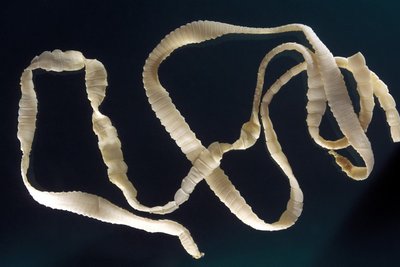
Q1. What helminth is shown in the image?
Background
Topic: Parasitology – Helminths (Worms)
This question is testing your ability to visually identify a helminth (parasitic worm) and understand its classification and significance in human disease. The image shows a segmented, ribbon-like organism, which is characteristic of a tapeworm.
Key Terms and Concepts:
Helminth: A general term for parasitic worms, including nematodes (roundworms), cestodes (tapeworms), and trematodes (flukes).
Tapeworm (Cestode): Flat, segmented worms that live in the intestines of their hosts.
Taenia solium: The pork tapeworm, a species of tapeworm that can infect humans.
Step-by-Step Guidance
Observe the organism's structure: Note the long, flat, ribbon-like body with visible segments (proglottids). This is a key feature of cestodes (tapeworms).
Recall the main groups of helminths: Nematodes (roundworms), cestodes (tapeworms), and trematodes (flukes). The segmented appearance rules out nematodes and trematodes.
Consider common human-infecting tapeworms: Taenia solium (pork tapeworm) and Taenia saginata (beef tapeworm) are the most clinically significant.
Think about the diseases associated with Taenia solium: This tapeworm can cause two main diseases in humans.
Try solving on your own before revealing the answer!
Final Answer:
The helminth shown is a tapeworm, specifically Taenia solium (pork tapeworm). Taenia solium causes two diseases in humans: taeniasis (intestinal infection with the adult worm) and cysticercosis (tissue infection with larval cysts, which can affect the brain and other tissues).


Taeniasis occurs when humans ingest undercooked pork containing cysticerci, leading to adult tapeworms in the intestine. Cysticercosis occurs when humans ingest eggs, leading to larval cysts in tissues.
