 Back
BackHorizontal Gene Transfer: Transformation, Conjugation, and the Discovery of DNA as Genetic Material
Study Guide - Smart Notes
 Tailored notes based on your materials, expanded with key definitions, examples, and context.
Horizontal Gene Transfer in Prokaryotes
Overview of Horizontal Gene Transfer (HGT)
Horizontal gene transfer (HGT) is the movement of genetic material between organisms other than by the "vertical" transmission of DNA from parent to offspring. In prokaryotes, HGT is a major mechanism for genetic diversity and adaptation, involving three primary processes: transformation, conjugation, and transduction.
Transformation: Uptake of free DNA from the environment by a competent bacterial cell.
Conjugation: Direct transfer of DNA from one bacterial cell to another via cell-to-cell contact.
Transduction: Transfer of bacterial genes by bacteriophages (viruses that infect bacteria).
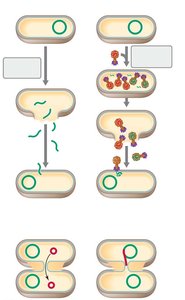
Transformation: Discovery and Mechanism
Griffith's Experiment and the Transforming Principle
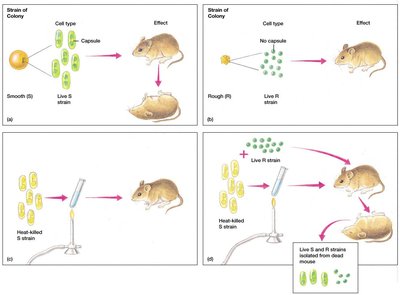
Frederick Griffith's 1928 experiment with Streptococcus pneumoniae demonstrated the phenomenon of transformation. He observed that non-virulent rough (R) strains could be transformed into virulent smooth (S) strains when mixed with heat-killed S cells, indicating the transfer of genetic material.
S strain: Encapsulated, virulent, kills mice.
R strain: Non-encapsulated, non-virulent, mice survive.
Key finding: Live R cells mixed with heat-killed S cells killed mice, and live S cells were recovered, indicating transformation.
Avery, MacLeod, and McCarty: Identification of DNA as the Transforming Principle
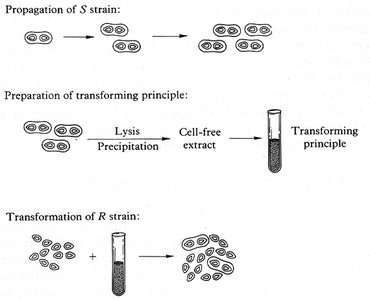
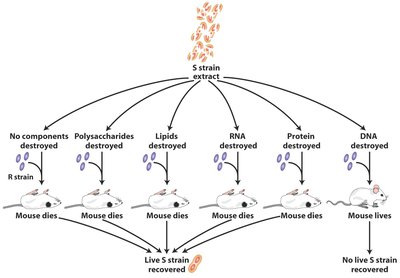
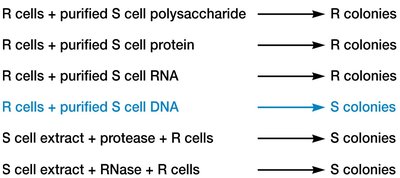
In 1944, Avery, MacLeod, and McCarty isolated the "transforming principle" and demonstrated that DNA, not protein or RNA, was responsible for transformation. They used chemical and enzymatic treatments to selectively destroy proteins, RNA, or DNA in cell extracts and showed that only destruction of DNA prevented transformation.
Experimental approach: Fractionation and enzymatic digestion of S strain extracts.
Conclusion: Only DNA was necessary for transformation of R cells to S cells.
Hershey-Chase Experiment: Confirmation with Bacteriophage
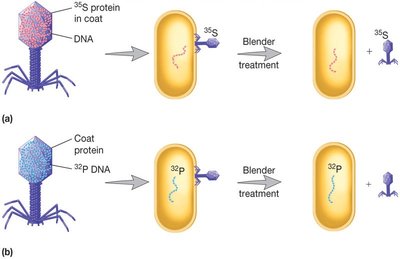
The 1952 Hershey-Chase experiment used bacteriophage T2 labeled with radioactive isotopes to confirm that DNA is the genetic material. They labeled phage protein with 35S and DNA with 32P, infected bacteria, and showed that only DNA entered the bacterial cell and directed viral replication.
Key result: 32P-labeled DNA entered cells; 35S-labeled protein did not.
Conclusion: DNA carries genetic information.
Molecular Mechanism of Transformation
Steps in Bacterial Transformation
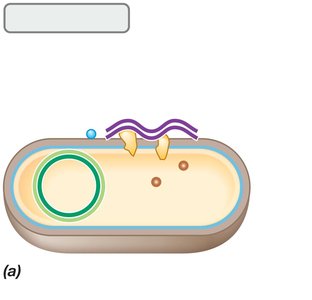
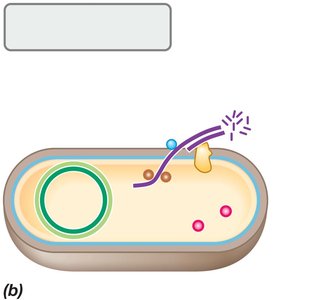
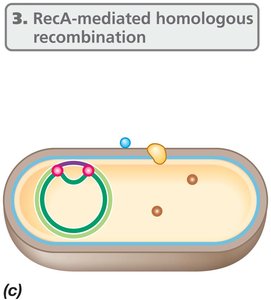
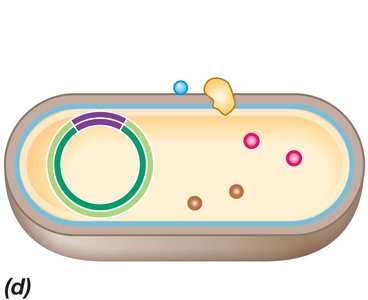
Transformation involves several steps, including DNA binding, uptake, and integration into the recipient genome. Competence, the ability to take up DNA, is regulated and often occurs at specific stages of the cell cycle.
Binding: Double-stranded DNA binds to the cell surface.
Uptake: One strand is degraded; the other enters the cell.
Integration: Homologous recombination incorporates the DNA into the chromosome.
Specialized DNA Uptake Systems
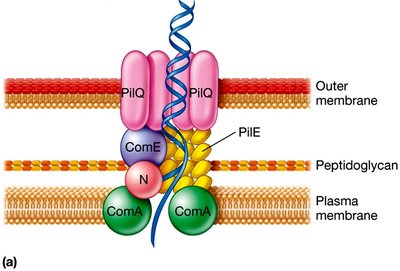
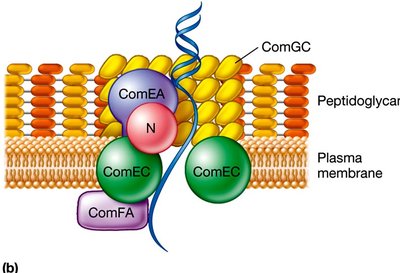
Different bacteria have evolved specialized protein complexes for DNA uptake. For example, Neisseria gonorrhoeae and Bacillus subtilis use distinct sets of proteins to transport DNA across their cell envelopes.
Pilus and Com proteins: Mediate DNA binding and translocation.
Transformation in Molecular Biology
Plasmid Transformation and Recombinant DNA Technology
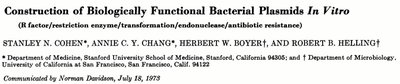
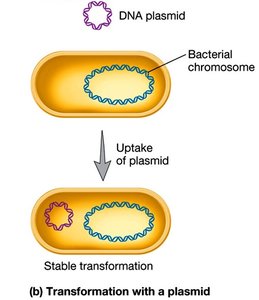
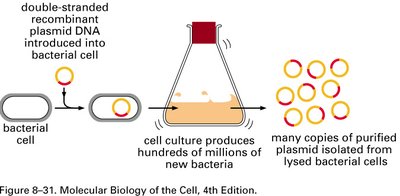
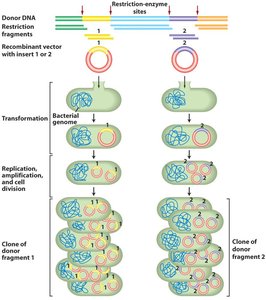
Transformation is a foundational technique in molecular biology, allowing the introduction of recombinant plasmids into bacteria for cloning and protein expression. Plasmids are circular DNA molecules that replicate independently of the bacterial chromosome.
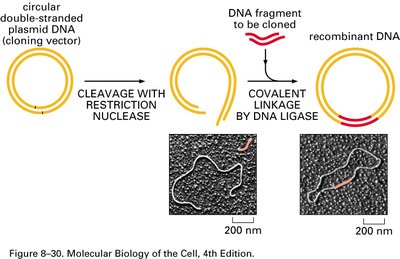
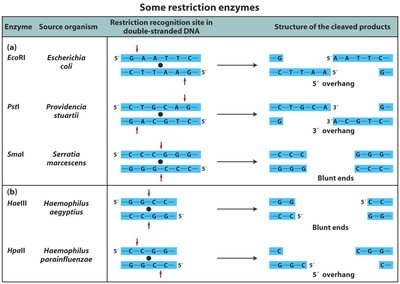
Restriction enzymes: Used to cut DNA at specific sequences, enabling insertion of foreign DNA into plasmids.
DNA ligase: Joins DNA fragments to form recombinant plasmids.
Selection: Transformed cells are selected using antibiotic resistance markers.
Key Experiments and Historical Figures
Summary Table: Key Experiments in Transformation
Experiment | Key Finding |
|---|---|
Griffith (1928) | Transformation of R to S strain in mice |
Avery, MacLeod, McCarty (1944) | DNA is the transforming principle |
Hershey-Chase (1952) | DNA, not protein, is genetic material in phage |
Applications and Importance
Genetic engineering: Transformation is essential for creating genetically modified organisms (GMOs).
Antibiotic resistance: Natural transformation can spread resistance genes among bacteria.
Research: Transformation is used to study gene function and regulation.
