 Back
BackImmunization and Immune Testing: Principles, Types, and Applications
Study Guide - Smart Notes
 Tailored notes based on your materials, expanded with key definitions, examples, and context.
Immunization and Immune Testing
Introduction to Immunization
Immunization is a critical strategy in microbiology and public health for preventing infectious diseases. It involves the administration of antigens or antibodies to induce immunity against specific pathogens. Immunization can be achieved through active or passive methods, each with distinct mechanisms and outcomes.
Principles and Effects of Vaccination
How Vaccines Work
Primary Immune Response: Vaccination provokes a primary immune response, leading to the production of antibodies and memory cells.
Secondary Immune Response: Upon subsequent exposure to the pathogen, the immune system mounts a rapid and intense secondary response.
Herd Immunity: When a large portion of the population is immune, outbreaks become sporadic due to the lack of susceptible individuals.
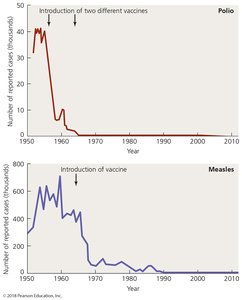
Example: The introduction of vaccines for polio and measles led to a dramatic decline in reported cases in the United States.
History of Immunization
Development of Vaccination
Variolation: Early immunization practice where material from smallpox scabs was used to induce immunity, first observed in China.
Edward Jenner (1796): Developed the process of vaccination using cowpox to protect against smallpox.
Antibody Transfer: Discovery that vaccines protect through the action of antibodies led to the development of passive immunotherapy.
Challenges: Many developing nations lack access to vaccines, and some pathogens still lack effective vaccines. Concerns about vaccine safety can also hinder vaccine development and uptake.
Types of Immunization
Active Immunization
Active immunization involves administering antigens to stimulate the patient's own immune system to mount an adaptive response.
Attenuated (Modified Live) Vaccines: Use pathogens with reduced virulence (attenuation). They can cause mild infections and provide strong, long-lasting immunity, sometimes even contact immunity. However, there is a small risk of disease in susceptible individuals.
Inactivated (Killed) Vaccines: Contain whole microbes that have been killed or antigenic fragments (subunit vaccines). They are safer but often require multiple doses and adjuvants to enhance immune response.
Toxoid Vaccines: Use chemically or thermally modified toxins to stimulate immunity, especially for bacterial diseases. Multiple doses are needed due to low antigenicity.
Combination Vaccines: Simultaneously administer antigens from several pathogens.
Recombinant Vaccines: Use recombinant DNA technology to improve efficacy, safety, and cost-effectiveness.
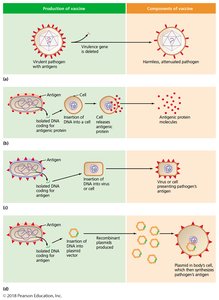
Example: Recombinant vaccines can be produced by inserting genes encoding antigens into harmless vectors or cells, which then express the antigen for use in vaccines.
Passive Immunotherapy
Passive immunotherapy involves the administration of preformed antibodies (antiserum) to provide immediate protection against infection or disease.
Immediate Protection: Useful for recent exposures or ongoing infections.
Limitations: Can cause allergic reactions (serum sickness), antibodies are degraded quickly, and no long-term immunity is conferred.
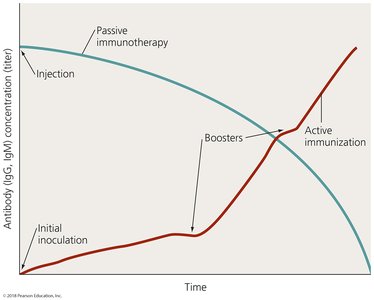
Comparison: Active immunization leads to long-lasting immunity with memory cell formation, while passive immunotherapy provides immediate but short-lived protection.
Vaccine Manufacture and Administration
Production Methods
Vaccines are mass-produced by growing microbes in culture vessels.
Viruses are often cultured in chicken eggs, which can be problematic for individuals with egg allergies.
CDC Recommended Immunization Schedule
The CDC provides guidelines for the timing and administration of vaccines throughout life, from infancy to adulthood.
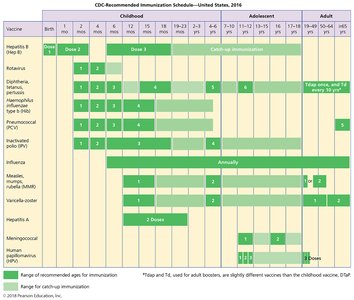
Principal Vaccines to Prevent Human Diseases
Common Vaccines and Their Characteristics
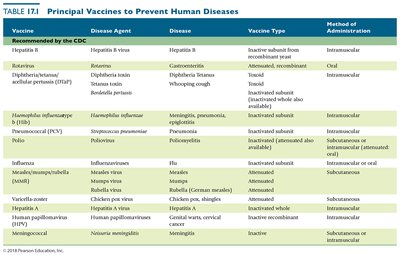
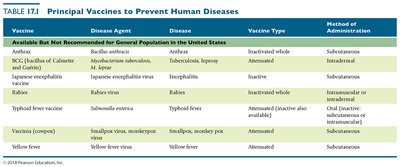
The following tables summarize principal vaccines, their target diseases, types, and methods of administration.
Vaccine | Disease Agent | Disease | Vaccine Type | Method of Administration |
|---|---|---|---|---|
Hepatitis B | Hepatitis B virus | Hepatitis B | Inactive subunit from recombinant yeast | Intramuscular |
Rotavirus | Rotavirus | Gastroenteritis | Attenuated, recombinant | Oral |
Diphtheria/Tetanus/Pertussis (DTaP) | Corynebacterium diphtheriae, Clostridium tetani, Bordetella pertussis | Diphtheria, tetanus, whooping cough | Toxoid, inactivated subunit | Intramuscular |
Haemophilus influenzae type b (Hib) | Haemophilus influenzae | Meningitis, pneumonia | Inactivated subunit, conjugate | Intramuscular |
Poliovirus (IPV) | Poliovirus | Poliomyelitis | Inactivated whole | Intramuscular or oral |
Measles/Mumps/Rubella (MMR) | Measles, mumps, rubella viruses | Measles, mumps, rubella | Attenuated whole | Subcutaneous |
Varicella-zoster | Varicella-zoster virus | Chickenpox, shingles | Attenuated whole | Subcutaneous |
Human papillomavirus (HPV) | HPV | Cervical, anal, oral cancers | Inactivated subunit | Intramuscular |
Vaccine Safety and Risks
Potential Problems
Mild Toxicity: Most common side effect, usually minor and temporary.
Anaphylactic Shock: Rare but severe allergic reaction.
Residual Virulence: Attenuated vaccines may rarely cause disease in immunocompromised individuals.
Controversies: Allegations of vaccines causing autism, diabetes, or asthma have not been substantiated by scientific research.
Despite rare risks, vaccines are the safest and most effective means of preventing infectious diseases in children and adults.
Advances in Vaccine Technology
New Developments
Development of vaccines without animal use
Plant-based vaccine production
Oral vaccines for easier administration
Vaccines for chronic diseases
"Reverse vaccinology" for cellular immunity
Nanopatch technology for skin delivery, requiring no refrigeration
Multiple-combination vaccines
Importance of Vaccination
Why Vaccinate?
Vaccines have drastically reduced the incidence of many infectious diseases. Even when cases are rare, vaccination is essential to maintain herd immunity and prevent outbreaks, especially as global travel can reintroduce diseases into populations.
Key Terms and Definitions
Vaccine: A preparation of antigens used to induce immunity against a specific disease.
Adjuvant: A substance added to vaccines to enhance the body's immune response to the antigen.
Attenuation: The process of reducing the virulence of a pathogen for use in vaccines.
Antiserum: Blood serum containing antibodies against specific antigens, used in passive immunotherapy.
