 Back
BackChapter 12
Study Guide - Smart Notes
 Tailored notes based on your materials, expanded with key definitions, examples, and context.
Symbiosis and Host-Microbe Relationships
Types of Symbiosis
Symbiosis refers to a close and long-term biological interaction between two different biological organisms. The outcome of these interactions can vary:
Mutualism: Both organisms benefit from the relationship.
Commensalism: One organism benefits, while the other is neither helped nor harmed. Many normal flora are commensals.
Parasitism: One organism benefits at the expense of the other; the harming organism is called a pathogen.
Amensalism: One organism is inhibited or destroyed while the other remains unaffected.
Normal flora (microbiota) are microorganisms that reside on or within the human body and do not normally cause disease. They are categorized as:
Resident flora: Remain throughout life in specific locations.
Transient flora: Present temporarily due to competition or immune responses.
Opportunistic pathogens are normal flora that can cause disease if the host's defenses are compromised, if they enter unusual locations, or if the balance of flora is disturbed.
Portals of Entry and Exit
Major Portals of Entry
Pathogens enter the body through specific sites known as portals of entry. These include:
Mucous membranes: Lining the GI, respiratory, urogenital tracts, and conjunctiva. The respiratory tract is the most common portal.
Skin: Normally a strong barrier, but can be breached by cuts, abrasions, or through hair follicles and sweat glands.
Placenta: Usually an effective barrier, but some pathogens can cross and infect the fetus.
Parenteral route: Pathogens introduced directly into tissues via punctures, bites, or medical procedures.
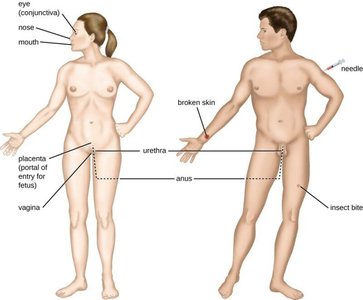
Most pathogens have a preferred portal of entry, and their ability to cause disease often depends on entering through this specific route.
Contamination, Infection, and Disease
Definitions and Stages
Understanding the progression from contamination to disease is crucial in microbiology:
Contamination: The presence of microbes on or in the body.
Infection: The growth and colonization of microorganisms in the host.
Disease: When infection leads to pathological changes and interferes with normal body function.
To cause infection, a pathogen must:
Gain entry into the body
Adhere to host cells (adhesion)
Multiply and colonize tissues
Virulence, Pathogenicity, and Virulence Factors
Virulence: The degree of pathogenicity of a microbe.
Pathogenicity: The ability of a microbe to cause disease.
Virulence factors: Traits or products (e.g., toxins, enzymes) that enable a microbe to harm its host.
Virulence factors include:
Adhesion: Binding to host cells via pili, fimbriae, or receptors.
Colonization: Multiplying at the site of infection.
Invasion: Penetrating host defenses using invasins.
Evasion: Avoiding immune responses (e.g., resisting phagocytosis).
Toxins: Substances that damage host cells or interfere with function.
Exotoxins are secreted proteins, often substrate-specific and highly potent. Endotoxins are lipopolysaccharides from Gram-negative bacteria, released upon cell lysis and are heat-stable.
Etiology and Koch’s Postulates
Determining the Cause of Disease
Etiology is the study of the cause of disease. Not all infections result in disease; only when pathological changes occur does disease manifest.
Koch’s postulates are a set of criteria used to establish a causative relationship between a microbe and a disease:
The suspected agent must be present in every case of the disease and absent from healthy organisms.
The agent must be isolated and grown in pure culture.
The cultured agent must cause the disease when inoculated into a healthy organism.
The agent must be reisolated from the newly diseased organism.
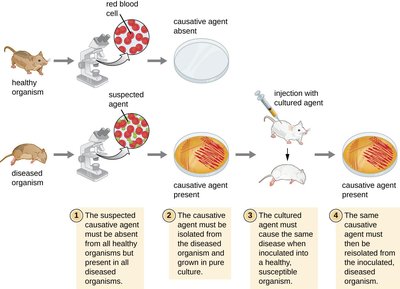
Limitations include pathogens that cannot be cultured, diseases with multiple causes, ethical issues, and pathogens causing different diseases depending on the portal of entry.
Patterns of Infection in Populations
Types of Infections
Local infection: Confined to a specific area (e.g., boils).
Focal infection: Starts local, then spreads to other tissues.
Systemic infection: Spreads throughout the body (e.g., septicemia, bacteremia, toxemia, viremia).
Mixed infection: Multiple pathogens at the same site.
Primary infection: Initial infection in a healthy host.
Secondary infection: Follows a primary infection, often by a different microbe.
Acute infection: Rapid onset, severe symptoms, short duration.
Chronic infection: Develops slowly, lasts a long time.
Subclinical infection: No noticeable symptoms.
Epidemiology and Disease in Populations
Approaches in Epidemiology
Epidemiology is the study of the distribution and determinants of diseases in populations. It informs public health interventions and preventive medicine.
Descriptive epidemiology: Collects and analyzes data on disease occurrence.
Analytical epidemiology: Tests hypotheses about disease causes using data.
Experimental epidemiology: Uses controlled experiments to study disease dynamics.
Disease frequency is measured as:
Prevalence: Total number of cases in a population.
Incidence: Number of new cases over a specific period.
Classification of disease occurrence:
Endemic: Constantly present in a population.
Sporadic: Occurs occasionally.
Epidemic: Higher than normal frequency in a population.
Pandemic: Worldwide epidemic.
Reservoirs of Infectious Agents
Types of Reservoirs
Reservoirs are sites where pathogens are maintained as sources of infection:
Animal reservoirs: Diseases that can be transmitted from animals to humans (zoonoses).
Human carriers: Infected individuals who may be symptomatic or asymptomatic but can transmit pathogens.
Nonliving reservoirs: Soil, water, and food can harbor pathogens.
Transmission of Infectious Diseases
Modes of Transmission
Contact transmission:
Direct contact: Physical interaction (e.g., touching, kissing).
Indirect contact: Via fomites (e.g., bedding, utensils).
Droplet transmission: Via respiratory droplets over short distances.
Vehicle transmission:
Airborne: Pathogens travel more than 1 meter in aerosols.
Waterborne: Contaminated water transmits pathogens.
Foodborne: Ingestion of contaminated food.
Bodily fluid: Contact with contaminated blood, urine, saliva, etc.
Vector transmission:
Biological vectors: Pathogens transmitted by biting arthropods (e.g., mosquitoes).
Mechanical vectors: Passive transmission on body parts of animals.
Vaccination and Public Health
Importance of Vaccination
Vaccination is the most effective method for preventing infectious diseases. Vaccines undergo rigorous development and testing for safety and efficacy, and must be approved by regulatory agencies such as the FDA. The CDC’s Global Immunization Division works to promote vaccination worldwide, preventing epidemics and pandemics. Immunization has led to the eradication of diseases such as smallpox and polio.

Healthcare-Associated (Nosocomial) Infections
Nature and Types of Nosocomial Infections
Nosocomial infections, or healthcare-associated infections (HAIs), are acquired in hospitals or healthcare settings and are a leading cause of morbidity and mortality. They may be:
Exogenous: Caused by pathogens from the healthcare environment.
Endogenous: Caused by the patient’s own normal flora becoming pathogenic.
Iatrogenic: Resulting from medical procedures (e.g., catheters, surgery).

The CDC monitors HAIs through the National Nosocomial Infections Surveillance system. Hand hygiene and infection control committees are critical for prevention.
Transmission and Prevention of HAIs
HAIs are transmitted via:
Direct contact (staff to patient, patient to patient)
Indirect contact (fomites, medical equipment)
Airborne transmission (ventilation systems)
Prevention strategies include:
Handwashing and good housekeeping
Blood-borne pathogen training
Sanitary food handling
Surgical asepsis
Infection control committees in all accredited hospitals
Antimicrobial resistance is a growing concern, with many HAI pathogens resistant to multiple drugs, leading to longer hospital stays and more complex treatments.
