 Back
BackInfection, Infectious Disease, and Epidemiology: Mechanisms, Disease Process, and Epidemiological Principles
Study Guide - Smart Notes
 Tailored notes based on your materials, expanded with key definitions, examples, and context.
Infection, Infectious Disease, and Epidemiology
Events in Establishing an Infectious Disease
Infectious diseases develop through a series of events that allow a pathogen to invade and multiply within a host, ultimately leading to disease. Understanding these steps is crucial for preventing and controlling infections.
Encounter: The initial contact between the pathogen and the host.
Entry (and multiplication): The pathogen enters the host and begins to multiply.
Disease process: The pathogen disrupts normal body functions, leading to disease.
Spread: The pathogen may disseminate within the host or to new hosts.
Damage: The pathogen or the host's immune response causes tissue damage.
Outcome: The infection may resolve, persist, or result in host death.
Role of Adhesion in Infection
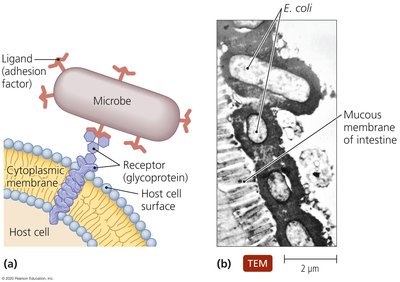
Adhesion is a critical step in the establishment of infection, as it allows pathogens to attach to host cells and resist removal by physical forces.
Adhesion factors: Specialized structures or attachment molecules (adhesins) on the pathogen surface that bind to specific receptors on host cells.
Ligand-receptor interaction: Determines host cell specificity and can influence the range of hosts a pathogen can infect.
Variation in adhesins: Some pathogens can express multiple types of adhesins or alter them to evade the immune system.
Virulence and Pathogenicity
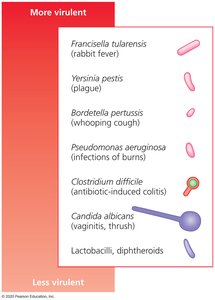
The ability of a microorganism to cause disease is termed pathogenicity, while virulence refers to the degree of pathogenicity. Various factors contribute to a pathogen's virulence.
Pathogenicity: The capacity of a microbe to cause disease.
Virulence: The relative ability of a pathogen to infect a host and cause disease.
Virulence factors: Include adhesion factors, extracellular enzymes, toxins, and antiphagocytic factors.
Virulence Factors: Extracellular Enzymes
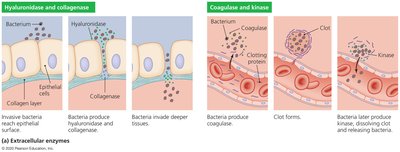
Extracellular enzymes are secreted by pathogens to facilitate invasion and evade host defenses by breaking down host tissues.
Function: Dissolve structural chemicals in the body, aiding in tissue invasion and immune evasion.
Examples: Hyaluronidase, collagenase, coagulase, and kinase.
Virulence Factors: Toxins
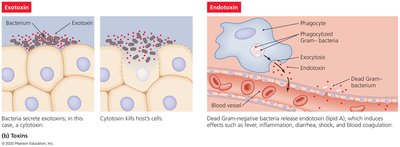
Toxins are chemicals produced by pathogens that damage host tissues or trigger harmful immune responses. They are classified as exotoxins or endotoxins.
Exotoxins: Secreted proteins that target specific host cells (e.g., cytotoxins, neurotoxins, enterotoxins).
Endotoxins: Lipid A component of lipopolysaccharide (LPS) in Gram-negative bacteria, released upon cell death.
Toxemia: The presence of toxins in the bloodstream.
Comparison of Exotoxins and Endotoxins
Feature | Exotoxins | Endotoxins |
|---|---|---|
Source | Mainly Gram-positive and Gram-negative bacteria | Gram-negative bacteria |
Relation to Bacteria | Secreted metabolic product | Lipid A of LPS, released on cell death |
Chemical Nature | Protein or short peptide | Lipid (Lipid A) |
Toxicity | High | Low (may be fatal in high doses) |
Heat Stability | Unstable above 60°C | Stable up to 121°C |
Effect on Host | Variable (cytotoxin, neurotoxin, enterotoxin) | Fever, shock, blood coagulation |
Fever Producing? | No | Yes |
Antigenicity | Strong (stimulates antibody production) | Weak |
Toxoid Formation | Possible (heat/formaldehyde) | Not feasible |
Representative Diseases | Botulism, tetanus, diphtheria, cholera | Typhoid fever, endotoxic shock |
Virulence Factors: Antiphagocytic Factors
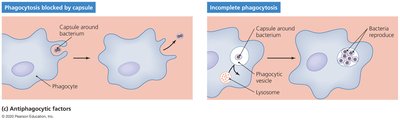
Some pathogens possess mechanisms to evade phagocytosis, allowing them to persist in the host and cause disease.
Bacterial capsule: Prevents recognition and engulfment by phagocytes.
Antiphagocytic chemicals: Inhibit phagocyte function or destroy phagocytes.
The Disease Process
Stages of Infectious Disease
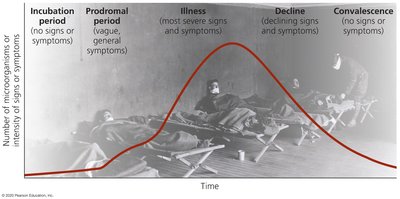
The progression of an infectious disease typically follows several stages, each with characteristic clinical features.
Incubation period: Time between infection and appearance of symptoms.
Prodromal period: Onset of mild, general symptoms.
Illness: Most severe stage, with characteristic signs and symptoms.
Decline: Symptoms subside as the immune response or treatment reduces pathogen numbers.
Convalescence: Recovery and return to normal function.
Manifestations of Disease: Symptoms and Signs
Diseases are characterized by symptoms (subjective experiences reported by the patient) and signs (objective findings observed by clinicians).
Symptoms: Pain, nausea, headache, chills, sore throat, fatigue, malaise, itching, abdominal cramps.
Signs: Swelling, rash, vomiting, diarrhea, fever, pus, anemia, leukocytosis/leukopenia, bubo, tachycardia/bradycardia.
Epidemiology of Disease
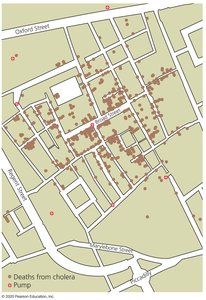
Frequency of Disease: Incidence and Prevalence
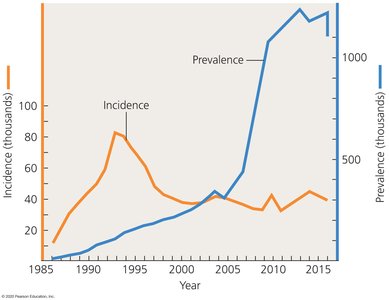
Epidemiologists track disease occurrence using two main measures: incidence and prevalence.
Incidence: Number of new cases in a given area and time period.
Prevalence: Total number of cases (new and existing) in a given area and time period.
Patterns of Disease Occurrence
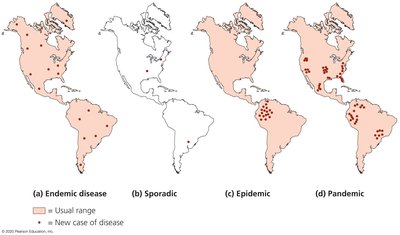
Diseases can occur in populations in different patterns, which are important for public health planning and response.
Endemic: Disease is constantly present in a population.
Sporadic: Disease occurs infrequently and irregularly.
Epidemic: Disease occurs in higher than expected numbers in a population.
Pandemic: An epidemic that spreads across multiple countries or continents.
Epidemiological Studies
Epidemiology uses different study designs to investigate disease patterns, causes, and control measures.
Descriptive epidemiology: Collects and analyzes data on the occurrence, distribution, and spread of disease (who, what, when, where).
Analytical epidemiology: Investigates the causes and risk factors of disease, often using comparison groups.
Experimental epidemiology: Tests hypotheses about disease prevention and treatment through controlled experiments.
Quiz Review: Key Concepts
Pathogens establish infection through adhesion, not by fusing cell walls with host cells (animal cells lack cell walls).
Disease is the term for when a pathogen causes damage to the host, resulting in symptoms and signs.
Endotoxins are only produced by Gram-negative bacteria (component of LPS).
Prevalence refers to the total number of disease cases in an area during a specific time period.
