 Back
BackInfection, Infectious Disease, and Epidemiology: The Human Microbiome and Symbiotic Relationships
Study Guide - Smart Notes
 Tailored notes based on your materials, expanded with key definitions, examples, and context.
Infection, Infectious Disease, and Epidemiology
The Human Microbiome and Microbiota
The human microbiome encompasses all the microorganisms that colonize the human body without normally causing disease. The term microbiota refers specifically to the actual organisms present. These microbes play essential roles in health and disease, and their composition is influenced by various factors.
Resident microbiota: Microbes that are consistently present on or in the body throughout life.
Transient microbiota: Microbes that temporarily colonize the body but do not persist long-term.
Types of Symbiotic Relationships
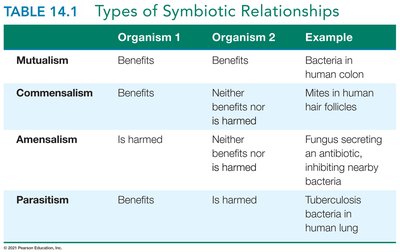
Microorganisms interact with their human host in different types of symbiotic relationships. These relationships can be classified based on the effects on both the microbe and the host.
Type | Organism 1 | Organism 2 | Example |
|---|---|---|---|
Mutualism | Benefits | Benefits | Bacteria in human colon |
Commensalism | Benefits | Neither benefits nor is harmed | Mites in human hair follicles |
Amensalism | Is harmed | Neither benefits nor is harmed | Fungus secreting an antibiotic, inhibiting nearby bacteria |
Parasitism | Benefits | Is harmed | Tuberculosis bacteria in human lung |
Mutualism: Both organisms benefit (e.g., bacteria in the human colon produce vitamins and receive nutrients).
Commensalism: One organism benefits, the other is unaffected (e.g., Staphylococcus epidermidis on skin).
Parasitism: One organism benefits at the expense of the other (e.g., tapeworms in the human colon).
Amensalism: One organism is harmed, the other is unaffected (e.g., antibiotic-producing fungi inhibiting bacteria).
Acquisition of the Human Microbiota
The human body is colonized by microbes shortly after birth. The womb is typically a sterile environment, and colonization begins during and after delivery. The resident microbiota is established within the first few months of life.
During birth: Exposure to maternal microbiota.
First breaths and meals: Introduction of environmental and dietary microbes.
Not in the womb: The fetus is generally free of microorganisms before birth.
Factors Influencing the Microbiome
Several factors can influence the composition and diversity of the human microbiome:
Age
Diet
Physiological state
Lifestyle and antibiotic use
Body site (different regions support different communities)
Distribution of Microbes in the Human Body
The highest density of microbes is found in the gut, particularly the colon. Other body sites, such as the skin, mouth, and urogenital tract, also harbor distinct microbial communities.
Resident and Transient Microbiota
Resident microbiota are long-term inhabitants of the body, while transient microbiota are present only temporarily. Transient microbiota may be removed by the immune system or competition from resident microbes.
Microorganisms that colonize the skin or mucosal surfaces for a limited period are called transient microbiota.
Opportunistic Pathogens
Normal microbiota can become opportunistic pathogens under certain conditions, causing disease when the opportunity arises. Factors that can lead to this include:
Introduction of normal microbiota into an unusual site in the body
Immune suppression
Changes in the normal microbiome (e.g., due to antibiotics)
Stressful or hormonal changes
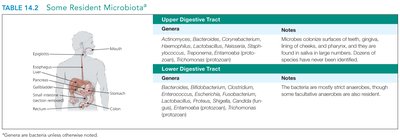
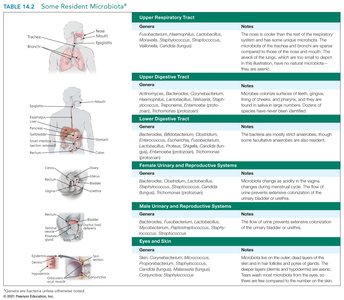
Summary Table: Some Resident Microbiota
The following table summarizes the genera of resident microbiota found in various body sites and their notable characteristics.
Body Site | Genera | Notes |
|---|---|---|
Upper Respiratory Tract | Staphylococcus, Streptococcus, Corynebacterium, Neisseria, Haemophilus, Mycoplasma, Fungi | The nose is cooler than the rest of the respiratory tract; contains unique microbiota. Microbes rarely cause disease unless immune system is compromised. |
Upper Digestive Tract | Actinomyces, Bacteroides, Corynebacterium, Haemophilus, Lactobacillus, Neisseria, Staphylococcus, Treponema, Entamoeba | Microbes colonize surfaces of teeth, gingiva, lining of cheeks, and pharynx. Dozens of species live in large numbers. |
Lower Digestive Tract | Bacteroides, Bifidobacterium, Clostridium, Enterococcus, Escherichia, Lactobacillus, Proteus, Shigella, Candida, Entamoeba, Trichomonas | Bacteria are mostly strict anaerobes, though some facultative anaerobes are also resident. |
Female Urinary and Reproductive Systems | Lactobacillus, Streptococcus, Staphylococcus, Candida | Microbiota changes as acidity in the vagina changes during the menstrual cycle. |
Male Urinary and Reproductive Systems | Staphylococcus, Streptococcus, Corynebacterium | Urine flow prevents colonization except in the distal portion of the urethra. |
Eyes and Skin | Staphylococcus, Corynebacterium, Propionibacterium, Micrococcus, Candida, Malassezia | Microbiota live on the outer dead layers of the skin and in hair follicles and pores; tears wash most away from the eyes. |
Key Concepts and Review Questions
Mutualism is a relationship where both members benefit (e.g., bacteria in the colon).
Humans acquire resident microbiota during birth, first breaths, and first meals, but not in the womb.
Normal microbiota can become opportunistic pathogens due to immune suppression, stress, antibiotics, or hormonal changes.
Transient microbiota are associated with the body for a limited amount of time.
Example: Staphylococcus epidermidis living on human skin is an example of commensalism or mutualism, depending on the context. Bacteria in the human colon typically represent mutualism, while tapeworms in the colon are parasitic.
