Back
Backchapter 14
Study Guide - Smart Notes
 Tailored notes based on your materials, expanded with key definitions, examples, and context.
Symbiotic Relationships Between Microbes and Their Hosts
Types of Symbiotic Relationships
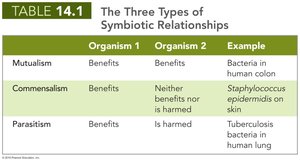
Symbiosis refers to the close association between two different organisms living together. In microbiology, humans have various symbiotic relationships with microorganisms, which can be classified based on the effects on each partner.
Mutualism: Both organisms benefit. Example: Bacteria in the human colon.
Commensalism: One organism benefits, the other is neither helped nor harmed. Example: Staphylococcus epidermidis on skin.
Parasitism: One organism benefits at the expense of the other. Example: Mycobacterium tuberculosis in human lungs.
Normal Microbiota in Hosts
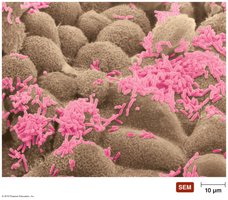
Normal microbiota (also called normal flora or indigenous microbiota) are organisms that colonize the body's surfaces without normally causing disease. They are divided into:
Resident microbiota: Present throughout life, mostly commensal.
Transient microbiota: Remain in the body for a short period due to competition, elimination by body defenses, or changes in the environment.
Acquisition and Opportunism of Normal Microbiota
The fetus is free of microorganisms, but microbiota begin to develop during birth and early life through contact with food, caretakers, and the environment. Normal microbiota can become opportunistic pathogens if introduced to unusual sites, if the immune system is suppressed, or if the balance of microbiota changes.
Reservoirs of Infectious Diseases of Humans
Types of Reservoirs
Reservoirs are sites where pathogens are maintained as sources of infection. They include:
Animal reservoirs: Zoonoses are diseases naturally spread from animal hosts to humans via direct contact, consumption, or vectors.
Human carriers: Asymptomatic individuals can transmit pathogens; some may never develop illness.
Nonliving reservoirs: Soil, water, and food contaminated by feces or urine can harbor pathogens (fecal-oral route).
Portals of Entry
Major Portals of Entry
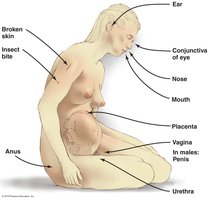
Pathogens enter the body through specific sites called portals of entry. The three major pathways are:
Skin: Pathogens enter through cuts, openings, or by burrowing/digesting outer layers.
Mucous membranes: Line body cavities; respiratory tract is the most common site. Gastrointestinal tract entry requires survival of acidic pH.
Placenta: Usually an effective barrier, but some pathogens can cross and infect the fetus (e.g., Listeria monocytogenes).
Parenteral route: Circumvents usual portals; pathogens are deposited directly into tissues (e.g., via needles, punctures).
The Invasion and Establishment of Microbes in Hosts: Infection
Contamination vs. Infection
Contamination is the mere presence of microbes in or on the body. Infection occurs when an organism evades external defenses, multiplies, and becomes established. Not all contamination leads to infection.
The Role of Adhesion in Infection
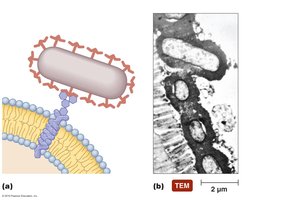
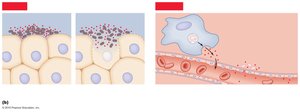
Adhesion is the process by which microorganisms attach to host cells, a critical step for colonization and infection. Microbes use adhesion factors such as attachment proteins (ligands) to bind to host cell receptors, determining host specificity. Some bacteria form biofilms for collective attachment.
The Nature of Infectious Disease
Manifestations of Disease: Symptoms, Signs, and Syndromes
Symptoms: Subjective characteristics felt by the patient (e.g., nausea, headache).
Signs: Objective manifestations observed by others (e.g., vomiting, rash).
Syndrome: A group of symptoms and signs that characterize a disease (e.g., AIDS).
Causation of Disease: Etiology and Koch's Postulates
Etiology is the study of the cause of disease. Koch's postulates are a series of criteria used to establish a causative relationship between a microbe and a disease:
The suspected agent must be present in every case of the disease.
The agent must be isolated and grown in pure culture.
The cultured agent must cause the disease when inoculated into a healthy host.
The same agent must be reisolated from the diseased experimental host.
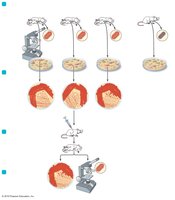
Exceptions exist, such as pathogens that cannot be cultured or diseases caused by multiple agents.
Virulence Factors of Infectious Agents
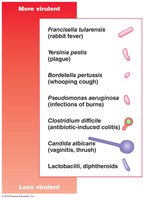
Pathogenicity is the ability to cause disease; virulence is the degree of pathogenicity. Virulence factors include:
Adhesion factors
Biofilms
Extracellular enzymes
Toxins
Antiphagocytic factors
Extracellular Enzymes
Secreted enzymes help pathogens invade host tissues by dissolving structural chemicals. Mutants lacking these enzymes are often avirulent.
Toxins
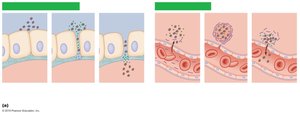
Toxins are chemicals that harm tissues or trigger damaging immune responses. Toxemia is the presence of toxins in the bloodstream. There are two main types:
Exotoxins: Secreted proteins causing specific damage (e.g., cytotoxins, neurotoxins, enterotoxins, hemolysins).
Endotoxins: Lipid A component of Gram-negative bacterial LPS, released upon cell death, causing systemic effects like fever and shock.
Feature | Exotoxins | Endotoxins |
|---|---|---|
Source | Mainly Gram-positive and some Gram-negative bacteria | Gram-negative bacteria |
Chemical Nature | Protein | Lipid A of LPS |
Toxicity | High | Low |
Fever Producing | No | Yes |
Immunogenicity | Strong | Weak |
*Additional info: Table inferred from image_9 and academic context.
Antiphagocytic Factors
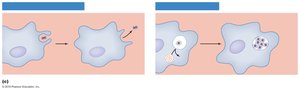
These factors help pathogens evade phagocytosis by host immune cells, allowing prolonged infection. Mechanisms include capsules (unrecognizable or slippery), chemicals that prevent lysosome fusion, and leukocidins that destroy white blood cells.
The Stages of Infectious Disease
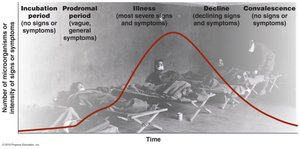
The progression of infectious disease typically follows these stages:
Incubation period: No signs or symptoms; pathogen is multiplying.
Prodromal period: Mild, general symptoms.
Illness: Most severe signs and symptoms.
Decline: Declining signs and symptoms as immune response mounts.
Convalescence: Recovery; no signs or symptoms.
Disease | Incubation Period |
|---|---|
Staphylococcus foodborne infection | <1 day |
Influenza | About 1 day |
Cholera | 2 to 3 days |
Genital herpes | About 5 days |
Tetanus | 5 to 15 days |
Syphilis | 10 to 21 days |
Hepatitis B | 70 to 100 days |
AIDS | 1 to >8 years |
Leprosy | 10 to >30 years |
*Additional info: Table inferred from image_12 and academic context.
The Movement of Pathogens Out of Hosts: Portals of Exit
Pathogens exit the host through portals of exit, often the same as portals of entry, in materials the body secretes or excretes (e.g., respiratory droplets, feces, urine).
Modes of Infectious Disease Transmission
Contact Transmission
Direct contact: Physical interaction between hosts.
Indirect contact: Via fomites (inanimate objects).
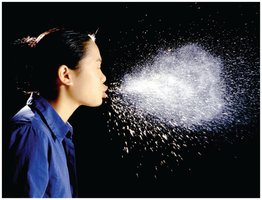
Droplet transmission: Via droplets of mucus from exhaling, coughing, or sneezing.
Vehicle Transmission
Airborne transmission: Pathogens travel more than 1 meter via aerosols (e.g., sneezing, air-conditioning).
Waterborne transmission: Spread via contaminated water, often fecal-oral route.
Foodborne transmission: Spread via contaminated, undercooked, or unrefrigerated foods.
Bodily fluid transmission: Blood, urine, saliva, etc., especially via breaks in skin or mucous membranes.

Vector Transmission
Biological vectors: Animals (e.g., mosquitoes, ticks) that transmit and host pathogens.
Mechanical vectors: Animals (e.g., houseflies) that passively carry pathogens on their bodies.
Epidemiology of Infectious Diseases
Frequency of Disease
Epidemiologists measure disease occurrence using:
Incidence: Number of new cases in a given area and time.
Prevalence: Total number of cases in a given area and time.
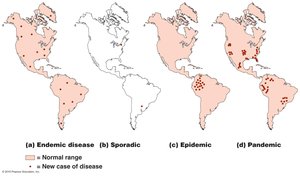
Occurrence is also described by geographic distribution:
Endemic: Disease normally present in a population.
Sporadic: Few cases occur irregularly.
Epidemic: Disease occurs with greater frequency than usual.
Pandemic: Disease crosses continents.
Epidemiological Studies
Descriptive epidemiology: Records location, date, and patient information to identify the index case.
Analytical epidemiology: Determines probable cause, mode of transmission, and prevention.
Experimental epidemiology: Tests hypotheses, often using Koch's postulates.
Hospital Epidemiology: Healthcare Associated (Nosocomial) Infections
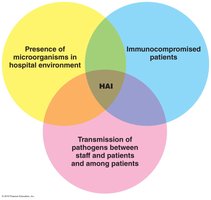
Healthcare-associated infections (HAIs) are acquired in healthcare settings. Types include:
Exogenous: Pathogen acquired from the healthcare environment.
Endogenous: Pathogen arises from normal microbiota due to factors in the healthcare setting.
Iatrogenic: Result from medical procedures.
Superinfections: Result from antimicrobial use reducing competition among microbiota.