 Back
BackInfection, Infectious Diseases, and Epidemiology: Core Concepts and Mechanisms
Study Guide - Smart Notes
 Tailored notes based on your materials, expanded with key definitions, examples, and context.
Infection and Epidemiology
Key Terminology in Infectious Disease
Understanding the language of infectious disease is foundational for microbiology. The following terms are essential:
Pathology: The study of disease.
Etiology: The study of the cause of a disease.
Pathogenesis: The development of disease.
Infection: Colonization of the body by pathogens.
Disease: An abnormal state in which the body is not functioning normally.
Symbiosis and Microbial Relationships
Symbiosis refers to the close association between two different organisms. Types include:
Mutualism: Both organisms benefit (e.g., bees and flowering plants).
Commensalism: One benefits, the other is unaffected (e.g., barnacles on whales).
Amensalism: One is harmed, the other is unaffected (e.g., large tree shading smaller plants).
Parasitism: One benefits (parasite), the other is harmed (host) (e.g., ticks on dogs).
Human Microbiome and Normal Microbiota
Types and Roles of Microbiota
The microbiome consists of organisms colonizing the body without causing disease, also called normal microbiota or flora. Two main types:
Resident microbiota: Permanent residents, mostly commensal, found on skin, eyes, respiratory tract, digestive tract, and reproductive systems.
Transient microbiota: Present temporarily; eliminated by competition, immune defenses, or body changes.
Examples of Resident Microbiota:
Skin/Eyes: Corynebacterium, Micrococcus, Staphylococcus, Candida (fungus)
Upper Respiratory Tract: Fusobacterium, Haemophilus, Streptococcus, Candida
Digestive Tract: Bacteroides, Escherichia, Lactobacillus, Clostridium
Reproductive Systems: Lactobacillus, Staphylococcus, Mycobacterium
Establishment and Disruption of Microbiota
Microbiome develops during birth and early life.
Normal microbiota can become opportunistic pathogens if introduced to unusual sites, during immune suppression, or after disruption (e.g., antibiotics).
Microbial antagonism: Normal microbiota compete with pathogens, protecting the host.
Probiotics: Live microbes ingested for beneficial effects.
Terminology of Disease
Common Prefixes and Suffixes
-itis: Inflammation (e.g., dermatitis – skin inflammation)
-emia: In the blood (e.g., viremia – viruses in blood)
-oma: Tumor or swelling (e.g., papilloma – wart)
-osis: Condition of (e.g., toxoplasmosis)
-patho: Disease or abnormal (e.g., pathology)
Carcino-: Cancer (e.g., carcinogenic)
Hepat-: Liver (e.g., hepatitis)
Etiology and Causation of Disease
Categories of Disease Causes
Hereditary: Genetic errors (e.g., sickle-cell anemia)
Congenital: Structural/functional defects present at birth
Degenerative: Result from aging (e.g., renal failure)
Nutritional: Lack of essential nutrients (e.g., rickets)
Mental: Emotional or psychosomatic (e.g., skin rash)
Immunological: Immune dysfunction (e.g., allergies)
Neoplastic: Abnormal cell growth (e.g., cancer)
Endocrine: Hormonal imbalances (e.g., Addison’s disease)
Categories of Diseases:
Infectious: Caused by infectious agents (e.g., influenza)
Iatrogenic: Result from medical procedures
Idiopathic: Unknown cause
Nosocomial: Acquired in healthcare settings
Koch’s Postulates
Steps to Establish Disease Causation
The microorganism must be present in every case of the disease.
It must be isolated and grown in pure culture.
The cultured microorganism must cause disease when introduced into a healthy host.
It must be re-isolated from the experimentally infected host and identified as identical to the original.
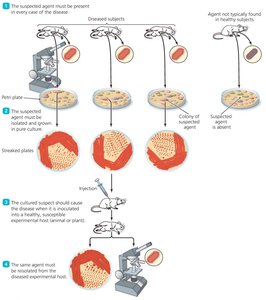
Exceptions: Some pathogens cannot be cultured, require human hosts, or involve multiple agents.
Reservoirs of Infectious Diseases
Types of Reservoirs
Animal reservoirs (zoonoses): Diseases naturally spread from animals to humans (e.g., rabies, Lyme disease).
Human carriers: Asymptomatic but infectious individuals (e.g., Typhoid Mary).
Nonliving reservoirs: Soil, water, and food (e.g., botulism, cholera).
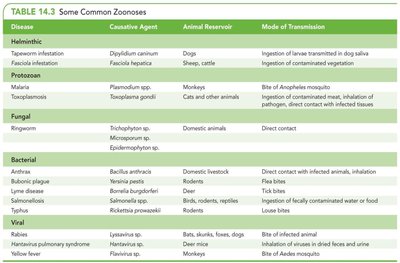
Classifying Infectious Diseases
Modes of Transmission
Communicable: Spread from host to host (e.g., tuberculosis).
Contagious: Easily spread (e.g., measles, influenza).
Noncommunicable: Not spread between hosts (e.g., tetanus).
Occurrence Patterns
Endemic: Constantly present (e.g., common cold).
Epidemic: Many cases in a short time (e.g., polio).
Pandemic: Worldwide epidemic (e.g., AIDS).
Sporadic: Occasional cases.
Herd immunity: Immunity in most of a population.
Severity and Duration
Acute: Rapid onset (e.g., influenza).
Chronic: Slow development (e.g., tuberculosis).
Subacute: Intermediate symptoms.
Latent: Inactive for a period (e.g., herpes).
Extent of Host Involvement
Local infection: Limited area (e.g., boils).
Systemic infection: Throughout body (e.g., gangrene).
Focal infection: Starts local, spreads systemically.
Sepsis: Toxic inflammatory response to infection.
Bacteremia: Bacteria in blood.
Septicemia: Bacterial growth in blood.
Toxemia: Toxins in blood.
Viremia: Viruses in blood.
Primary infection: Initial illness.
Secondary infection: Follows primary infection (e.g., pneumonia after influenza).
Subclinical disease: No noticeable symptoms.
Stages of Infectious Disease
Infectious diseases progress through several stages:
Incubation period: Time between infection and first symptoms.
Prodromal period: Early, mild symptoms.
Period of illness: Most severe symptoms.
Period of decline: Symptoms subside.
Period of convalescence: Recovery and return to health.
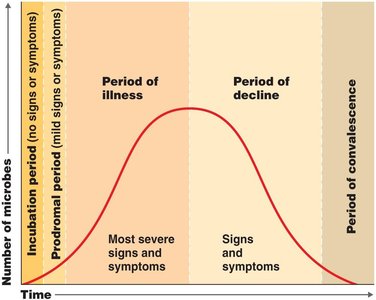
Portals of Entry and Infection
Major Portals of Entry
Skin: Entry through cuts, wounds, or direct penetration.
Mucous membranes: Respiratory, gastrointestinal, and urogenital tracts.
Placenta: Pathogens may cross to infect fetus.
Parenteral route: Circumvents usual portals (e.g., injections, bites).
Nature of Infectious Disease
Symptoms: Subjective effects felt by patient.
Signs: Objective evidence observed by others.
Syndrome: Group of symptoms and signs characteristic of a disease.
Asymptomatic (subclinical): No symptoms, but signs may be present.
Virulence Factors of Infectious Agents
Pathogenicity and Virulence
Pathogenicity: Ability to cause disease.
Virulence: Degree of pathogenicity; determined by virulence factors.
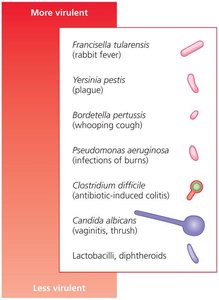
Major Virulence Factors
Adhesion factors: Enable attachment to host cells (e.g., ligands, biofilms).
Extracellular enzymes: Break down host tissues, aiding invasion.
Toxins: Harm host tissues or trigger damaging immune responses.
Antiphagocytic factors: Prevent destruction by host immune cells (e.g., capsules, leukocidins).
Types of Toxins:
Exotoxins: Secreted proteins (both Gram-positive and Gram-negative bacteria).
Endotoxins: Lipid A of LPS in Gram-negative bacteria.
Transmission of Infectious Diseases
Modes of Transmission
Contact transmission: Direct (person-to-person), indirect (fomites), or droplet (coughing, sneezing).
Vehicle transmission: Airborne (aerosols), waterborne (fecal-oral), foodborne, or via bodily fluids.
Vector transmission: Biological (bites, life cycle in vector) or mechanical (carried on body parts).
Disease Classification and Epidemiology
Measuring Disease Frequency
Incidence: Number of new cases in a given area and time.
Prevalence: Total number of cases in a given area and time.
Types of Epidemiological Studies
Descriptive: Tabulation of data, identification of index case.
Analytical: Determines cause, transmission, and prevention; often retrospective.
Experimental: Tests hypotheses, applies Koch’s postulates.
Public Health and Disease Control
Agencies (e.g., CDC, WHO) monitor and control disease spread.
Efforts include sanitation, immunization, vector control, and public education.
Healthcare-Associated (Nosocomial) Infections
Types and Control
Exogenous: Acquired from healthcare environment.
Endogenous: Arise from patient’s own microbiota.
Iatrogenic: Result from medical procedures.
Superinfections: Result from antimicrobial use disrupting normal flora.
Control: Aggressive hygiene, especially handwashing, is most effective.
