 Back
BackInfection, Infectious Diseases, and Epidemiology: Microbial Interactions and Host Invasion
Study Guide - Smart Notes
 Tailored notes based on your materials, expanded with key definitions, examples, and context.
Symbiotic Relationships Between Microbes and Their Hosts
Types of Symbiosis
Symbiosis refers to the close and long-term biological interaction between two different biological organisms. In the context of microbiology, humans maintain various symbiotic relationships with microorganisms, which can be classified as follows:
Mutualism: Both organisms benefit from the relationship.
Commensalism: One organism benefits, while the other is neither helped nor harmed.
Amensalism: One organism is harmed while the other is unaffected.
Parasitism: One organism benefits at the expense of the other.
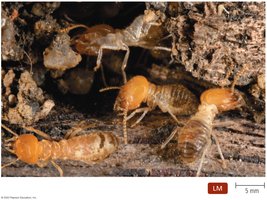
Example: Termites and their gut protozoa exhibit mutualism, where protozoa digest cellulose for the termite, and in return, receive a habitat and nutrients.
Normal Microbiota of Humans
The microbiome of humans consists of all the microorganisms that colonize the body's surfaces without normally causing disease. These are also known as normal microbiota, normal flora, or indigenous microbiota. There are two main types:
Resident microbiota: Remain a part of the normal microbiota throughout life and are mostly commensal.
Transient microbiota: Remain in the body for a short period and cannot persist due to competition, elimination by body defenses, or chemical/physical changes.
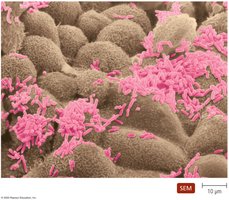
Example: The surface of the human tongue is colonized by various bacteria, as seen in scanning electron micrographs.
Distribution of Resident Microbiota
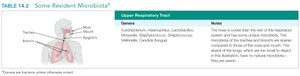
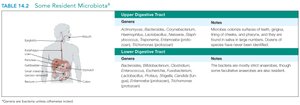
Resident microbiota are distributed throughout various regions of the body. The following tables summarize the main genera and notes for each region:
Region | Genera | Notes |
|---|---|---|
Upper Respiratory Tract | Fusobacterium, Haemophilus, Lactobacillus, Moraxella, Staphylococcus, Streptococcus, Mycobacteria, Candida (fungus) | The nose is cooler than the rest of the respiratory system and has distinct microbiota. The microbiota of the trachea and bronchi are similar to those of the nose and mouth. The alveoli of the lungs are usually axenic (free of microbes), but can be colonized in disease. |
Region | Genera | Notes |
|---|---|---|
Upper Digestive Tract | Actinomyces, Bacteroides, Corynebacterium, Haemophilus, Lactobacillus, Moraxella, Neisseria, Streptococcus, Treponema, Candida (fungus), Entamoeba (protozoan) | Microbiota colonize surfaces of teeth, gingiva, lining of cheeks, and pharynx; they are found in saliva in large numbers. Densities of species are highest where teeth and gums meet. |
Lower Digestive Tract | Bacteroides, Bifidobacterium, Clostridium, Enterococcus, Escherichia, Lactobacillus, Proteus, Klebsiella, Peptostreptococcus, Staphylococcus, Streptococcus, Candida (fungus), Trichomonas (protozoan) | The lower bowel is mostly anaerobic, though some facultative anaerobes are also present. |
Region | Genera | Notes |
|---|---|---|
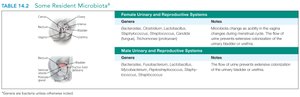
Female Urinary and Reproductive Systems | Lactobacillus, Candida (fungus), Trichomonas (protozoan) | Microbiota change as activity in the vagina changes during menstrual cycles. The flow of urine prevents extensive colonization of the urinary bladder or urethra. |
Male Urinary and Reproductive Systems | Lactobacillus, Mycobacterium, Peptostreptococcus, Staphylococcus, Streptococcus | The flow of urine prevents extensive colonization of the urinary bladder or urethra. |
Region | Genera | Notes |
|---|---|---|
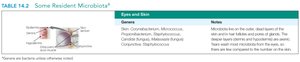
Eyes and Skin | Corynebacterium, Micrococcus, Propionibacterium, Staphylococcus, Candida (fungus), Malassezia (fungus), Streptococcus | Microbiota live on the outer, dead layers of the skin and in hair follicles and pores of glands. The deeper layers (dermis and hypodermis) are axenic, except when broken by cuts or wounds. |
Acquisition and Changes in the Microbiome
Humans develop their microbiome after birth, as the womb is typically free of microorganisms. The microbiome is established during the birthing process and continues to develop in the first months of life. Changes in the microbiome can occur due to immune suppression, introduction of microbiota into unusual sites, or stressful conditions, potentially leading to opportunistic infections.
Reservoirs of Infectious Diseases of Humans
Types of Reservoirs
Pathogens require reservoirs to survive outside their host. There are three main types:
Animal reservoirs: Diseases that naturally spread from animal hosts to humans are called zoonoses. Transmission can occur via direct contact, consumption, or vectors such as arthropods. Humans are often dead-end hosts for zoonotic pathogens.
Human carriers: Asymptomatic individuals can transmit pathogens to others. Some carriers never develop illness due to effective immune responses.
Nonliving reservoirs: Soil, water, and food can harbor pathogens, often due to contamination by feces or urine.
The Invasion and Establishment of Microbes in Hosts: Infection
Contamination vs. Infection
Contamination: The mere presence of microbes in or on the body.
Infection: Occurs when an organism evades the body's external defenses, multiplies, and becomes established in the body.
Portals of Entry
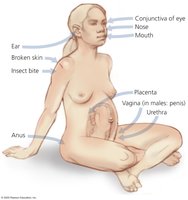
Pathogens enter the body through specific sites known as portals of entry. The three major pathways are:
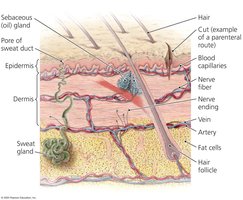
Skin: Acts as a barrier, but pathogens can enter through cuts, openings, or by burrowing/digesting the outer layers.
Mucous membranes: Line body cavities open to the environment, such as the respiratory and gastrointestinal tracts. The respiratory tract is the most common entry site.
Placenta: Usually an effective barrier, but some pathogens can cross and infect the fetus, causing serious outcomes.
Parenteral route: Not a true portal, but refers to pathogens being deposited directly into tissues beneath the skin or mucous membranes (e.g., via punctures).
The Role of Adhesion in Infection
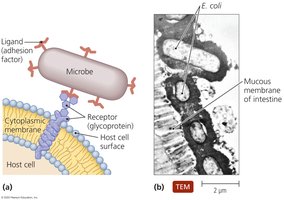
Adhesion is the process by which microorganisms attach themselves to host cells, a critical step for colonization and infection. This process involves:
Adhesion factors: Specialized structures or attachment molecules (e.g., ligands, adhesins) that bind to host cell receptors.
Host specificity: The interaction between microbial ligands and host receptors determines which cells can be infected.
Biofilm formation: Some bacteria attach to each other and surfaces, forming biofilms that enhance colonization and resistance.
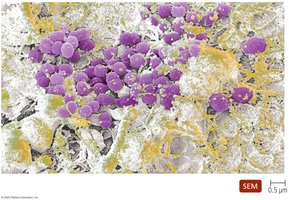
Example: Dental plaque is a biofilm formed by bacteria adhering to the surface of teeth, demonstrating the importance of adhesion in microbial colonization.
