 Back
Infection, Infectious Diseases, and Epidemiology: Microbiology Study Notes
Study Guide - Smart Notes
 Tailored notes based on your materials, expanded with key definitions, examples, and context.
Symbiotic Relationships Between Microbes and Their Hosts
Types of Symbiosis
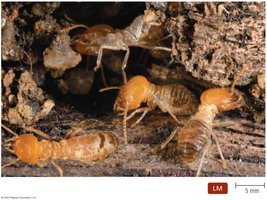
Symbiosis refers to the interaction between two different organisms living in close physical association. In microbiology, humans have symbiotic relationships with numerous microorganisms, which can be classified as follows:
Mutualism: Both organisms benefit from the relationship.
Commensalism: One organism benefits, while the other is neither helped nor harmed.
Amensalism: One organism is harmed, while the other is unaffected.
Parasitism: One organism benefits at the expense of the other.
Microbiome of Humans
Normal Microbiota
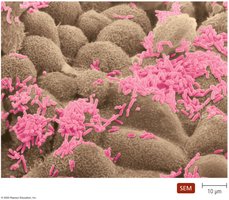
The human microbiome consists of organisms that colonize the body’s surfaces without causing disease under normal circumstances. These are also known as normal microbiota, normal flora, or indigenous microbiota. There are two main types:
Resident microbiota: Present throughout life and are mostly commensal.
Transient microbiota: Present for a short period; eliminated by competition, body defenses, or changes in the body.
Distribution of Resident Microbiota
Resident microbiota are found in various regions of the body. The following tables summarize their locations and representative genera:
Region | Genera | Notes |
|---|---|---|
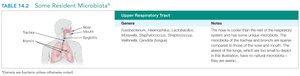
Upper Respiratory Tract | Fusobacterium, Haemophilus, Lactobacillus, Neisseria, Staphylococcus, Streptococcus, Moraxella, Candida (fungus) | The nose is cooler than the rest of the respiratory system and has distinct microbiota. The microbiota of the trachea and bronchi are similar to those of the nose and mouth. The alveoli of the lungs are sterile. |
Region | Genera | Notes |
|---|---|---|
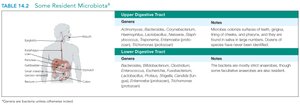
Upper Digestive Tract | Actinomyces, Bacteroides, Corynebacterium, Haemophilus, Lactobacillus, Moraxella, Staphylococcus, Treponema, Entamoeba (protozoan), Neisseria | Microbiota colonize surfaces of teeth, gums, lining of cheeks, palate, and they are found in saliva and tongue. Densities of species are higher near teeth surfaces. |
Lower Digestive Tract | Bacteroides, Clostridium, Enterococcus, Lactobacillus, Proteus, Escherichia, Shigella, Candida (fungus), Trichomonas (protozoan) | The lower bowel hosts many microbiota, though some bacteria are present in small numbers. |
Region | Genera | Notes |
|---|---|---|
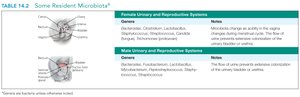
Female Urinary and Reproductive Systems | Bacteroides, Clostridium, Lactobacillus, Staphylococcus, Streptococcus, Candida (fungus), Trichomonas (protozoan) | Microbiota change as activity in the vagina changes during menstrual cycles. The flow of urine prevents colonization of the urinary bladder or urethra. |
Male Urinary and Reproductive Systems | Bacteroides, Pseudomonas, Lactobacillus, Proteus, Streptococcus, Staphylococcus | The flow of urine prevents extensive colonization of the urinary bladder or urethra. |
Region | Genera | Notes |
|---|---|---|
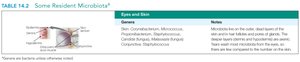
Eye and Skin | Skin: Corynebacterium, Micrococcus, Propionibacterium, Staphylococcus, Candida (fungus), Malassezia (fungus); Conjunctiva: Staphylococcus | Microbiota live on the outer, dead layers of the skin and hair follicles and pores of glands. The deeper layers, muscles, and glands are sterile. Tears contain chemicals that limit the growth of microbes on the eye surface. |
Reservoirs of Infectious Diseases
Types of Reservoirs
Pathogens require reservoirs to survive outside their host. There are three main types:
Animal reservoir: Pathogens maintained in animals; zoonoses are diseases naturally spread from animals to humans.
Human carriers: Asymptomatic individuals who can transmit pathogens.
Nonliving reservoir: Soil, water, and food contaminated by feces or urine.
The Invasion and Establishment of Microbes in Hosts: Infection
Exposure to Microbes: Contamination and Infection
Contamination is the presence of microbes on or in the body. Infection occurs when microbes evade external defenses, multiply, and become established.
Portals of Entry
Pathogens enter the body through specific sites:
Skin: Acts as a barrier; pathogens may enter through cuts or by burrowing.
Mucous membranes: Line body cavities; respiratory tract is the most common entry site.
Placenta: Usually a barrier, but some pathogens can cross and infect the fetus.
The Nature of Infectious Disease
Manifestations of Disease: Symptoms, Signs, and Syndromes
Infection is the invasion of the host by a pathogen. Disease (morbidity) results if normal body functions are altered. Manifestations include:
Symptoms: Subjective characteristics felt by the patient.
Signs: Objective manifestations observed or measured by others.
Syndrome: A group of symptoms and signs that characterize a disease.
Asymptomatic (subclinical) infections: Lack symptoms but may have signs.
Causation of Disease: Etiology
Etiology is the study of the cause of disease. Diseases may have multiple causes and can be classified by their origin.
Virulence Factors of Infectious Agents
Virulence factors are characteristics that enable pathogens to cause disease. These include:
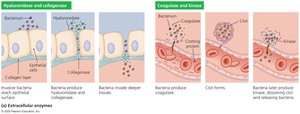
Extracellular enzymes: Secreted by pathogens to dissolve structural chemicals and aid invasion.
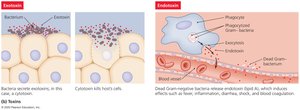
Toxins: Chemicals that harm tissues or trigger damaging immune responses. Toxemia is the presence of toxins in the bloodstream. Two types: Exotoxins (secreted) and Endotoxins (released from dead Gram-negative bacteria).
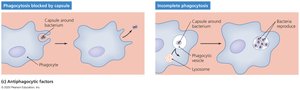
Antiphagocytic factors: Prevent phagocytosis by host cells, allowing pathogens to persist.
The Stages of Infectious Disease
Progression of Disease
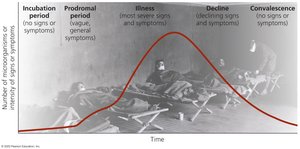
Infectious diseases typically progress through five stages:
Incubation period: No signs or symptoms.
Prodromal period: Mild, vague symptoms.
Illness: Most severe signs and symptoms.
Decline: Signs and symptoms begin to subside.
Convalescence: Recovery; no signs or symptoms.
The Movement of Pathogens Out of Hosts: Portals of Exit
Portals of Exit
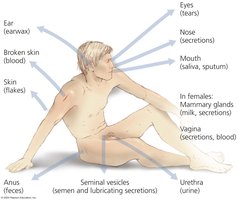
Pathogens leave the host through specific portals, often the same as entry sites. They are typically expelled in secretions or excretions.
Modes of Infectious Disease Transmission
Transmission Pathways
Transmission occurs from a reservoir or portal of exit to another host’s portal of entry. The main modes are:
Contact transmission: Direct, indirect, or droplet contact.
Vehicle transmission: Via air, water, or food.
Vector transmission: Biological (e.g., mosquitoes) or mechanical (e.g., flies).
Classification of Infectious Diseases
Methods of Classification
Diseases can be classified by taxonomic category, affected body system, longevity and severity, mode of transmission, and population effects.
Epidemiology of Infectious Diseases
Epidemiological Studies
Epidemiology is the study of disease occurrence and spread. Types of studies include:
Descriptive epidemiology: Tabulation of data, recording location and time, collecting patient information, and identifying the index case.
Nationally Notifiable Infectious Diseases
Certain diseases must be reported to health authorities. Examples include anthrax, botulism, cholera, dengue, hepatitis, HIV/AIDS, influenza, malaria, measles, tuberculosis, and many others.
Hospital Epidemiology: Healthcare-Associated (Nosocomial) Infections
Healthcare-associated infections are acquired in medical settings. Types include:
Exogenous: Pathogen acquired from the healthcare environment.
Endogenous: Pathogen arises from normal microbiota within the patient.
Iatrogenic: Results from medical procedures.
Superinfections: Antimicrobial drugs inhibit some resident microbiota, allowing others to thrive.
Epidemiology and Public Health
Public health agencies work to limit disease transmission by enforcing cleanliness, reducing vectors and reservoirs, establishing immunization schedules, treating exposed individuals, and implementing isolation and quarantine measures. Education campaigns are essential for controlling diseases transmitted sexually and through the air.
Additional info: The notes above expand on brief points with academic context, definitions, and examples to ensure completeness and clarity for exam preparation.
