 Back
BackInnate Immune System: Structure, Function, and Mechanisms
Study Guide - Smart Notes
 Tailored notes based on your materials, expanded with key definitions, examples, and context.
Innate Immune System
General Purpose, Components, and Organization
The innate immune system is the body's first line of defense against invading pathogens. It provides immediate, non-specific responses to a wide variety of threats, including bacteria, viruses, fungi, and parasites. Unlike the adaptive immune system, the innate system does not require prior exposure to a pathogen to mount a response and does not generate immunological memory.
Physical barriers: Skin, mucous membranes, cilia, tears, and sebum prevent pathogen entry.
Chemical barriers: Acidic pH, enzymes (e.g., lysozyme, pepsin), bile, and antimicrobial peptides (defensins) destroy or inhibit microbes.
Biological barriers: Normal flora outcompete pathogens for resources and space.
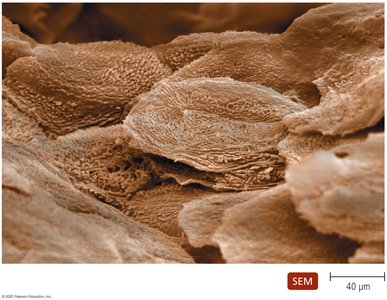
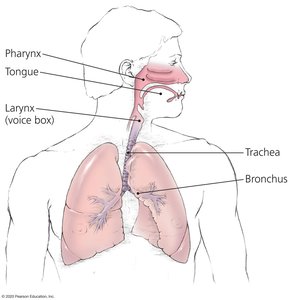
The innate immune system is organized into several key components: physical and chemical barriers, cellular defenses (e.g., phagocytes, natural killer cells), and soluble factors (e.g., complement proteins, cytokines).
Comparison of Innate and Adaptive Immune Systems
Innate Immunity: Immediate, non-specific, no memory, uses pattern recognition, and is always present.
Adaptive Immunity: Delayed (3-5 days), highly specific, generates memory, and requires prior exposure for a robust response.
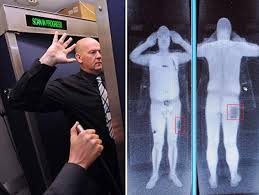
Analogy: Innate immunity is like airport security (general screening), while adaptive immunity is like the FBI (specific investigation).

Detection and Recognition of Pathogens
The innate immune system detects pathogens using pattern recognition receptors (PRRs) that bind to pathogen-associated molecular patterns (PAMPs). PAMPs are conserved molecular structures found in microbes but not in host cells.
Cellular PRRs: Located on immune cells (e.g., macrophages, dendritic cells) and stromal cells.
Soluble PRRs: Circulating proteins such as complement that bind pathogens and trigger immune responses.

Examples of PAMPs and PRRs
Toll-like receptors (TLRs): Recognize bacterial lipopolysaccharide (LPS), flagellin, viral RNA, and other microbial molecules.
NOD-like receptors (NLRs): Detect intracellular pathogens.
TLR | PAMP (Microbial Molecule) |
|---|---|
TLR1 | Bacterial lipopeptides and certain proteins in multicellular parasites |
TLR2 | Peptidoglycan, lipoteichoic acid (Gram-positive cell wall), yeast cell wall |
TLR4 | Lipid A in LPS (Gram-negative bacteria) |
TLR5 | Flagellin (bacterial flagella) |
TLR3 | Double-stranded RNA (viruses) |
TLR7/8 | Single-stranded viral RNA |
TLR9 | Unmethylated CpG DNA (bacteria, viruses) |

Series of Events in Innate Immune Responses
Innate immune responses follow a characteristic sequence:
Recognition: Detection of pathogens by PRRs.
Alarm: Release of cytokines and chemokines to activate and recruit immune cells.
Inflammation: Vasodilation, increased permeability, and recruitment of white blood cells (WBCs) to the site of infection.
Innate Cell Recruitment: Neutrophils, macrophages, natural killer cells, and others migrate to the infection site.
Effector Functions: Phagocytosis, cytotoxicity, production of reactive oxygen species, antimicrobial peptides, and destructive enzymes.

Physical and Chemical Barriers: The First Line of Defense
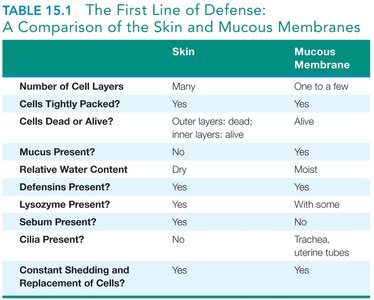
Physical and chemical barriers are the body's initial defense against pathogens. The skin and mucous membranes provide structural and biochemical protection.
Skin | Mucous Membrane | |
|---|---|---|
Number of Cell Layers | Many | One to a few |
Cells Tightly Packed? | Yes | Yes |
Cells Dead or Alive? | Outer layers: dead; inner layers: alive | Alive |
Mucus Present? | No | Yes |
Relative Water Content | Dry | Moist |
Lysozyme Present? | Yes | With some |
Defensins Present? | Yes | Yes |
Sebum Present? | Yes | No |
Cilia Present? | No | Trachea, uterine tubes |
Constant Shedding and Replacement of Cells? | Yes | Yes |
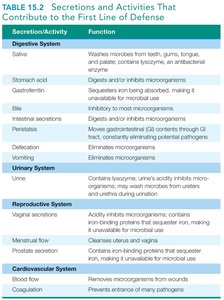
Secretions and Activities Contributing to the First Line of Defense
Secretion/Activity | Function |
|---|---|
Saliva | Washes microbes from teeth, gums, tongue; contains lysozyme |
Stomach acid | Digests and/or inhibits microorganisms |
Bile | Inhibitory to most microorganisms |
Defecation/Vomiting | Eliminates microorganisms |
Urine | Contains lysozyme, acidity inhibits microorganisms |
Vaginal secretions | Acidity inhibits microorganisms |
Menstrual flow | Cleanses uterus and vagina |
Blood flow | Removes microorganisms from wounds |
Coagulation | Prevents entrance of many pathogens |
The Complement System
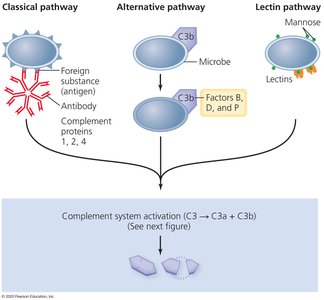
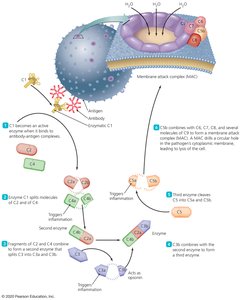
The complement system is a group of serum proteins that are activated in a cascade to fight infections. It can be triggered by three pathways:
Classical pathway: Initiated by antibodies bound to microbes.
Alternative pathway: Triggered directly by microbial surfaces.
Lectin pathway: Initiated by lectin binding to microbial carbohydrates.
Activation leads to the formation of the membrane attack complex (MAC), which creates pores in pathogen membranes, leading to cell lysis. Complement also tags pathogens for phagocytosis (opsonization) and recruits immune cells.
Inflammation and Cell Recruitment
Inflammation is a hallmark of innate immunity, characterized by heat (calor), pain (dolor), redness (rubor), and swelling (tumor). It is triggered by cytokines and chemokines released from immune and stromal cells.
Vasodilation: Increases blood flow to the affected area.
Increased permeability: Allows immune cells and proteins to enter tissues.
Extravasation: Movement of white blood cells from blood to tissues.

Innate Effector Functions
Effector functions of the innate immune system include:
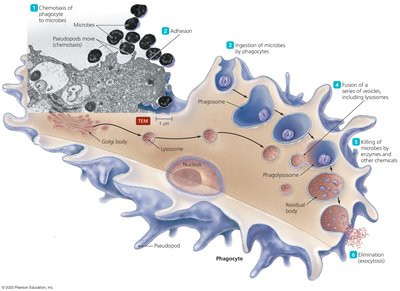
Phagocytosis: Engulfment and destruction of pathogens by macrophages, neutrophils, and dendritic cells.
Cytotoxicity: Killing of infected or abnormal cells by natural killer (NK) cells.
Production of reactive oxygen species (ROS): Toxic molecules that destroy pathogens.
Release of antimicrobial peptides and enzymes: Directly damage or kill microbes.

Cellular Components of Innate Immunity
Granulocytes: Neutrophils (phagocytosis, pus formation), basophils/mast cells (allergic reactions, histamine release), eosinophils (allergy, parasite defense).
Monocytes/Macrophages: Circulate in blood, mature in tissues, key phagocytes, long-lived.
Dendritic Cells: Professional antigen-presenting cells, bridge innate and adaptive immunity.
Lymphocytes: B cells (antibody production), T cells (helper and cytotoxic functions), NK cells (innate cytotoxicity).
The Lymphatic System and Hematopoiesis
The lymphatic system drains excess fluid and proteins from tissues, returning them to the blood. It includes primary lymphoid organs (bone marrow, thymus) where lymphocytes mature, and secondary lymphoid organs (lymph nodes, spleen, MALT) where immune responses are initiated.
Lymph nodes: Sites for immune cell interaction and activation.
Hematopoiesis: Formation of blood cells from pluripotent stem cells in bone marrow.
Summary Table: Key Differences Between Innate and Adaptive Immunity
Feature | Innate Immunity | Adaptive Immunity |
|---|---|---|
Specificity | Non-specific (pattern recognition) | Highly specific (antigen recognition) |
Response Time | Immediate (minutes to hours) | Delayed (days) |
Memory | None | Present |
Major Components | Barriers, phagocytes, NK cells, complement | B cells, T cells, antibodies |
Additional info: The innate immune system is essential for immediate defense and for activating the adaptive immune system. Defects in innate immunity can lead to increased susceptibility to infections and inflammatory diseases.
