 Back
BackInnate Immunity: Mechanisms and Cellular Components
Study Guide - Smart Notes
 Tailored notes based on your materials, expanded with key definitions, examples, and context.
Innate Immunity
Overview of Immunity
Immunity is the body's ability to resist or eliminate potentially harmful foreign materials or abnormal cells. It is divided into two main types: innate (non-specific) immunity and adaptive (specific) immunity.
Susceptibility: Lack of resistance to a disease.
Immunity: Ability to ward off disease.
Innate immunity: Defenses against any pathogen, present from birth, and does not require prior exposure.
Adaptive immunity: Immunity or resistance to a specific pathogen, acquired after exposure.
First Line of Defense: Barriers
The first line of defense consists of physical and chemical barriers that prevent pathogens from entering the body.
Physical barriers:
Skin: Epidermis made of tightly packed cells with keratin, a protective protein.
Mucus: Traps microbes.
Ciliary escalator: Moves trapped microbes away from the lungs.
Lacrimal apparatus: Washes the eye.
Saliva, urine, vaginal secretions: Wash microbes out of the body.
Chemical barriers:
Sebum: Contains fungistatic fatty acids.
Low pH: Skin (3–5), gastric juice (1.2–3.0), vaginal secretions (3–5).
Lysozyme: Enzyme in perspiration, tears, saliva, and urine, especially effective against Gram-positive bacteria.
Function: Stop pathogens before they enter the body.
Second Line of Defense: Internal Defenses
If pathogens bypass the first line, the second line involves cellular and protein-based responses.
Cells: Natural killer (NK) cells, phagocytes (macrophages, neutrophils).
Proteins: Complement proteins, interferons.
Response: Recognize general features of pathogens, attack, and destroy them.
Leukocytes (White Blood Cells)
Types and Functions
Leukocytes are the main defenders against infection, disease, and foreign invaders. They are classified as granulocytes and agranulocytes.
Granulocytes:
Neutrophils: Perform phagocytosis; first responders to bacterial infections (60–70% of WBCs).
Basophils: Release histamine, cause inflammation, and participate in allergic reactions (0.5–1%).
Eosinophils: Kill parasites and help control allergic responses (2–4%).
Agranulocytes:
Lymphocytes: B cells produce antibodies; T cells destroy infected/cancerous cells; dendritic cells present antigens; NK cells attack abnormal cells (20–25%).
Monocytes: Become macrophages in tissues, perform phagocytosis, and initiate immune responses (3–8%).
Other blood components: Thrombocytes (platelets) for clotting; erythrocytes (red blood cells) for oxygen transport.
Phagocytosis
Mechanism of Phagocytosis
Phagocytosis is the process by which phagocytes (e.g., neutrophils, macrophages) ingest and destroy microbes and debris.
Steps:
Chemotaxis and adherence of microbe to phagocyte.
Ingestion of microbe by phagocyte (formation of phagosome).
Fusion of phagosome with lysosome to form phagolysosome.
Digestion of ingested microbe by enzymes.
Formation of residual body containing indigestible material.
Discharge of waste materials.
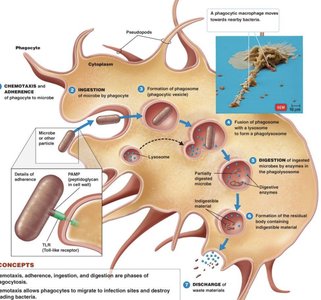
Example: Neutrophils and macrophages engulf and digest bacteria at sites of infection.
Microbial Evasion of Phagocytosis
Some microbes have evolved mechanisms to evade destruction by phagocytes:
Inhibit adherence: M proteins or capsules prevent phagocyte attachment (e.g., Streptococcus pyogenes, Streptococcus pneumoniae).
Kill phagocytes: Production of leukocidins (e.g., Staphylococcus aureus).
Lyse phagocytes: Trigger formation of membrane attack complex (e.g., Listeria monocytogenes).
Escape from phagosome: Bacteria escape into cytoplasm (e.g., Shigella, Rickettsia).
Prevent phagosome/lysosome fusion: Block fusion to avoid digestion (e.g., HIV, Mycobacterium tuberculosis).
Survive inside phagolysosome: Resist digestion (e.g., Coxiella burnetii).
Inflammation
Process and Mediators
Inflammation is a local response to infection or injury, characterized by redness, swelling, pain, and heat.
Acute-phase proteins: Produced by the liver; include complement proteins and cytokines.
Vasodilation: Widening of blood vessels, mediated by histamine, kinins, prostaglandins, and leukotrienes.
Redness (erythema): Increased blood flow to the area.
Swelling (edema): Fluid and immune cells leave the bloodstream and enter tissues.
Pain (algia): Caused by swelling and chemical mediators stimulating nerve endings.
Heat (fever): Local heat from increased blood flow; systemic fever induced by cytokines.
Complement System
Pathways of Complement Activation
The complement system is a group of proteins that enhance immune responses by promoting inflammation, opsonization, and cytolysis. There are three main activation pathways:
Classical pathway: Triggered by antibodies bound to pathogens; leads to opsonization, membrane attack complex (MAC) formation, and inflammation.
Lectin pathway: Triggered by mannose-binding lectin binding to pathogen sugars; similar outcomes as classical pathway.
Alternative pathway: Triggered directly by pathogen surfaces; provides immediate defense before antibodies are produced.
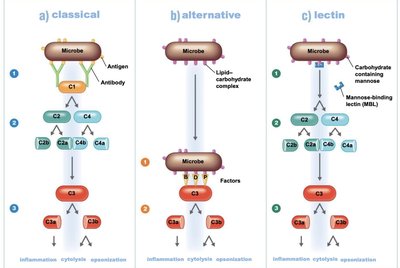
Key outcomes: Opsonization (tagging pathogens for phagocytosis), cytolysis (MAC formation), and inflammation.
Bacterial Evasion of Complement
Capsules: Prevent complement activation.
Surface lipid-carbohydrates: Prevent MAC formation.
Discourage opsonization: Seen in Salmonella, Neisseria gonorrhoeae, Bordetella pertussis, Haemophilus influenzae.
Enzymatic digestion of C5a: Some Gram-positive bacteria degrade complement proteins.
Interferons
Types and Functions
Interferons (IFNs) are signaling proteins released by host cells in response to pathogens, especially viruses.
IFN-α and IFN-β: Released by virus-infected cells; induce production of antiviral proteins (AVPs) in neighboring cells to block viral replication.
IFN-γ: Released by T cells and NK cells; activates macrophages and neutrophils to enhance phagocytosis and killing of microbes.
Example: IFN-α and IFN-β help limit the spread of viral infections, while IFN-γ boosts the ability of immune cells to clear infections.
Summary Table: Leukocyte Types and Functions
Leukocyte Type | Percentage in Blood | Main Function |
|---|---|---|
Neutrophils | 60–70% | Phagocytosis; first responders to infection |
Basophils | 0.5–1% | Release histamine; inflammation, allergy |
Eosinophils | 2–4% | Kill parasites; modulate allergic responses |
Monocytes | 3–8% | Become macrophages; phagocytosis; initiate immune response |
Lymphocytes | 20–25% | B cells (antibodies), T cells (cell-mediated immunity), NK cells |
