 Back
Innate Immunity: The First Line of Defense
Study Guide - Smart Notes
 Tailored notes based on your materials, expanded with key definitions, examples, and context.
Innate Immunity
Overview of the Immune System
The immune system protects the body from infectious agents through two main defense systems: innate immunity and adaptive immunity. Innate immunity provides immediate, nonspecific defense against pathogens, while adaptive immunity offers a specific response that develops later.
Innate Immunity (Nonspecific Defenses): Includes first and second line defenses, such as physical barriers, chemical barriers, and cellular responses.
Adaptive Immunity (Specific Defenses): Involves third-line defenses, including antibodies and cytotoxic cells, which target specific pathogens.
First Line of Defense: Physical and Chemical Barriers
Skin: Physical Structure
The skin acts as a primary physical barrier to microbial invasion. It is composed of two main layers:
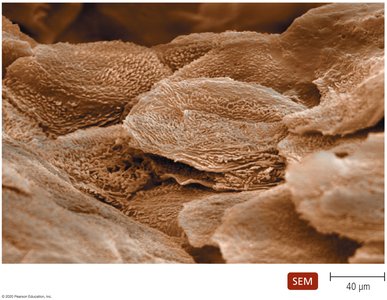
Epidermis: Multiple layers of tightly packed cells, with the outermost layers consisting of dead cells that are regularly shed, removing attached microbes. Dendritic cells within the epidermis play a role in immune surveillance.
Dermis: Contains collagen fibers that provide strength and flexibility, helping the skin resist abrasions that could introduce microbes.
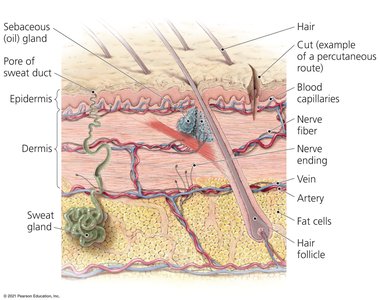
Example: A cut through the skin can provide a route for pathogens to enter, bypassing the protective barrier.
Skin: Chemical Defenses
The skin produces several chemicals that inhibit microbial growth:
Perspiration: Contains salt, which inhibits pathogen growth, and lysozyme, which destroys bacterial cell walls.
Sebum: Secreted by sebaceous glands, keeps skin pliable and lowers pH, inhibiting many bacteria.
Antimicrobial peptides: Small proteins that act against a variety of microbes.
Mucous Membranes: Physical Structure
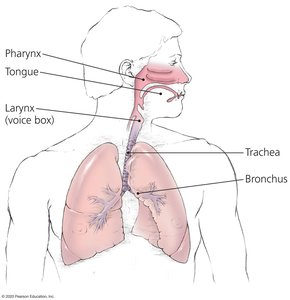
Mucous membranes line all body cavities open to the environment and serve as another important barrier:
Epithelium: Thin, living outer layer of tightly packed cells that prevents pathogen entry. Contains goblet cells (produce mucus) and ciliated columnar cells (move mucus and trapped invaders out).
Deeper connective layer: Produces chemicals that defend against pathogens.
Comparison of Skin and Mucous Membranes
The following table compares the main features of skin and mucous membranes as barriers to infection:
Feature | Skin | Mucous Membrane |
|---|---|---|
Number of Cell Layers | Many | One to a few |
Cells Tightly Packed? | Yes | Yes |
Cells Dead or Alive? | Outer layers: dead; inner layers: alive | Alive |
Mucus Present? | No | Yes |
Relative Water Content | Yes | Yes |
Lysozyme Present? | Yes | With some |
Sebum Present? | Yes | No |
Cilia Present? | No | Trachea, uterine tubes |
Constant Shedding and Replacement of Cells? | Yes | Yes |
Lacrimal Apparatus
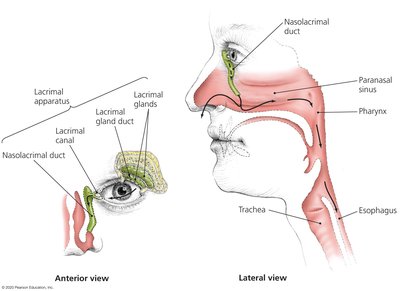
The lacrimal apparatus protects the eyes by producing and draining tears. Blinking spreads tears and washes the surface of the eye, while lysozyme in tears destroys bacteria.
Role of the Microbiome in Innate Immunity
The normal microbiota (microbiome) provides protection through microbial antagonism, making it difficult for pathogens to establish themselves:
Compete with pathogens for nutrients and attachment sites
Create an environment unfavorable to other microbes (e.g., by altering pH)
Stimulate the body's second line of defense
Produce antimicrobial compounds
Promote overall health by providing vitamins and modulating immunity
Other Secretions and Chemicals
Various organs secrete chemicals with antimicrobial properties, contributing to the first line of defense:
Antimicrobial peptides: Present in skin, mucous membranes, and neutrophils; act against a variety of microbes in several ways.
Other secretions: Many organs produce chemicals that inhibit or destroy microbes.
Secretions and Activities of Body Systems
The following tables summarize the secretions and activities of different body systems that contribute to the first line of defense:
System | Secretion/Activity | Function |
|---|---|---|
Digestive | Saliva | Washes microbes from oral surfaces; contains lysozyme |
Digestive | Stomach acid | Digests/inhibits microorganisms |
Digestive | Gastroferritin | Sequesters iron, making it unavailable for microbes |
Digestive | Bile | Inhibitory to most microorganisms |
Digestive | Intestinal secretions | Digest/inhibit microorganisms |
Digestive | Peristalsis | Moves GI contents, eliminating pathogens |
Digestive | Defecation/Vomiting | Eliminates microorganisms |
System | Secretion/Activity | Function |
|---|---|---|
Urinary | Urine | Contains lysozyme; acidity inhibits microbes; washes microbes from tract |
Reproductive | Vaginal secretions | Acidity inhibits microbes; contains iron-binding proteins |
Reproductive | Menstrual flow | Cleanses uterus and vagina |
Reproductive | Prostate secretion | Contains iron-binding proteins |
Cardiovascular | Blood flow | Removes microorganisms from wounds |
Cardiovascular | Coagulation | Prevents pathogen entry |
Summary Questions and Key Points
Mucus-secreting membranes are found in all body cavities open to the environment, including the urinary, digestive, and respiratory systems.
The skin is inhospitable to most microbes due to salt, defensins, enzymes, and low pH, but some normal microbiota are present.
Normal microbiota protect the body by consuming nutrients, altering pH, and keeping the immune system stimulated, but do not directly attack and kill pathogens.
