 Back
BackIntroduction to Microbiology: Foundations, Methods, and Key Concepts
Study Guide - Smart Notes
 Tailored notes based on your materials, expanded with key definitions, examples, and context.
Introduction to Microbiology
Definition and Scope
Microbiology is the scientific study of microorganisms (microbes), which are typically too small to be seen with the naked eye. This field encompasses both cellular and noncellular entities, including bacteria, archaea, fungi, protists, helminths, viruses, and prions.
Microbe (Microorganism): A microscopic organism, which may be unicellular, multicellular, or acellular.
Cellular Microbes: Includes bacteria, archaea, fungi, protists, and helminths.
Nonliving/Noncellular Microbes: Includes viruses and prions.
Not all microbes are microscopic; some fungi, helminths, and protists can be macroscopic.
Major Groups of Microorganisms
Bacteria: Prokaryotic, unicellular organisms; can be pathogenic or nonpathogenic.
Fungi: Eukaryotic; includes unicellular (yeasts) and multicellular (mushrooms) forms; both pathogenic and nonpathogenic species exist.
Protozoans: Eukaryotic, unicellular organisms (e.g., amoebae).
Viruses: Acellular, nonliving entities; infect animal, plant, or bacterial cells; possess either DNA or RNA genomes.
Prions: Infectious proteins; noncellular and nonliving; can be transmitted by ingestion or transplant, and some diseases are inherited.
Microbe | Cell Type | Notes |
|---|---|---|
Bacteria | Prokaryotic | Unicellular; pathogenic and nonpathogenic |
Protozoans | Eukaryotic | Unicellular (e.g., amoebae) |
Fungi | Eukaryotic | Unicellular (yeast) and multicellular (mushrooms) |
Viruses | Not cells | Infect animal, plant, or bacterial cells; DNA or RNA genome |
Prions | Not cells | Infectious proteins; transmitted by transplant or ingestion |
Cell Types
Prokaryotic Cells: Lack a true nucleus; include bacteria and archaea; earliest life forms.
Eukaryotic Cells: Have a true nucleus and membrane-bound organelles; can be unicellular or multicellular; evolved later via endosymbiotic theory.
Applications of Microbiology
Healthcare, agriculture, industry, and environmental sciences.
Professions: Medical microbiology, public health microbiology, epidemiology, immunology, industrial microbiology.
Microbial Roles in the Environment and Society
Participate in the nitrogen and oxygen cycles, and decomposition.
Essential for food production, medication synthesis, and environmental remediation.
Biotechnology and Genetic Engineering
Biotechnology: Manipulation of microbes to produce industrial products.
Genetic Engineering: Alteration of microbial genetics to create new products and GMOs.
Recombinant DNA Technology: Transfer and deliberate alteration of genetic material between organisms.
Bioremediation: Use of microbes to clean up environmental pollutants.
Pathogens and Disease
Pathogens: Microbes that cause disease; about 1,400 known to infect humans.
Less than 1% of microbes are pathogenic.
True Pathogens: Always cause disease in humans.
Opportunistic Pathogens: Cause disease only in weakened hosts.
The Historical Foundations of Microbiology
The Development of the Microscope
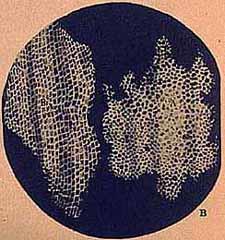
The invention of the microscope was pivotal in the development of microbiology. Early pioneers include Robert Hooke and Antonie van Leeuwenhoek.
Robert Hooke: First to observe cells in cork (1665); published a book on microbes.
Antonie van Leeuwenhoek: Developed simple microscopes; first to observe bacteria, which he called "animalcules."

Spontaneous Generation vs. Biogenesis
Historically, it was debated whether life could arise spontaneously from nonliving matter (spontaneous generation) or only from pre-existing life (biogenesis).
Spontaneous Generation: The belief that living organisms could develop from nonliving matter (e.g., maggots from meat).
Biogenesis: The theory that life arises only from pre-existing life.
Francesco Redi's Experiments
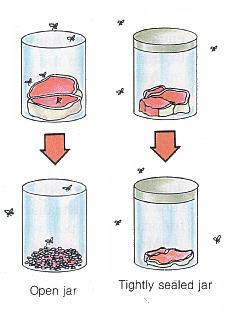
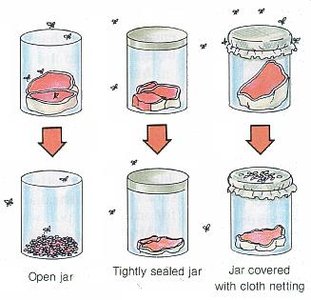
Redi was the first to refute spontaneous generation through controlled experiments with meat and jars.
Uncovered jars developed maggots; tightly sealed jars did not.
Critics argued that sealing the jars excluded the "life force."
Further experiments used gauze-covered jars, which prevented maggots on the meat but allowed air in, supporting biogenesis.
Louis Pasteur's Swan-Neck Flask Experiments
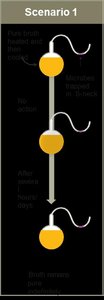
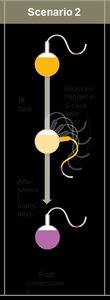
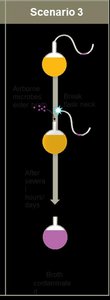
Pasteur definitively disproved spontaneous generation by showing that sterilized broth in swan-neck flasks remained free of microbes unless exposed to contaminated air.
Broth in undisturbed swan-neck flasks remained pure.
Tilted flasks or broken necks allowed contamination.
The Germ Theory of Disease
The germ theory revolutionized medicine by establishing that specific microbes cause specific diseases. Key contributors include Semmelweis, Lister, Nightingale, Koch, and Pasteur.
Semmelweis: Introduced handwashing to reduce puerperal sepsis in maternity wards.
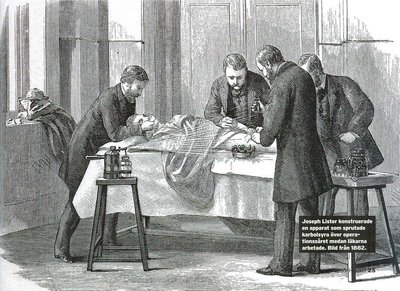
Joseph Lister: Used phenol as an antiseptic during surgery and on wound bandages.
Florence Nightingale: Introduced aseptic techniques in nursing.
Pasteur: Developed pasteurization and vaccines for anthrax and rabies.
Robert Koch: Identified Bacillus anthracis as the cause of anthrax; formulated Koch's postulates for linking microbes to disease.
Koch's Postulates
The same organism must be present in every case of the disease.
The organism must be isolated from the diseased host and grown as a pure culture.
The isolated organism should cause the same disease when inoculated into a susceptible host.
The organism must be re-isolated from the inoculated, diseased animal.
The Scientific Method
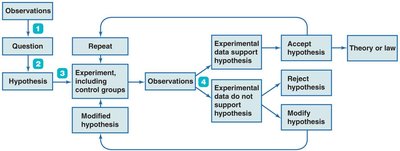
The scientific method is a systematic approach to investigating phenomena, acquiring new knowledge, or correcting and integrating previous knowledge.
Observation: Noticing and describing phenomena.
Hypothesis: Formulating an educated guess or explanation.
Experimentation: Conducting controlled tests to gather data.
Analysis: Interpreting data to support or refute the hypothesis.
Conclusion: Accepting, rejecting, or modifying the hypothesis based on results.
Taxonomy and Nomenclature
Taxonomy
Taxonomy is the science of naming, defining, and classifying organisms based on shared characteristics. Early classification relied on morphology and physiology.
Three domains: Bacteria, Archaea, Eukarya.
Hierarchy (from most general to most specific): Domain, Kingdom, Phylum/Division, Class, Order, Family, Genus, Species.
Nomenclature
Formal system for naming organisms to ensure universal understanding.
Binomial System (Linnaeus): Each organism is given a two-part name: genus (capitalized) and species (lowercase), both italicized (e.g., Staphylococcus aureus).
Genus name can be abbreviated after first use (e.g., S. aureus).
Host–Microbe Interactions
Microbes and hosts interact in various ways, forming symbiotic relationships that can be beneficial, neutral, or harmful.
Symbiotic Relationship: Close association between two or more organisms.
Parasitism: Microbe harms the host.
Mutualism: Both microbe and host benefit.
Commensalism: Microbe benefits without affecting the host.
Normal Microbiota (Flora): Stable community of microbes residing in the host.
Transient Microbiota: Temporary microbes that do not persist in the host.
Pathogenic Microbiota: Harmful microbes that cause disease.
