 Back
Introduction to Microbiology: Living and Nonliving Agents
Study Guide - Smart Notes
 Tailored notes based on your materials, expanded with key definitions, examples, and context.
Introduction to Microbiology
Overview of Microbiology
Microbiology is the study of microorganisms, or microbes, which are often invisible to the naked eye. Microbes include both living and nonliving entities, and they inhabit nearly every region of the planet. Understanding the diversity of these agents is foundational to the field of microbiology.
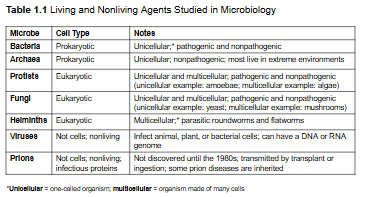
Living and Nonliving Agents Studied in Microbiology
Microbiology encompasses a wide range of agents, both cellular and acellular. The following table summarizes the main groups of microbes, their cell types, and notable characteristics:
Microbe | Cell Type | Notes |
|---|---|---|
Bacteria | Prokaryotic | Unicellular*; pathogenic and nonpathogenic |
Archaea | Prokaryotic | Unicellular, nonpathogenic; most live in extreme environments |
Protists | Eukaryotic | Unicellular and multicellular; pathogenic and nonpathogenic (unicellular example: amoeba; multicellular example: algae) |
Fungi | Eukaryotic | Unicellular and multicellular; pathogenic and nonpathogenic (unicellular example: yeast; multicellular example: mushrooms) |
Helminths | Eukaryotic | Multicellular*; parasitic roundworms and flatworms |
Viruses | Not cells; nonliving | Infect animal, plant, or bacterial cells; can have a DNA or RNA genome |
Prions | Not cells; nonliving, infectious proteins | Not discovered until the 1980s; transmitted by transplant or ingestion; some prion diseases are inherited |
*Unicellular = one-celled organism; multicellular = organism made of many cells
Key Definitions and Examples
Bacteria: Prokaryotic, unicellular organisms found in diverse environments. Some are pathogenic, while many are harmless or beneficial.
Archaea: Prokaryotic, unicellular, and nonpathogenic. Often inhabit extreme environments such as hot springs and salt lakes.
Protists: Eukaryotic organisms that can be unicellular (e.g., Amoeba) or multicellular (e.g., algae). They include both pathogens and nonpathogens.
Fungi: Eukaryotic, can be unicellular (yeasts) or multicellular (mushrooms). Some cause disease, while others are essential decomposers.
Helminths: Multicellular eukaryotic parasites, such as roundworms and flatworms, that can cause disease in humans.
Viruses: Acellular, nonliving infectious agents. They require a host cell to replicate and can infect all forms of life.
Prions: Infectious proteins that lack nucleic acids. They cause neurodegenerative diseases and are notable for their resistance to standard sterilization methods.
Example: Escherichia coli is a bacterium commonly found in the human gut; some strains are harmless, while others can cause foodborne illness.
