 Back
BackIntroduction to Microbiology: Main Themes, Microbial Diversity, and Historical Foundations
Study Guide - Smart Notes
 Tailored notes based on your materials, expanded with key definitions, examples, and context.
Introduction to Microbiology
Definition and Scope
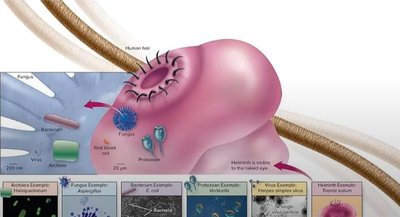
Microbiology is the study of organisms too small to be seen without magnification, including bacteria, viruses, fungi, protozoa, parasites (helminths), and algae. These organisms are collectively referred to as microorganisms or microbes. The term germ is often used for microbes that have the potential to cause disease.
Bacteriology: Study of bacteria
Virology: Study of viruses
Mycology: Study of fungi, molds, and yeasts
Protozoology: Study of protozoans
Parasitology: Study of parasites (helminths)
Phycology: Study of algae
Microorganisms: Microbes and Germs
Microorganisms are defined as any organisms of microscopic or near-microscopic size. While the term microbe is often used interchangeably, it usually refers to bacteria. Germs are microbes with the potential to cause disease and can include bacteria, molds, yeasts, protozoans, and even viruses (though viruses are not true cells).
Microbial Diversity and Classification
Evolutionary Timeline and Domains of Life
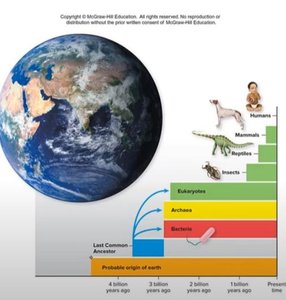
Microbes have shaped Earth's habitat for billions of years. The earliest single-celled organisms appeared about 3.8 billion years ago. From a single common ancestor, three cell types arose:
Eukaryotes: Cells with a true nucleus (animals, plants, fungi, protists)
Bacteria: Single-celled, no true nucleus, most have peptidoglycan cell walls
Archaea: Single-celled, no true nucleus, cell wall lacks peptidoglycan, often extremophiles
Eukaryotic vs. Prokaryotic Cells
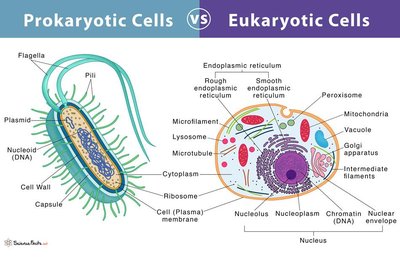
Eukaryotic cells contain membrane-bound organelles and a double-membrane nucleus, while prokaryotic cells (bacteria and archaea) lack these features.
Eukaryotic Cells: Animals, plants, fungi, protists; compartmentalized cytoplasm; linear DNA
Prokaryotic Cells: Bacteria, archaea; no nucleus; circular DNA; most have cell walls
Characteristics of Life
All living organisms share certain characteristics:
Reproduction and heredity: Genome composed of DNA
Growth and development
Metabolism: Chemical and physical life processes
Response to stimuli: Movement or irritability
Cell support and protection: Cell walls, vacuoles, granules
Transport: Movement of nutrients and waste
Microbial Dimensions
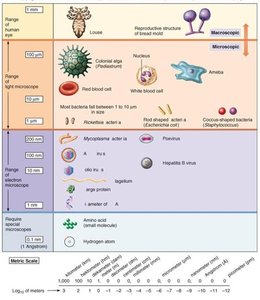
Microbes vary greatly in size, from viruses (measured in nanometers) to protozoa and fungi (measured in micrometers). For comparison, a human hair is about 50–180 μm in diameter.
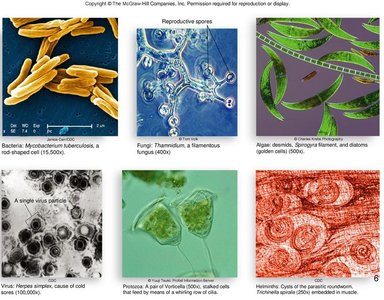
Types of Microbes
Bacteria: Prokaryotic, most have peptidoglycan cell walls, reproduce by binary fission, can be autotrophic or heterotrophic
Archaea: Prokaryotic, cell wall lacks peptidoglycan, extremophiles (thermophiles, halophiles, methanogens)
Fungi: Eukaryotic, cell wall of chitin, heterotrophic, unicellular (yeasts) or multicellular (molds, mushrooms)
Protozoa: Eukaryotic, usually lack cell walls, heterotrophic, unicellular, various modes of motility (pseudopods, flagella, cilia)
Algae: Eukaryotic, cell wall of cellulose, photosynthetic, unicellular or multicellular
Viruses: Acellular, obligate intracellular parasites, DNA or RNA genome, protein capsid, may be enveloped or naked
Helminths: Multicellular animal parasites (flatworms, roundworms), heterotrophic, reproduce sexually or asexually, have microscopic stages
Historical Foundations of Microbiology
Early Discoveries and Cell Theory
The cell theory, established in the 17th century, states that all living things are composed of cells and come from preexisting cells. Key contributors include Robert Hooke (first observed cells) and Anton van Leeuwenhoek (described live microorganisms).
Spontaneous Generation vs. Biogenesis
Spontaneous generation was the belief that life could arise from nonliving matter. This was disproved by experiments from Francesco Redi, Louis Pasteur, and others, leading to the acceptance of biogenesis—the idea that living things arise only from other living things.
Redi's experiment: Showed maggots do not arise from meat without exposure to flies
Pasteur's swan-neck flask: Demonstrated that microbes come from the air, not from nonliving matter
Germ Theory of Disease
The germ theory states that specific diseases are caused by specific microorganisms. Key figures include:
Ignaz Semmelweis: Advocated handwashing to prevent childbirth fever
Joseph Lister: Introduced disinfection in surgery
Robert Koch: Developed Koch's postulates to link specific microbes to specific diseases
Vaccination and Antibiotics
Edward Jenner: Developed the first vaccine (smallpox) using cowpox
Louis Pasteur: Discovered why vaccinations work (attenuated strains)
Alexander Fleming: Discovered penicillin, the first antibiotic
Microbes in Our Lives
Beneficial and Harmful Roles
Most microbes are harmless or beneficial, playing essential roles in food production, biotechnology, and environmental processes. However, some are pathogens and cause disease.
Biotechnology: Production of foods, drugs, and vaccines using living organisms
Genetic engineering: Manipulation of genes for new products (e.g., insulin)
Bioremediation: Use of microbes to clean up pollutants
Pathogens: Microbes that cause disease; over 2,000 known to cause human disease
Epidemiology: Principles and Applications
Definition and Purpose
Epidemiology is the study of the distribution and determinants of health-related states or events in populations, and the application of this study to control health problems. It is foundational to public health and involves both descriptive and analytic approaches.
Descriptive epidemiology: Examines distribution by time, place, and person
Analytic epidemiology: Tests hypotheses about cause-effect relationships
Key Measures in Epidemiology
Prevalence: Proportion of a population with a disease at a specific time
Incidence: Number of new cases in a population over a period
Risk Ratio (Relative Risk, RR): Strength of association between exposure and disease
Impact fractions: Proportion of disease preventable if exposure is removed
Basic Triad of Analytical Epidemiology
Host: Genetic endowment, immunologic status, personal behavior
Agent: Biological (microbes), physical, chemical, environmental, psychological
Environment: Living conditions, climate, modes of transmission
Summary Table: Major Groups of Microorganisms
Group | Cell Type | Cell Wall | Reproduction | Example |
|---|---|---|---|---|
Bacteria | Prokaryotic | Peptidoglycan (most) | Binary fission (asexual) | Escherichia coli |
Archaea | Prokaryotic | Pseudomurein (no peptidoglycan) | Binary fission (asexual) | Halophiles |
Fungi | Eukaryotic | Chitin | Sexual/asexual | Saccharomyces cerevisiae |
Protozoa | Eukaryotic | Usually none | Sexual/asexual | Trypanosoma |
Algae | Eukaryotic | Cellulose | Sexual/asexual | Green algae |
Viruses | Acellular | None (protein capsid) | Host-dependent | Influenza virus |
Helminths | Multicellular | None | Sexual/asexual | Roundworm |
