 Back
BackIntroduction to Microbiology: Microbes and Their Building Blocks
Study Guide - Smart Notes
 Tailored notes based on your materials, expanded with key definitions, examples, and context.
Introduction to Microbiology
Microbes: Tiny but Mighty
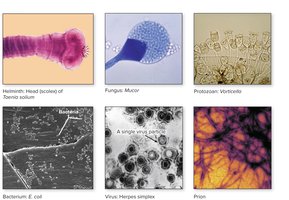
Microbiology is the study of organisms too small to be seen without magnification. These microorganisms include bacteria, archaea, protozoa, fungi, helminths, algae, viruses, and prions. They play essential roles in Earth's ecosystems and human health.
Bacteria: Single-celled prokaryotes, found everywhere.
Archaea: Single-celled prokaryotes, distinct from bacteria.
Protozoa: Single-celled eukaryotes, often motile.
Fungi: Eukaryotes, can be single-celled (yeasts) or multicellular (molds).
Helminths: Multicellular parasitic worms.
Algae: Photosynthetic eukaryotes.
Viruses: Acellular infectious agents, require host cells to replicate.
Prions: Infectious proteins, even simpler than viruses.
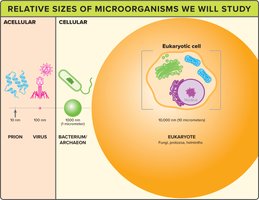
Relative Sizes of Microorganisms
Microorganisms vary greatly in size, from prions (10 nm) to eukaryotic cells (10,000 nm).
Acellular: Prions and viruses are much smaller than cells.
Cellular: Bacteria and archaea are smaller than eukaryotes.
Microbes and the Planet
Microbes' Role in Earth's Development
Microbes have shaped Earth's habitat for billions of years. Single-celled organisms appeared about 3.8 billion years ago, evolving into three main cell types:
Eukaryotes: "True nucleus"
Bacteria: No true nucleus
Archaea: No true nucleus, distinct from bacteria
Relatedness of Organisms
The three domains of life—Bacteria, Archaea, and Eukarya—share a last common ancestor and have diversified into many lineages. 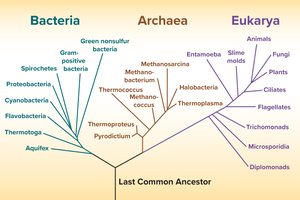
Evolutionary Timeline
The timeline of life shows the origin of Earth, the emergence of bacteria and archaea, the evolution of eukaryotes, and the appearance of multicellular organisms and humans. 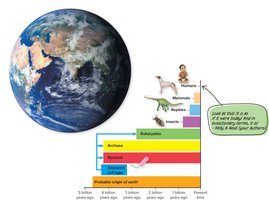
Microbes Are Ubiquitous
Microbes are found everywhere: deep in the earth's crust, polar ice caps, oceans, inside plants and animals, and throughout the landscape. They are essential to life.
Theories of Evolution and Science
Theory of Evolution
The theory of evolution describes the accumulation of changes in organisms as they adapt to their environments. It is a well-tested, well-established scientific concept, not a random guess.
Natural selection: Favors changes that enhance survival and reproduction.
Phylogeny: Represents the natural relatedness between groups of living beings.
Microbes and Energy Flow
Microbes in Ecosystems
Microbes drive energy and nutrient flow in ecosystems. Bacteria evolved photosynthesis before plants, producing oxygen and shaping the atmosphere. 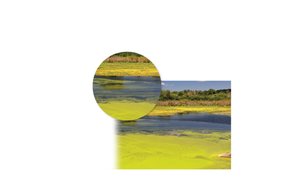
Photosynthesis
Anoxygenic photosynthesis: Occurred in bacteria, did not produce oxygen.
Oxygenic photosynthesis: Evolved later, more efficient, responsible for most of Earth's photosynthesis.
Microbes and Humans
Historical Uses of Microbes
Humans have used microbes for bread, alcohol, cheese production, wound treatment, mining, and bioremediation.
Biotechnology
Genetic engineering: Manipulates genetics for new products and GMOs.
Recombinant DNA technology: Transfers genetic material between organisms.
Bioremediation: Uses microbes to clean up pollutants.
Microbes Harming Humans
Most microbes are harmless or beneficial, but pathogens cause disease. Over 2,000 microbes cause disease, leading to billions of infections annually.
Top Causes of Death in the U.S.
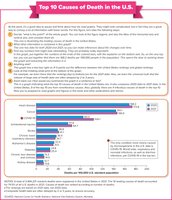
Infectious diseases are significant causes of death worldwide, though in the U.S., most top causes are noninfectious. COVID-19 is a notable exception.
Cause | 2020 Deaths per 100,000 | 2021 Deaths per 100,000 |
|---|---|---|
Heart disease | 168.2 | 173.8 |
Cancer | 144.1 | 146.6 |
COVID-19 | 85.0 | 104.1 |
Unintentional injuries | 57.6 | 64.7 |
Stroke | 38.8 | 41.1 |
Chronic lower respiratory diseases | 36.4 | 34.7 |
Alzheimer's disease | 32.4 | 31.0 |
Diabetes | 24.8 | 25.4 |
Chronic liver disease and cirrhosis | 13.3 | 14.5 |
Kidney disease | 12.7 | 13.6 |
Cellular Organization
Eukaryotes vs. Bacteria and Archaea
Eukaryotes: Have organelles (e.g., nucleus, mitochondria, chloroplasts), can be single-celled or multicellular.
Bacteria and Archaea: Lack organelles, all are microorganisms, ten times smaller than eukaryotes.
Viruses and Prions
Viruses: Not independently living, composed of DNA or RNA and a protein coat.
Prions: Infectious proteins, no nucleic acid.
Biochemical Building Blocks
Macromolecules
Cells are built from four main families of biochemicals:
Carbohydrates: Energy and structural support.
Lipids: Energy storage, membrane structure.
Proteins: Enzymes, structural components.
Nucleic acids: Genetic information (DNA, RNA).
Taxonomy and Classification
Taxonomic Categories
Taxonomy is the science of classifying living things. The hierarchy includes:
Domain
Kingdom
Phylum
Class
Order
Family
Genus
Species
Woese-Fox System
Based on ribosomal RNA sequences, this system divides life into three domains: Bacteria, Archaea, and Eukarya.
Summary Table: Types of Microorganisms
Type | Cellular/Acellular | Example | Size |
|---|---|---|---|
Bacteria | Cellular | E. coli | ~1,000 nm |
Archaea | Cellular | Halobacteria | ~1,000 nm |
Protozoa | Cellular | Vorticella | ~10,000 nm |
Fungi | Cellular | Mucor | ~10,000 nm |
Helminths | Cellular | Taenia solium | ~10,000 nm |
Viruses | Acellular | Herpes simplex | ~100 nm |
Prions | Acellular | Prion | ~10 nm |
Key Images for Study
- : Visualizes the size differences among prions, viruses, bacteria/archaea, and eukaryotes.
- : Shows the phylogenetic tree of Bacteria, Archaea, and Eukarya.
- : Illustrates the timeline of life's evolution on Earth.
- : Demonstrates microbial photosynthesis and its impact on Earth's atmosphere.
- : Provides data on infectious and noninfectious causes of death.
- : Micrographs of helminth, fungus, protozoa, bacterium, virus, and prion.
