 Back
BackIntroduction to Microbiology: The Microbial World, Cell Structure, Evolution, and Impact on Humans
Study Guide - Smart Notes
 Tailored notes based on your materials, expanded with key definitions, examples, and context.
The Microbial World and Its Importance
What Is Microbiology About?
Microbiology is the study of microorganisms, focusing on both fundamental life processes and their applications for human benefit. Microbes serve as model organisms for understanding cellular functions and are essential in medicine, agriculture, and industry.
Microorganisms are the oldest form of life and constitute the largest mass of living material on Earth.
They drive major biogeochemical cycles and can inhabit extreme environments.
Other life forms depend on microbes for survival.
Microbial Cell Structure and Function
Prokaryotic vs. Eukaryotic Cells
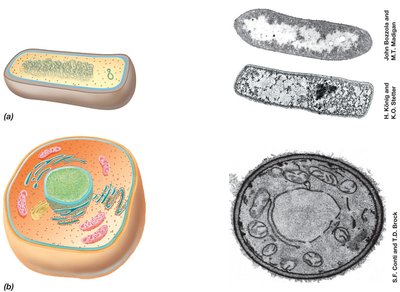
Microbial cells are classified as prokaryotic or eukaryotic, each with distinct structural features.
Prokaryotes (Bacteria and Archaea): Lack membrane-bound organelles and a nucleus; generally smaller and simpler.
Eukaryotes (Eukarya): Possess a membrane-bound nucleus and organelles; larger and more complex.
Evolution and Diversity of Microbial Cells
Three Domains of Life
Comparative rRNA sequencing has revealed three domains: Bacteria, Archaea, and Eukarya. Although Archaea and Bacteria are both prokaryotes, Archaea are more closely related to Eukarya.
Bacteria: Prokaryotic domain
Archaea: Prokaryotic domain, evolutionarily closer to Eukarya
Eukarya: Eukaryotic domain, ancestors of multicellular organisms
Microorganisms and Their Environments
Microbial Communities and Ecology
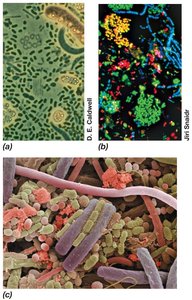
Microorganisms exist in populations and communities, interacting within their habitats. Microbial ecology studies these interactions and their effects on ecosystems.
Microbial community: Assemblage of interacting populations
Habitat: Environment where a population lives
Ecosystem: All living organisms plus physical and chemical environmental factors
Diversity and Adaptation
Microbial diversity is the result of nearly 4 billion years of evolution. Microbes vary in size, shape, motility, physiology, and pathogenicity, and have adapted to exploit every possible energy source.
Microbial abundance and diversity are controlled by resources and environmental conditions (e.g., temperature, pH, oxygen).
Microbial activities influence the chemical and physical properties of their habitats.
Extremophiles: Microbes that thrive in extreme conditions (hot, cold, acidic, caustic, salty, high pressure).
The Impact of Microorganisms on Humans
Microorganisms as Disease Agents
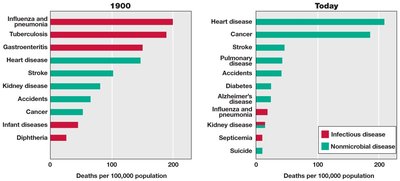
Microbes can be both beneficial and harmful. While pathogens cause infectious diseases, most microbes are beneficial. Advances in disease control have reduced the impact of infectious diseases over the past century.
Emphasis is often placed on pathogens, but beneficial microbes far outnumber harmful ones.
Microorganisms in Agriculture
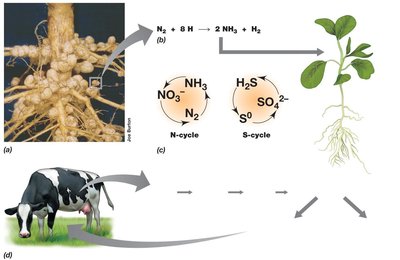
Microbes play crucial roles in agriculture, including nutrient cycling, nitrogen fixation, and cellulose degradation. They can also cause plant and animal diseases.
Nitrogen-fixing bacteria: Convert atmospheric nitrogen to forms usable by plants.
Cellulose-degrading microbes: Aid digestion in ruminant animals.
Microbes regenerate nutrients in soil and water.
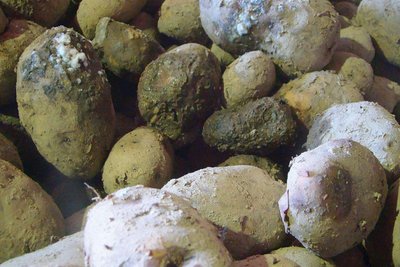
Plant diseases, such as potato blight, are caused by pathogenic microbes.
Microorganisms and the Human Gastrointestinal Tract
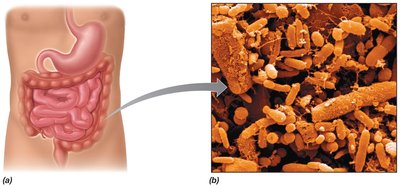
The human GI tract harbors large populations of microbes, especially in the colon and oral cavity. These microbes synthesize vitamins, compete with pathogens, and aid digestion.
Normal microbiota: Includes bacteria, archaea, and eukaryotic microbes.
Functions: Immunomodulation, vitamin and amino acid production, digestion, and potential effects on mood and brain function.
Microorganisms and Food
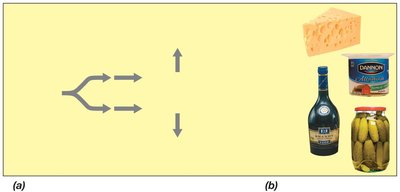
Microbes can cause food spoilage, necessitating preservation methods. However, microbial fermentations are essential for producing many foods, such as dairy products, pickles, bread, and alcoholic beverages.
Negative impact: Food spoilage
Positive impact: Fermentation yields various food products
Microorganisms, Energy, and the Environment
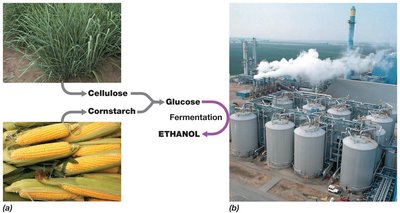
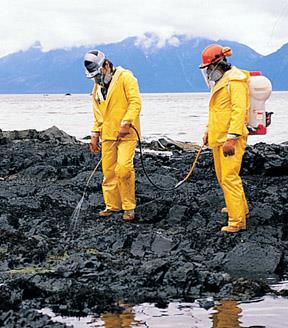
Microbes are involved in biofuel production (e.g., methane, ethanol, hydrogen) and bioremediation, which uses microbes to clean up pollutants such as oil and mercury.
Biofuels: Produced by microbial fermentation of plant materials
Bioremediation: Microbial degradation or detoxification of environmental pollutants
Microorganisms as Biological Insecticides
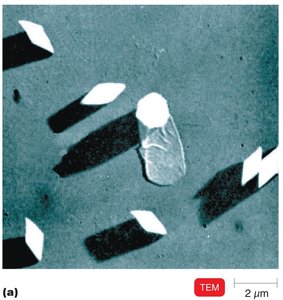
Microbes pathogenic to insects, such as Bacillus thuringiensis, are used as biological insecticides, providing alternatives to chemical pesticides.
Bacillus thuringiensis: Produces toxic crystals fatal to insects but harmless to other animals and plants.
Microorganisms and Biotechnology
Microbes are exploited for the production of antibiotics, enzymes, and chemicals. Genetic engineering enables the creation of valuable products, such as insulin.
Microbial genetic resources are central to biotechnology.
The Discovery of Microorganisms
Early Microscopy and Microbial Observation
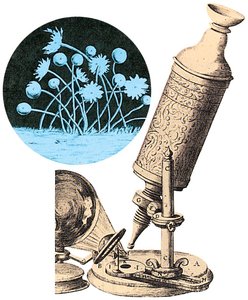
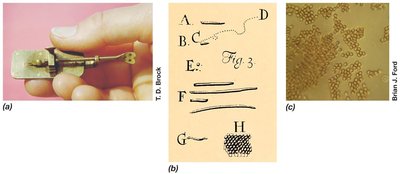
The field of microbiology began with the invention of the microscope. Robert Hooke first described molds, while Antoni van Leeuwenhoek was the first to describe bacteria. Ferdinand Cohn contributed to bacterial classification and discovered endospores.
Microscopy enabled the visualization and study of microbes.
Early Theories of Disease
Fracastoro proposed that diseases were caused by imperceptible entities (seminaria) that could multiply and propagate, foreshadowing the germ theory of disease.
Pioneers of Microbiology
The 13 Pillars of Microbiology: Historical Foundations
Evaluate the specific contributions of the following investigators as documented in the provided curriculum and Brock text:
Scientist and Technical and Documented Contributions
Robert Hooke: First to describe microorganisms; illustrated the fruiting bodies of molds in Micrographia (1665).
Antoni van Leeuwenhoek: Constructed simple microscopes; first to observe and describe "wee animalcules" (bacteria) in 1676.
Edward Jenner: Developed the first scientific vaccine procedure using cowpox to confer immunity against smallpox.
Louis Pasteur: Disproved spontaneous generation using swan-neck flasks; developed vaccines for anthrax, cholera, and rabies; pioneered pasteurization.
Robert Koch: Formulated Koch’s Postulates for germ theory; discovered M. tuberculosis and B. anthracis; developed solid culture media (agar).
Ignaz Semmelweis: Identified the link between hand hygiene and the prevention of puerperal (childbed) fever in clinical settings.
Joseph Lister: Pioneered antiseptic surgical techniques through the application of phenol (carbolic acid) to treat wounds and instruments.
Florence Nightingale: Utilized medical statistics to demonstrate the impact of sanitation on disease mortality; reformed nursing education.
Paul Ehrlich: Developed the concept of "selective toxicity" and the "magic bullet"; synthesized Salvarsan for the treatment of syphilis.
Alexander Fleming: Observed the inhibition of Staphylococcus by the mold Penicillium, leading to the discovery of the first antibiotic.
Martinus Beijerinck: Developed the enrichment culture technique; first to describe the concept of a virus (Tobacco Mosaic Virus).
Sergei Winogradsky: Discovered the concept of chemolithotrophy (energy from inorganic compounds); developed the Winogradsky column.
Carl Woese: Utilized 16S rRNA sequencing to redefine the Tree of Life into three domains: Bacteria, Archaea, and Eukarya.Louis Pasteur and Spontaneous Generation
Pasteur demonstrated that fermentation was a biological process and disproved spontaneous generation. He developed aseptic techniques and vaccines for several diseases.
Pasteur's experiments showed that microbes do not spontaneously arise but come from pre-existing life.
He developed vaccines for anthrax, fowl cholera, and rabies.
Vaccination and Disease Prevention
Edward Jenner pioneered vaccination using cowpox to protect against smallpox. Lady Montague promoted variolation, an early form of immunization.
Robert Koch and Infectious Disease
Koch established the link between microbes and infectious diseases, identified causative agents, and formulated Koch's postulates for proving microbial causation. He developed methods for obtaining pure cultures using solid media.
Koch's postulates: Criteria for establishing a causal relationship between a microbe and a disease.
Pure cultures are obtained by growing microbes on solid media, allowing observation of colony morphology.
The Rise of Microbial Diversity
Microbial Diversity and Environmental Microbiology
The study of microbial diversity focuses on nonmedical aspects, such as environmental roles and biogeochemical cycles. Martinus Beijerinck developed enrichment culture techniques, and Sergei Winogradsky introduced the concept of chemolithotrophy.
Enrichment culture: Isolating microbes by manipulating nutrient and incubation conditions.
Chemolithotrophy: Energy conservation through oxidation of inorganic compounds.
Recent Advances
New antibiotics, such as clovibactin, continue to be discovered from environmental microbes, offering potential solutions to antibiotic resistance.
Cell Type | Key Features | Examples |
|---|---|---|
Prokaryote | No nucleus, no organelles, small size | Bacteria, Archaea |
Eukaryote | Nucleus, organelles, larger size | Fungi, Protozoa, Plants, Animals |
Microbial Impact | Positive Effects | Negative Effects |
|---|---|---|
Agriculture | Nitrogen fixation, cellulose degradation, nutrient regeneration | Plant and animal diseases |
Human Health | Vitamin synthesis, immune training, digestion | Pathogenic infections |
Food | Fermentation, food production | Food spoilage |
Environment | Biofuel production, bioremediation | Pollution (rare) |
Key Equation:
Nitrogen fixation by bacteria:
Summary: Microbiology is a foundational science that explores the diversity, structure, evolution, and impact of microorganisms. Microbes are essential for life, play critical roles in ecosystems, agriculture, human health, and industry, and have shaped scientific understanding through pioneering discoveries and ongoing research.
