 Back
BackIntroduction to Microbiology: The Microbial World and You
Study Guide - Smart Notes
 Tailored notes based on your materials, expanded with key definitions, examples, and context.
Chapter 1: The Microbial World and You
Introduction to Microorganisms
Microbiology is the study of microorganisms, which are organisms too small to be seen with the unaided eye. Understanding microorganisms is essential for preventing disease, food spoilage, and for the development of medical and laboratory techniques.
Microorganisms: Organisms that are microscopic in size.
Germ: Refers to a rapidly growing cell, often associated with disease.
Knowledge of microorganisms helps us to:
Prevent food spoilage
Understand causes and transmission of disease to prevent epidemics
Treat infections
Development of aseptic techniques is crucial to prevent contamination in medicine and microbiology laboratories.

Microbes in Our Lives
Microbes play diverse roles in the environment and human society. While some are pathogenic, many are beneficial and essential for ecological balance and industrial processes.
A few are pathogenic (disease-causing).
Some decompose organic waste, recycling nutrients in ecosystems.
Some generate oxygen through photosynthesis.
Some produce industrial chemicals such as ethanol, acetone, and vitamins.
Microbes are used to produce fermented foods (e.g., vinegar, cheese, bread).
They also produce products used in manufacturing (e.g., cellulase) and disease treatment (e.g., insulin).

Types of Microorganisms
Microorganisms are classified into several major groups based on their cellular structure, metabolism, and genetic characteristics.
Bacteria
Archaea
Fungi
Protozoa
Algae
Viruses (debated)
Multicellular animal parasites



Bacteria
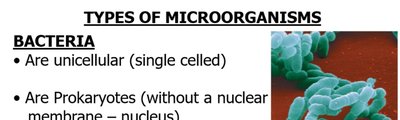
Bacteria are unicellular prokaryotes that exhibit a variety of shapes and metabolic capabilities. They are essential for nutrient cycling, but some can cause disease.
Unicellular (single-celled)
Prokaryotes: Lack a true nucleus (no nuclear membrane)
Shapes include:
Bacillus (rod-shaped)
Coccus (spherical or ovoid)
Spiral (corkscrew or curved)
Stella (star-shaped), etc.
May form pairs, clusters, or chains
Cell wall contains peptidoglycan
Reproduce by binary fission (asexual reproduction)
Archaea
Archaea are prokaryotic microorganisms distinct from bacteria, often found in extreme environments. They have unique biochemical and genetic properties.
Prokaryotes (lack a nucleus)
May or may not have a cell wall; if present, cell wall lacks peptidoglycan
Often found in extreme environments (e.g., high salt, high temperature)
Divided into three main groups:
Methanogens (produce methane)
Extreme halophiles (live in salty environments)
Extreme thermophiles (live in hot, sulfurous waters)
Not pathogenic (do not cause disease in humans)

Fungi
Fungi are eukaryotic organisms that can be unicellular or multicellular. They play important roles in decomposition and nutrient cycling.
Eukaryotes (have a true nucleus)
Divided into three groups: yeasts, molds, and mushrooms
Yeasts are unicellular; molds and mushrooms are multicellular
Molds and mushrooms consist of masses of mycelia (filaments called hyphae)
Cell wall (if present) is composed of chitin
Reproduce sexually or asexually
Absorb organic material from the environment for nourishment

Protozoa
Protozoa are unicellular eukaryotes that move by various mechanisms and can live freely or as parasites. They are important in aquatic ecosystems and some cause disease.
Unicellular
Eukaryotes
Move by:
Pseudopods (false feet)
Flagella
Cilia
Live freely or as parasites
Reproduce sexually or asexually
Ingest or absorb organic material from the environment

Additional info:
Other groups such as algae, viruses, and multicellular animal parasites are also considered in microbiology due to their microscopic stages or impact on human health.
