 Back
Introduction to Microbiology: The Microbial World and You
Study Guide - Smart Notes
 Tailored notes based on your materials, expanded with key definitions, examples, and context.
Microbiology: The Study of Microorganisms
Definition and Scope
Microbiology is the scientific discipline concerned with the study of microorganisms, which are organisms too small to be seen with the naked eye. The term is derived from three Greek roots: micro (small), bio (life), and logy (study of). Microorganisms include a diverse group of organisms that perform essential functions in nature and human life.
Microorganisms can be single-celled or multicellular.
They have relatively simple structure and organization compared to macroscopic organisms.
Most microorganisms are beneficial or neutral to humans; only a small percentage are pathogenic.
Microbes are the most dominant organisms on Earth and have existed long before humans.

Objectives of Microbiology
Understand what microorganisms are, including their history and morphology.
Learn about the classification and origin of microbes.
Explore how microbes affect daily life and the principles of nomenclature.
Major Groups of Microorganisms
Acellular Microorganisms
Acellular microorganisms are not fully living on their own. The most notable example is viruses, which consist of nucleic acid and protein or glycoprotein. Viruses can be beneficial (e.g., gut microbiota) or pathogenic.
Prokaryotic Microorganisms
Archaea: Rarely associated with human disease; often inhabit extreme environments (high heat, salinity, acidity).
Bacteria: Lack a nucleus and membrane-bound organelles; found in virtually every environment. Roles range from beneficial (gut microbiota, nutrient cycling) to pathogenic.
Eukaryotic Microorganisms
Fungi: Include yeasts (unicellular) and molds (multicellular). Focus is on unicellular fungi.
Protozoa: Often motile (flagella, cilia, pseudopodia); many are free-living, some are parasitic (e.g., Plasmodium).
Microscopic algae: Photosynthetic organisms found in aquatic environments; important primary producers of oxygen.
Visual Representation of Microbial Groups
The major groups of microbes include bacteria, archaea, fungi, protozoa, algae, viruses, and multicellular animal parasites.
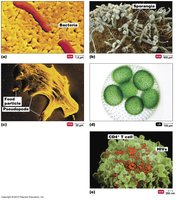
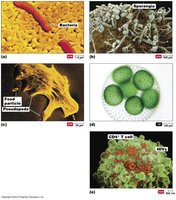
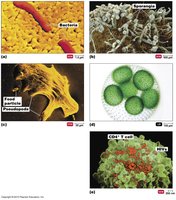
Characteristics of Microorganisms
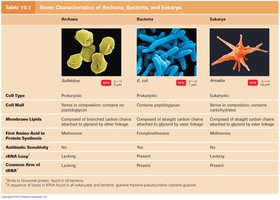
Summary Table: Comparison of Archaea, Bacteria, and Eukarya
This table compares the main characteristics of the three domains of life: Archaea, Bacteria, and Eukarya.
Archaea | Bacteria | Eukarya | |
|---|---|---|---|
Cell Type | Prokaryotic | Prokaryotic | Eukaryotic |
Cell Wall | Varies in composition; contains no peptidoglycan | Contains peptidoglycan | Varies in composition; contains carbohydrates |
Membrane Lipids | Composed of branched carbon chains attached to glycerol by ether linkage | Composed of straight carbon chains attached to glycerol by ester linkage | Composed of straight carbon chains attached to glycerol by ester linkage |
First Amino Acid in Protein Synthesis | Methionine | Formylmethionine | Methionine |
Antibiotic Sensitivity | No | Yes | No |
rRNA Loop | Lacking | Present | Lacking |
Common Areas of rRNA | Lacking | Present | Present |
Observing Microorganisms
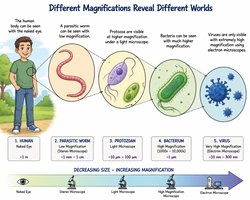
Different Magnifications Reveal Different Worlds
Microorganisms are observed using various types of microscopes, depending on their size. Human bodies can be seen with the naked eye, while parasitic worms, protozoans, bacteria, and viruses require increasing levels of magnification.
Parasitic worms: Seen with low magnification
Protozoans: Seen with light microscopes
Bacteria: Seen with higher magnification
Viruses: Seen only with electron microscopes
History of Microbiology
The First Observations
The field of microbiology began with the discovery of cells and microorganisms. In 1665, Robert Hooke reported that living things were composed of cells. The first microbes were observed in 1673. Rudolf Virchow later stated that cells arise from preexisting cells, forming the basis of the cell theory.
Cell Theory: All living things are composed of cells and come from preexisting cells.
Ancestors of bacteria were the first life on Earth, appearing about 3.5 billion years ago.
The Debate over Spontaneous Generation
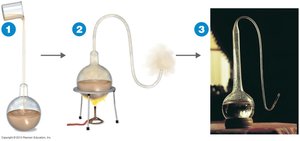
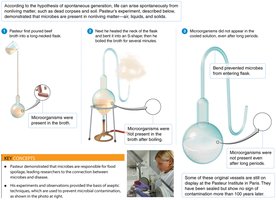
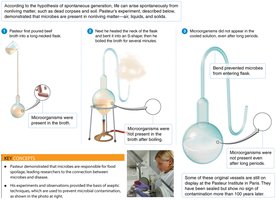
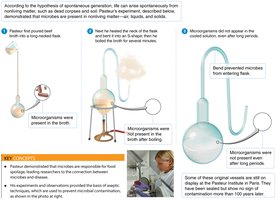
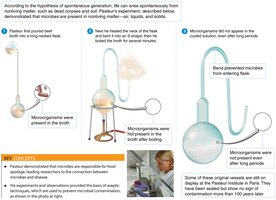
Spontaneous generation was the hypothesis that living organisms arise from nonliving matter, a belief held for over 2000 years. Biogenesis, the alternative hypothesis, states that living organisms arise from preexisting life.
Key experiments by Francesco Redi, John Needham, Lazzaro Spallanzani, and Louis Pasteur challenged spontaneous generation.
Pasteur's experiments demonstrated that microorganisms are present in the air and do not spontaneously arise in sterile environments.
Impact of Microorganisms on Human Affairs
Microbes in Agriculture, Energy, Food, Disease, and Biotechnology
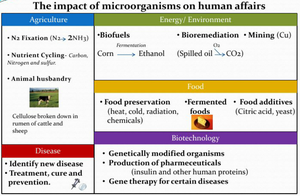
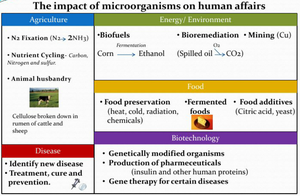
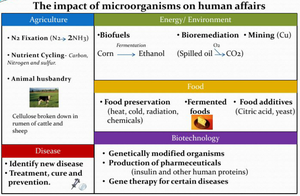
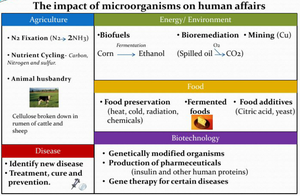
Microorganisms play crucial roles in various sectors, including agriculture, energy/environment, food, disease, and biotechnology.
Agriculture: Nitrogen fixation, nutrient cycling, animal husbandry.
Energy/Environment: Biofuels, bioremediation, mining.
Food: Food preservation, fermented foods, food additives.
Disease: Identification, treatment, cure, and prevention of diseases.
Biotechnology: Genetically modified organisms, pharmaceuticals, gene therapy.
Scientific Nomenclature
Binomial System of Naming Microorganisms
Each microorganism is given two names: the genus and the specific epithet. This system was established by Linnaeus.
Genus: The first part of the name, always capitalized (e.g., Escherichia).
Specific epithet: The second part, not capitalized (e.g., coli).
Names often honor the discoverer or describe the organism's characteristics or habitat.
Examples: Escherichia coli (named after Theodor Escherich, found in the colon), Staphylococcus aureus (describes clustered spherical cells and gold-colored colonies).
Key Questions for Review
List several ways in which microbes affect our lives. Describe some of the destructive and beneficial actions of microbes.
Recognize the system of scientific nomenclature that uses two names: a genus and a specific epithet. Distinguish a genus from a specific epithet.
Differentiate the major characteristics of each group of microorganisms. Which groups of microbes are prokaryotes? Which are eukaryotes? List the three domains.
Explain the importance of observations made by Hooke and van Leeuwenhoek. What is the cell theory?
Compare spontaneous generation and biogenesis. What evidence supported spontaneous generation?
Identify the contributions to microbiology made by Needham, Spallanzani, and Pasteur.
How was spontaneous generation disproved?
