 Back
Introduction to the Microbial World: Structure, Diversity, and Impact
Study Guide - Smart Notes
 Tailored notes based on your materials, expanded with key definitions, examples, and context.
Chapter 1: The Microbial World
Introduction to Microbiology
Microbiology is the study of microorganisms, which are organisms too small to be seen with the naked eye. This field encompasses the structure, function, diversity, and roles of microbes in various environments, including their impact on health, industry, and the biosphere.
Microbial Communities
Microorganisms rarely exist in isolation; they form complex communities where they interact with each other and their environment. These communities can be found in diverse habitats, from soil and water to the human body.
Biofilms: Structured communities of microorganisms attached to surfaces.
Microbiome: The collective genomes of microorganisms in a particular environment, such as the human gut.
Colony-Forming Unit (CFU): A single cell or group of cells that gives rise to a colony on a solid medium.
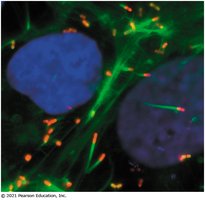
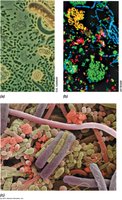
Applications of Microbiology
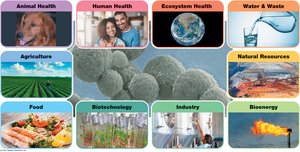
Microorganisms play essential roles in various sectors, including health, agriculture, industry, and environmental management.
Animal and Human Health: Microbes are involved in disease, immunity, and the maintenance of normal flora.
Ecosystem Health: Microbes drive nutrient cycles and energy flow.
Biotechnology and Industry: Microbes are used in the production of antibiotics, enzymes, and biofuels.
Food and Agriculture: Microbes are crucial in fermentation and soil fertility.
Microbial Cell Structure and Function
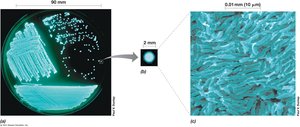
Microbial Growth and Colonies
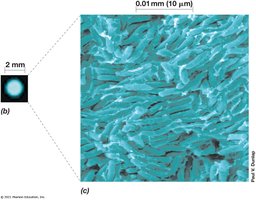
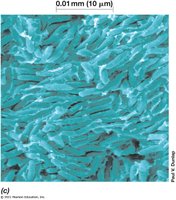
Microbial growth refers to the increase in the number of cells, typically through binary fission. Colonies on solid media originate from a single CFU, and ideally, all cells in a colony are genetically identical.
Replication: The process by which cells divide and multiply.
Colony: A visible mass of microbial cells derived from a single progenitor.
Cell Structure: Prokaryotes vs. Eukaryotes
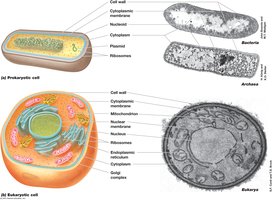
Microbial cells are classified as prokaryotic (Bacteria and Archaea) or eukaryotic (Eukarya). Their structural differences are fundamental to their biology and classification.
Prokaryotes: Lack a nucleus; DNA is not enclosed by a membrane and is typically circular. No membrane-bound organelles.
Eukaryotes: Have a true nucleus enclosed by a nuclear membrane and possess membrane-bound organelles (e.g., mitochondria, Golgi apparatus, endoplasmic reticulum).
Plasmids: Extra-chromosomal DNA elements, often carrying antibiotic resistance genes in bacteria.
Cytoplasm: Site of metabolic processes.
Properties and Diversity of Microbial Cells
Properties of Microbial Cells
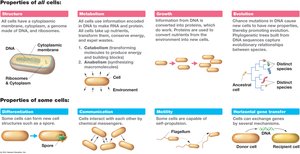
All microbial cells share certain fundamental properties, but some possess unique features that allow them to thrive in diverse environments.
Metabolism: The sum of all chemical reactions in a cell. Includes catabolism (breakdown of molecules) and anabolism (synthesis of molecules).
Growth: Increase in cell number through division.
Evolution: Genetic changes over generations leading to adaptation and speciation.
Motility: Some cells can move using structures like flagella or cilia.
Communication: Cells can interact via chemical signals (quorum sensing).
Differentiation: Some cells can form specialized structures, such as spores.
Horizontal Gene Transfer: Exchange of genetic material between cells, contributing to genetic diversity.
Cell Size and Volume
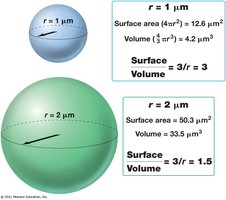
Microbial cells vary greatly in size and volume, influencing their physiology and ecological roles. The surface area-to-volume ratio is a critical factor affecting nutrient uptake and growth rates.
Organism | Characteristics | Morphology | Size (μm) | Cell Volume (μm³) | Volume Compared to E. coli |
|---|---|---|---|---|---|
Thiomargarita namibiensis | Sulfur chemolithotroph | Coccus in chains | 750 | 200,000,000 | 3,000,000 |
Epulopiscium fishelsoni | Chemoorganotroph | Rods with tapered ends | 80 × 600 | 100,000,000 | 1,500,000 |
Escherichia coli | Chemoorganotroph | Rod | 1 × 3 | 1 | 1 |
Mycoplasma pneumoniae | Chemoorganotroph | Pleomorphic | 0.2 × 0.3 | 0.01 | 0.01 |
"Candidatus Pelagibacter ubique" | Chemoorganotroph | Rod | 0.2 × 0.5 | 0.01 | 0.01 |

Surface Area-to-Volume Ratio
The surface area-to-volume ratio decreases as cell size increases, affecting the efficiency of nutrient uptake and waste elimination. Smaller cells have a higher ratio, which supports faster growth rates.
Formula for Surface Area of a Sphere:
Formula for Volume of a Sphere:
Surface Area-to-Volume Ratio:
Cell Morphologies
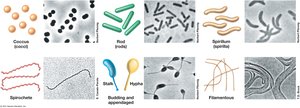
Microorganisms exhibit a variety of shapes, which can be used for identification and classification.
Coccus: Spherical
Bacillus: Rod-shaped
Spirillum: Spiral-shaped
Filamentous: Thread-like
Pleomorphic: Variable shape
Microbial Diversity and Evolution
Extremophiles
Extremophiles are microorganisms that thrive in extreme environmental conditions, such as high temperature, acidity, salinity, or pressure. They are important for understanding the limits of life and have biotechnological applications.
Extreme | Descriptive Term | Genus, Species | Domain | Habitat | Minimum | Optimum | Maximum |
|---|---|---|---|---|---|---|---|
Temperature | Hyperthermophile | Archaeoglobus fulgidus | Archaea | Hydrothermal vents | 80°C | 95°C | 110°C |
pH | Acidophile | Picrophilus oshimae | Archaea | Acidic hot springs | 0.06 | 0.7 | 4 |
Pressure | Barophile | Photobacterium profundum | Bacteria | Deep sea | 0.1 MPa | 50 MPa | 120 MPa |
Salt (NaCl) | Halophile | Halobacterium salinarum | Archaea | Salt lakes | 5% | 20% | 32% |

Microbial Evolution and the Tree of Life
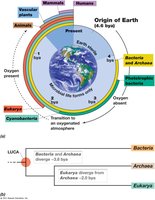
Microorganisms have existed for billions of years and are central to the evolution of life on Earth. The three domains of life—Bacteria, Archaea, and Eukarya—share a common ancestor known as LUCA (Last Universal Common Ancestor).
Phylogenetic Tree: Diagram showing evolutionary relationships among organisms.
rRNA (ribosomal RNA): Used as a molecular chronometer for constructing phylogenetic trees.
Historical Foundations of Microbiology
Early Microscopy and Discovery of Microbes
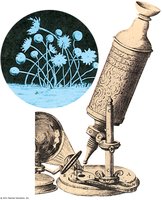
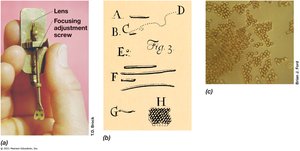
The development of the microscope was crucial for the discovery of microorganisms. Pioneers like Robert Hooke and Antonie van Leeuwenhoek made significant contributions to early microscopy and the visualization of microbes.
Robert Hooke: First to describe cells in cork and mold.
Antonie van Leeuwenhoek: First to observe and describe bacteria and protozoa.
Disproving Spontaneous Generation
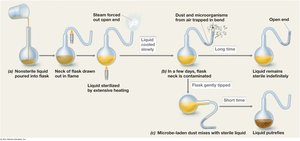
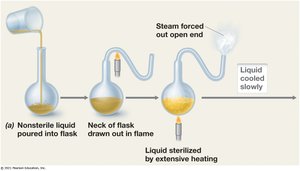
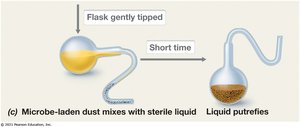
Louis Pasteur's experiments with swan-necked flasks demonstrated that microorganisms do not arise spontaneously but come from pre-existing life, laying the foundation for the field of microbiology.
Swan-Necked Flask Experiment: Showed that sterilized broth remained free of microbes unless exposed to contaminated dust.

Koch’s Postulates
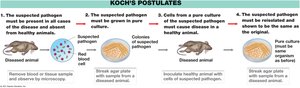
Robert Koch established a set of criteria, known as Koch’s postulates, to prove the causal relationship between a microorganism and a disease. These postulates remain foundational in medical microbiology.
The suspected pathogen must be present in all cases of the disease and absent from healthy animals.
The suspected pathogen must be grown in pure culture.
Cells from a pure culture must cause disease in a healthy animal.
The suspected pathogen must be reisolated and shown to be the same as the original.
Conclusion
Microbiology is a foundational biological science that explores the unseen world of microorganisms. Understanding their structure, diversity, and roles in nature and human affairs is essential for advances in health, industry, and environmental stewardship.
