 Back
BackIntroduction to Virology: Structure, Classification, and Importance of Viruses
Study Guide - Smart Notes
 Tailored notes based on your materials, expanded with key definitions, examples, and context.
Introduction to Virology
Definition and Scope
Virology is the scientific study of viruses, which are acellular infectious agents that require a host cell for replication. Recent viral epidemics, such as those caused by SARS-CoV-2 and Monkeypox virus, highlight the importance of understanding viral biology for public health.
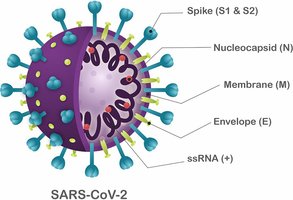

Characteristics of Viruses
Obligate Intracellular Parasites
Dependence on Host: Viruses cannot replicate or carry out metabolic processes independently. They must hijack a living host cell's resources, including ATP, enzymes, and ribosomes, to create new viral components.
Acellular Structure
Lack of Cellular Organization: Viruses are not composed of cells. A single viral particle, or virion, consists of a core of genetic material (either DNA or RNA, but never both) enclosed within a protein shell called a capsid.
Small Size
Ultramicroscopic: Viruses range from about 20 to 400 nanometers (nm), making them much smaller than most bacteria and eukaryotic cells.
Diverse Hosts
Host Range: Viruses can infect animals, plants, fungi, bacteria (bacteriophages), and archaea. Many viruses are highly specific, infecting only certain cell types within a host species.
Evolution and Mutation
Genetic Variation: Viral replication is often error-prone, leading to mutations that drive viral evolution and the emergence of new strains, including drug-resistant variants.
Virus Structure
Genetic Material (Genome)
The viral genome can be DNA or RNA, single-stranded (ss) or double-stranded (ds), linear or circular, and segmented or non-segmented. This diversity underlies the classification and replication strategies of viruses.
Capsid
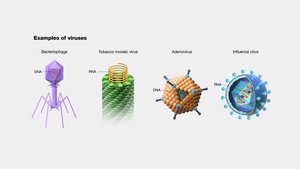
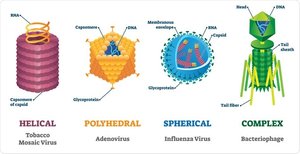
The capsid is a protective protein shell made of repeating subunits called capsomeres. It determines the virus's shape and symmetry, which can be:
Icosahedral (20-sided, spherical-like): e.g., Adenovirus
Helical (rod-shaped): e.g., Tobacco Mosaic Virus
Complex: e.g., Bacteriophages (head and tail structure)
Envelope (Optional)
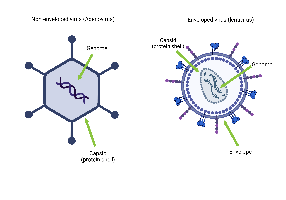
Some viruses possess an outer lipid membrane called an envelope, derived from the host cell membrane during viral budding. Enveloped viruses often contain viral glycoproteins that facilitate host cell entry but are generally less stable outside the host than non-enveloped viruses.

Glycoprotein Spikes (Optional)
Enveloped viruses may have glycoprotein spikes that protrude from their surface, enabling attachment to specific host cell receptors and mediating entry into the cell.
Virion: The Infectious Particle
Definition and Function
Virion: The fully assembled, infectious form of a virus particle that exists outside a host cell.
Function: Responsible for infection and delivery of the viral genome into a new host cell, where replication occurs.
Virion vs. Virus
Virion: The complete, infectious viral particle.
Virus: A broader term that can refer to a virion, a virus inside a host cell, or viral genetic material integrated into a host's DNA.
Virus Architecture and Nomenclature
Virus Architecture
Virus architecture refers to the specific arrangement of macromolecules (proteins and nucleic acids) that form a virion. The structure determines the virus's infectivity, stability, and interaction with host cells.
Virus Nomenclature
Standardization: The International Committee on Taxonomy of Viruses (ICTV) governs the formal system for naming and classifying viruses.
Taxonomic Hierarchy: Viruses are classified into Order (-virales), Family (-viridae), Genus (-virus), and Species.
Binomial Species Naming: New virus species are named using a two-part format (e.g., Orthoflavivirus zikaense for Zika virus).
Baltimore Classification of Viruses
Principles and Classes
The Baltimore classification system categorizes viruses based on their type of genetic material and their mechanism of mRNA synthesis. All viruses must produce mRNA to synthesize proteins and replicate. The system divides viruses into seven classes:
Group I: dsDNA viruses
Group II: ssDNA viruses
Group III: dsRNA viruses
Group IV: (+)ssRNA viruses
Group V: (–)ssRNA viruses
Group VI: RNA reverse-transcribing viruses
Group VII: DNA reverse-transcribing viruses

Early Virus Studies and Discovery
Historical Milestones
Original Definition: Viruses were initially defined as agents that could pass through filters that trap most known bacteria (e.g., Chamberland porcelain ultrafilters).
Electron Microscopy: Enabled visualization of viruses for the first time.
First Virus Discovered: Tobacco mosaic virus (TMV).
Bacteriophages: Viruses that infect bacteria, first isolated from sources such as human sewage.

Viruses That Challenge the Definition of a Virus
Giruses and Virophages
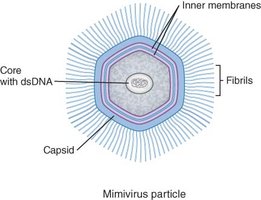
Giruses: "Giant" DNA-containing viruses, such as Mimivirus and Mamavirus, which possess large genomes and complex structures.
Virophages: Subviral agents that infect other large viruses (e.g., Sputnik virophage).

Human and Aquatic Viromes
Definition and Impact
Virome: The total collection of viruses present in a particular environment, such as the human body or aquatic ecosystems.
Human Virome: Includes viruses on the skin and other body sites, influencing health and disease states. Studied using metagenomics and projects like the Human Microbiome Project.
Aquatic Viromes: Affect the ecology, diversity, evolution, and health of aquatic organisms.
Applications of Viruses in Health and Medicine
Bacteriophage Therapy and Gene Therapy
Bacteriophage Therapy: Uses viruses that infect bacteria to treat bacterial infections, including those caused by antibiotic-resistant "superbugs" and bacterial biofilms.
Gene Therapy: Employs viruses (e.g., retroviruses, adenoviruses) to deliver functional copies of genes to treat genetic disorders.
Review Questions and Applications
Which term is used to describe the viral nucleic acid genome enclosed within a protein coat? Answer: A) Nucleocapsid
Which of the following best describes an icosahedral virus? Answer: B) 20-sided symmetrical structure
Capsomeres are: Answer: C) Structural proteins forming the capsid
The envelope of a virus is primarily derived from: Answer: B) The host cell membrane
Application Example
A newly discovered virus has a helical capsid, RNA genome, and an outer lipid layer with spike proteins. Its likely mode of entry into host cells is via fusion with the host cell membrane, mediated by the spike proteins. The presence of an envelope and surface glycoproteins makes it a candidate for vaccine development targeting these proteins, as seen with influenza and coronaviruses.
Summary Table: Virus Structure Types
Shape | Example | Genome Type | Envelope |
|---|---|---|---|
Helical | Tobacco Mosaic Virus | RNA | No |
Icosahedral (Polyhedral) | Adenovirus | DNA | No |
Spherical | Influenza Virus | RNA | Yes |
Complex | Bacteriophage | DNA | No |
Key Terms
Virion: The complete, infectious virus particle.
Capsid: Protein shell enclosing the viral genome.
Envelope: Lipid membrane derived from the host cell, present in some viruses.
Capsomere: Protein subunit of the capsid.
Virome: The total collection of viruses in a particular environment.
Baltimore Classification: System for classifying viruses based on genome type and replication strategy.
Additional info: This guide integrates foundational virology concepts with modern applications and classification systems, providing a comprehensive overview suitable for college-level microbiology students.
