 Back
MCB2000 Exam Two Study Guide – Microbiology Concepts and Applications
Study Guide - Smart Notes
 Tailored notes based on your materials, expanded with key definitions, examples, and context.
Q10. Define Operons and explain their role in gene expression (transcription) in bacteria. Give examples.
Background
Topic: Gene Regulation in Prokaryotes
This question tests your understanding of how bacteria regulate gene expression using operons, which are clusters of genes transcribed together. The lac operon is a classic example, illustrating how bacteria can turn genes on or off in response to environmental changes.
Key Terms and Concepts:
Operon: A group of genes under the control of a single promoter and operator, transcribed as a single mRNA.
Promoter: DNA sequence where RNA polymerase binds to initiate transcription.
Operator: DNA segment where a repressor protein can bind to block transcription.
Inducible Operon: Usually off, can be turned on by an inducer (e.g., lac operon).
Repressible Operon: Usually on, can be turned off by a repressor (e.g., trp operon).
Lac Operon: Controls genes for lactose metabolism in E. coli.
Step-by-Step Guidance
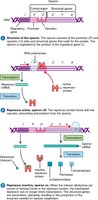
Start by defining what an operon is and its components (promoter, operator, structural genes).
Explain how the operon model allows bacteria to regulate multiple genes together, responding efficiently to environmental changes.
Describe the difference between inducible and repressible operons, and give an example of each (e.g., lac operon for inducible, trp operon for repressible).
For the lac operon, outline the sequence of events when lactose is present versus absent, focusing on the roles of the repressor, operator, and RNA polymerase.
Try solving on your own before revealing the answer!
Q12. Cells Prefer glucose over lactose. How are genes expressed to facilitate this preference?
Background
Topic: Catabolite Repression and Diauxic Growth
This question explores how bacteria prioritize glucose metabolism over other sugars, such as lactose, using regulatory mechanisms like catabolite repression and the lac operon.
Key Terms and Concepts:
Catabolite Repression: A regulatory mechanism where the presence of glucose suppresses the use of alternative carbon sources.
Diauxic Growth: A two-phase growth pattern observed when two sugars are present; glucose is used first, then lactose.
cAMP (cyclic AMP): A signaling molecule whose levels are inversely related to glucose concentration.
CAP (Catabolite Activator Protein): Binds with cAMP to activate transcription of the lac operon.
Step-by-Step Guidance
Describe how the presence of glucose affects cAMP levels in the cell.
Explain how low cAMP levels prevent the CAP-cAMP complex from forming, reducing transcription of the lac operon.
Discuss what happens when glucose is depleted and lactose is available—cAMP levels rise, CAP-cAMP complex forms, and the lac operon is activated.
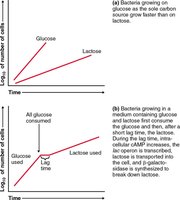
Relate these regulatory mechanisms to the observed diauxic growth curve, where bacteria first consume glucose, then switch to lactose after a lag phase.
Try solving on your own before revealing the answer!
Q15. Explain how a technique called RFLP works in analyzing DNA
Background
Topic: DNA Analysis Techniques
This question tests your understanding of Restriction Fragment Length Polymorphism (RFLP), a molecular technique used to detect genetic variation by analyzing the lengths of DNA fragments produced by restriction enzyme digestion.
Key Terms and Concepts:
Restriction Enzymes: Proteins that cut DNA at specific sequences.
Gel Electrophoresis: Technique to separate DNA fragments by size.
Probe Hybridization: Use of labeled DNA probes to detect specific fragments.
Polymorphism: Variation in DNA sequence among individuals.
Step-by-Step Guidance
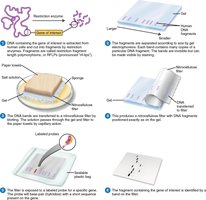
Begin by extracting DNA from cells and digesting it with restriction enzymes to produce fragments of varying lengths.
Separate the DNA fragments by size using gel electrophoresis.
Transfer the separated DNA fragments from the gel to a nitrocellulose filter (blotting).
Expose the filter to a labeled DNA probe that binds to a specific sequence of interest, allowing visualization of the fragment containing the gene of interest.
Try solving on your own before revealing the answer!
Q19. How can one amplify DNA fragments in laboratory?
Background
Topic: Polymerase Chain Reaction (PCR)
This question focuses on the PCR technique, which is used to make millions of copies of a specific DNA segment from a small initial sample.
Key Terms and Concepts:
Polymerase Chain Reaction (PCR): A method to amplify DNA sequences.
Primers: Short DNA sequences that initiate DNA synthesis.
DNA Polymerase: Enzyme that synthesizes new DNA strands.
Thermal Cycling: Repeated heating and cooling cycles to denature DNA, anneal primers, and extend new strands.
Step-by-Step Guidance
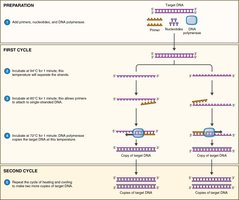
Prepare the reaction mixture by adding template DNA, primers, nucleotides, and DNA polymerase.
Denature the DNA by heating to separate the strands.
Cool the mixture to allow primers to anneal (bind) to the target sequences.
Raise the temperature to allow DNA polymerase to extend the primers, synthesizing new DNA strands.
Try solving on your own before revealing the answer!
Q33. What is the connection between horizontal gene transfer and antibiotic resistance genes? What is the role of plasmids in this process?
Background
Topic: Horizontal Gene Transfer and Antibiotic Resistance
This question examines how bacteria acquire and spread antibiotic resistance genes through horizontal gene transfer, with a focus on the role of plasmids.
Key Terms and Concepts:
Horizontal Gene Transfer (HGT): Movement of genetic material between organisms other than by descent.
Plasmids: Small, circular DNA molecules that replicate independently of chromosomal DNA.
Conjugation: Transfer of plasmids between bacteria via direct contact.
Antibiotic Resistance Genes: Genes that confer resistance to antibiotics, often carried on plasmids.
Step-by-Step Guidance
Describe how horizontal gene transfer allows bacteria to acquire new genes, including those for antibiotic resistance, from other bacteria.
Explain the role of plasmids as vectors for antibiotic resistance genes, and how they can be transferred between cells via conjugation.
Discuss the significance of this process in the spread of antibiotic resistance in bacterial populations.
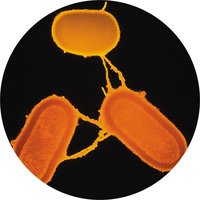
Relate the image of bacterial conjugation to the transfer of plasmids carrying resistance genes.
Try solving on your own before revealing the answer!
Q36. What is the significance of Ti Plasmid?
Background
Topic: Genetic Engineering in Plants
This question focuses on the Ti plasmid, a tool used in biotechnology to introduce new genes into plant cells, enabling the development of genetically modified crops.
Key Terms and Concepts:
Ti Plasmid: Tumor-inducing plasmid from Agrobacterium tumefaciens, used to transfer genes into plant cells.
Genetic Engineering: The process of altering the genetic material of an organism.
Transgenic Plants: Plants that have received foreign genes via genetic engineering.
Step-by-Step Guidance
Describe the natural role of the Ti plasmid in causing crown gall disease in plants.
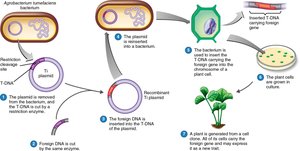
Explain how scientists use the Ti plasmid as a vector to introduce new genes into plant cells.
Outline the steps involved in creating a genetically modified plant using the Ti plasmid, including gene insertion, transformation, and plant regeneration.
Discuss the significance of this technology for agriculture and biotechnology.
Try solving on your own before revealing the answer!
