 Back
BackMechanisms of Genetic Variation in Microorganisms
Study Guide - Smart Notes
 Tailored notes based on your materials, expanded with key definitions, examples, and context.
Mechanisms of Genetic Variation
Terminology and Principles
Genetic variation in microorganisms is fundamental to their adaptability and evolution. Variation arises through mutations and genetic transfer mechanisms, affecting both genotype and phenotype.
Genome: The complete set of genetic material in an organism. Prokaryotes typically possess double-stranded DNA (dsDNA) and are haploid.
Mutation: A permanent change in the nucleotide sequence of DNA, which may be neutral, beneficial, or harmful.
Genotype: The genetic makeup of an organism.
Phenotype: Observable characteristics resulting from genotype.
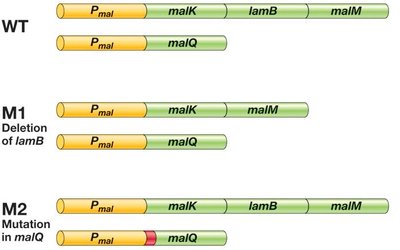
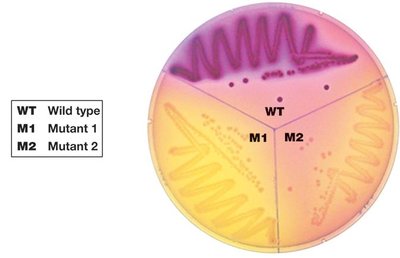
Wild-type (WT): The strain or gene isolated from nature.
Mutant: A strain or gene derived from WT with a nucleotide sequence change.
Mutations
Mutations are classified as spontaneous or induced, each with distinct molecular mechanisms and effects.
Spontaneous Mutations
Spontaneous mutations occur naturally due to errors in DNA replication or chemical instability of DNA bases.
Point mutations: Single base pair changes, including transitions (purine to purine or pyrimidine to pyrimidine) and transversions (purine to pyrimidine or vice versa).
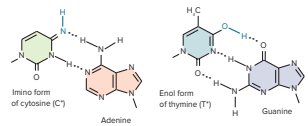
Tautomeric shifts: Rare isomers of bases alter hydrogen bonding, leading to mispairing during replication.
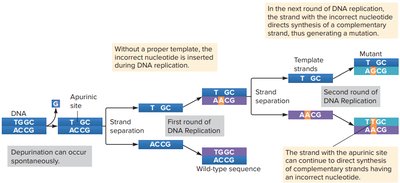
Abasic sites: Loss of a base (apurinic/apyrimidinic sites) can cause incorrect nucleotide incorporation.
Frameshift Mutations
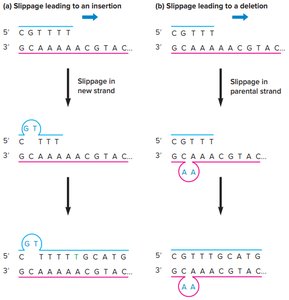
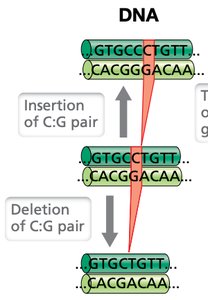
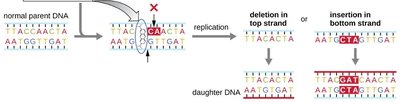
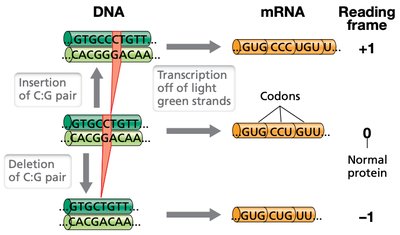
Frameshift mutations result from insertions or deletions (indels) of base pairs, shifting the reading frame and altering downstream coding.
DNA polymerase slippage: Occurs in regions of repeated nucleotides, causing displacement and indels.
Induced Mutations
Induced mutations are caused by external agents (mutagens) such as chemicals, radiation, or biological elements.
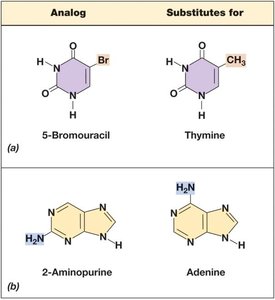
Base analogs: Chemicals resembling nucleotide bases, causing faulty base pairing (e.g., 5-bromouracil, 2-aminopurine).
Nucleotide altering agents: Modify nucleotides chemically, leading to point mutations or indels (e.g., nitrous oxide, hydroxylamine, nitrogen mustard).
Intercalating agents: Insert between DNA base pairs, distorting structure and causing frameshift mutations (e.g., acridines, ethidium bromide).
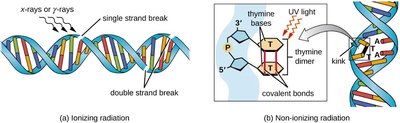
Radiation: Ionizing (X-rays, gamma rays) causes strand breaks; non-ionizing (UV) forms pyrimidine dimers.

Effects of Mutations
Mutations can affect regulatory sequences or protein coding regions, resulting in various outcomes:
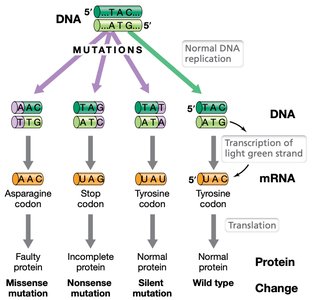
Silent mutations: No change in amino acid sequence.
Missense mutations: Change in amino acid, possibly altering protein function.
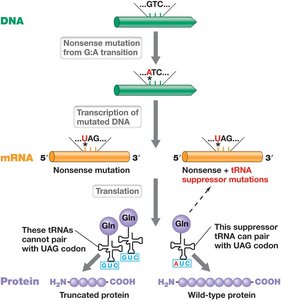
Nonsense mutations: Premature stop codon, producing truncated proteins.
Frameshift mutations: Alter reading frame, often resulting in faulty or incomplete proteins.
Reversions and Mutation Rates
Some mutations are reversible (reversions), while suppressor mutations restore function by compensating for the original mutation.
Reversions: Back mutations that restore the original sequence.
Suppressor mutations: Occur at different sites, restoring function by altering another gene or producing compensatory enzymes.
Mutation rates: Spontaneous rates are typically to per replication; mutagens increase rates to to per gene per replication.
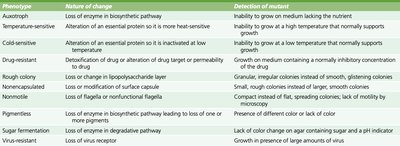
Isolation, Detection, and Selection of Mutants
Mutants can be isolated and detected using selective or screening methods.
Selectable mutants: Confer an advantage, allowing direct selection (e.g., antibiotic resistance).
Non-selectable mutants: Detected by screening for altered phenotype (e.g., replica plating).
Auxotrophs: Mutants unable to grow without a specific nutrient.
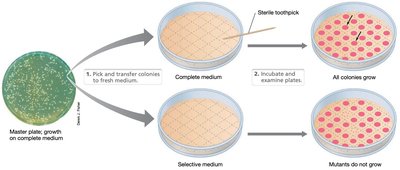
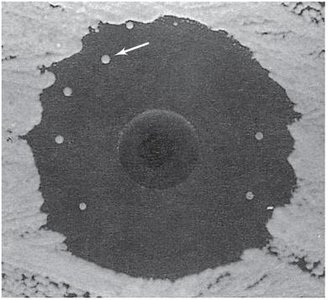
Ames Test
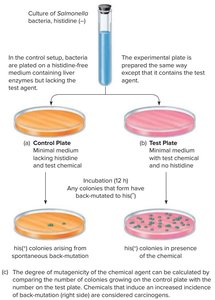
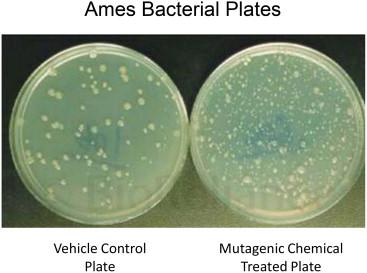
The Ames test screens for mutagenic and carcinogenic chemicals by measuring the rate of mutation reversal in auxotrophic bacteria.
His- Salmonella strain: Used to detect mutagenicity by observing back-mutation to His+.
Effectiveness: Provides a rapid, sensitive assay for mutagenic potential.
DNA Repair Mechanisms
Proofreading and Repair
Cells possess multiple mechanisms to repair DNA and maintain genetic integrity.
Proofreading: DNA polymerase corrects errors during replication.
Mismatch repair: Corrects errors missed by proofreading, using methyl-directed repair systems.
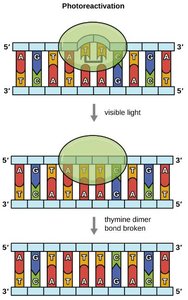
Direct repair: Repairs damage without removing DNA regions (e.g., photoreactivation).
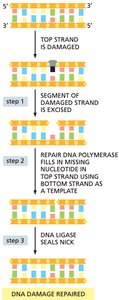
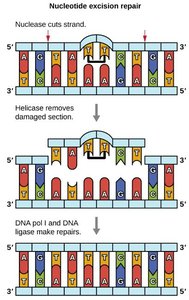
Excision repair: Removes and replaces damaged bases or nucleotides.
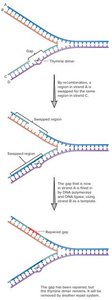
Recombinational repair: Uses homologous recombination to repair severe damage.
SOS response: Error-prone repair activated by extensive DNA damage.
Genetic Transfer and Recombination
Vertical vs. Horizontal Gene Transfer
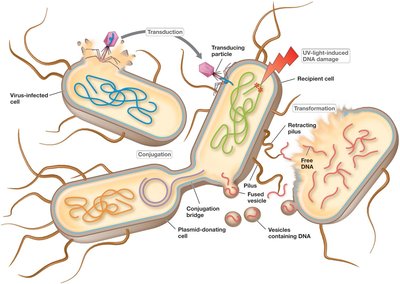
Genetic information can be transferred vertically (parent to offspring) or horizontally (between unrelated cells).
Vertical gene transfer: Transmission from parent to progeny.
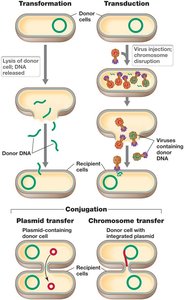
Horizontal gene transfer (HGT): Transfer between unrelated cells, leading to rapid acquisition of new traits.
Recombinant cell: Recipient cell with integrated donor DNA.
Homologous Recombination
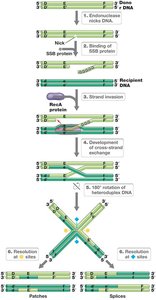
Homologous recombination involves the exchange of genetic material between similar DNA sequences, facilitated by RecA protein.
Mechanism: Endonuclease nicks donor DNA, helicase separates strands, RecA mediates strand invasion, and heteroduplex regions form.
Transformation
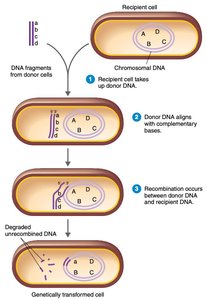
Transformation is the uptake of free DNA from the environment by competent cells, leading to genetic change.
Competent cell: Able to take up DNA and be transformed.
Laboratory methods: Chemical or electrical treatments (e.g., electroporation) increase competence.
Transduction
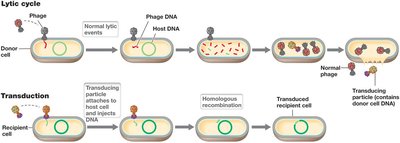
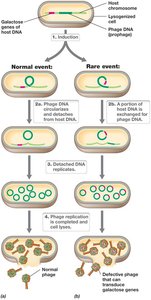
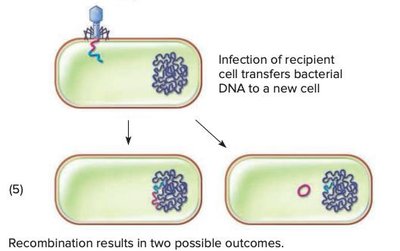
Transduction is the transfer of DNA from one cell to another via bacteriophages.
Generalized transduction: Random incorporation of chromosomal DNA into defective virus particles; any gene can be transferred.
Specialized transduction: Transfer of specific genes adjacent to prophage integration site; highly efficient.
Conjugation
Conjugation is the direct transfer of plasmids between bacteria via cell-to-cell contact, often mediated by sex pili.
F plasmids: Contain genes for pilus formation and transfer (tra region), integration (IS region), and replication (oriV).
Hfr strains: F plasmid integrated into chromosome, enabling partial chromosome transfer.
F' plasmids: F plasmids containing chromosomal genes.
Summary Table: Chemical and Physical Mutagens and Their Modes of Action
Agent | Action | Result |
|---|---|---|
Base analogs | Substitute for normal bases | Point mutations |
Nucleotide altering agents | Modify DNA structure | Point mutations, indels |
Intercalating agents | Insert between base pairs | Frameshift mutations |
Ionizing radiation | Break DNA strands | Mutations, deletions |
Non-ionizing radiation | Form pyrimidine dimers | Mutations, deletions |
*Additional info: Table entries inferred from lecture content and standard microbiology references.*
Conclusion
Genetic variation in microorganisms is driven by mutations and horizontal gene transfer, with multiple mechanisms for DNA repair and recombination. These processes underpin microbial evolution, adaptability, and diversity.
