 Back
BackMechanisms of Genetic Variation in Microorganisms
Study Guide - Smart Notes
 Tailored notes based on your materials, expanded with key definitions, examples, and context.
Mechanisms of Genetic Variation
Introduction
Genetic variation is essential for the adaptation and evolution of microorganisms. It arises through mutations and horizontal gene transfer, enabling microbes to survive changing environments and acquire new traits such as antibiotic resistance or metabolic capabilities.
Mutations: Their Chemical Basis and Effects
Types of Mutations
Point Mutations: The most common type, involving changes in a single nucleotide pair. These can result from base substitutions, insertions, or deletions.
Larger Mutations: Less common, involving insertions, deletions, inversions, duplications, or translocations of nucleotide sequences.
Origin of Mutations
Spontaneous Mutations: Occur without external influence, often due to errors in DNA replication, base tautomerization (leading to transition and transversion mutations), or the action of mobile genetic elements (transposons).
Induced Mutations: Result from exposure to mutagens such as base analogs (which mimic normal bases), DNA-modifying agents (which alter base pairing), and intercalating agents (which distort DNA and cause insertions or deletions).
Effects of Mutations
Wild Type: The most prevalent form of a gene in a population.
Forward Mutation: Changes a wild-type gene to a mutant form.
Reversion Mutation: Restores the wild-type phenotype from a mutant form.
Suppressor Mutation: A second mutation at a different site restores the wild-type phenotype.
Mutations in Protein Coding Genes
Silent Mutation: Alters the nucleotide sequence without changing the encoded amino acid.
Missense Mutation: Substitutes one amino acid for another in the protein product.
Nonsense Mutation: Converts a codon encoding an amino acid into a stop codon, truncating the protein.
Frameshift Mutation: Insertion or deletion of nucleotides shifts the reading frame, altering downstream amino acid sequence.
Detection and Isolation of Mutants
Methods for Mutant Detection
Phenotypic Observation: Detecting visible changes in phenotype.
Replica Plating Technique: Used to identify auxotrophic mutants by transferring colonies to media lacking specific nutrients.
Selective Media: Only mutants with desired traits (e.g., revertants from auxotrophy to prototrophy) will grow under specific conditions.
DNA Repair Mechanisms
Excision Repair
Excision repair corrects DNA damage that distorts the double helix. Two main types are:
Nucleotide Excision Repair: Removes bulky lesions such as thymine dimers.
Base Excision Repair: Removes damaged bases that do not distort the helix.
Both mechanisms remove the damaged DNA segment and use the complementary strand as a template for repair.
Recombinational Repair
Recombinational repair corrects DNA with damage in both strands by exchanging segments with an undamaged DNA molecule. The RecA protein is essential for catalyzing these recombination events.
Horizontal Gene Transfer (HGT)
Overview
HGT is the transfer of genetic material between mature cells, differing from vertical gene transfer (parent to offspring). It is a major driver of microbial evolution, allowing for the acquisition of new traits and expansion into new ecological niches.
Genetic Recombination
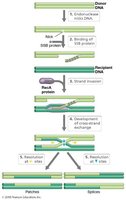
Homologous Recombination: Exchange of genetic material between similar DNA sequences, mediated by RecA protein.
Mechanism: Involves endonuclease nicking, helicase unwinding, single-strand binding protein attachment, and strand invasion.
Transposable Elements
Types of Transposable Elements
Insertion Sequences (IS): The simplest transposable elements, containing only the genes required for transposition.
Composite Transposons: Contain additional genes, such as antibiotic resistance genes, flanked by insertion sequences.
Simple Transposition (Cut-and-Paste)
Transposase enzyme excises the transposable element and integrates it into a new site in the genome.
Bacterial Plasmids—F Factors and Insertions
F Factors
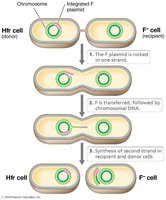
F (fertility) factors carry genes for the formation of the sex pilus, enabling DNA transfer during conjugation.
Insertion sequences on F factors facilitate plasmid integration into the bacterial chromosome.
Bacterial Conjugation
Mechanism
Requires direct cell-to-cell contact, mediated by the F pilus.
DNA transfer is unidirectional, from donor (F+ or Hfr) to recipient (F−).
Bacterial Transformation
Mechanism
Uptake of naked DNA fragments from the environment by a competent cell.
Incorporation of the DNA into the recipient genome by homologous recombination.
Transduction
Generalized Transduction
Any part of the bacterial genome can be transferred by a lytic bacteriophage.
During viral assembly, host DNA fragments may be mistakenly packaged into phage particles, creating generalized transducing particles.
Specialized Transduction
Only specific portions of the bacterial genome are transferred by temperate phages during lysogeny.
Occurs when a prophage is incorrectly excised, carrying adjacent bacterial genes with it.
Additional info: These mechanisms are central to microbial genetics and evolution, influencing traits such as antibiotic resistance, pathogenicity, and metabolic diversity.
