 Back
BackMetabolic Strategies and Energy Flow in Microorganisms
Study Guide - Smart Notes
 Tailored notes based on your materials, expanded with key definitions, examples, and context.
Metabolic Strategies in Microorganisms
Overview of Metabolism
Metabolism encompasses all chemical reactions within a cell, divided into two main categories: catabolism (breaking down molecules to release energy) and anabolism (using energy to build cellular components). Prokaryotes (bacteria and archaea) exhibit a greater diversity of metabolic pathways compared to eukaryotes, allowing them to thrive in a wide range of environments.
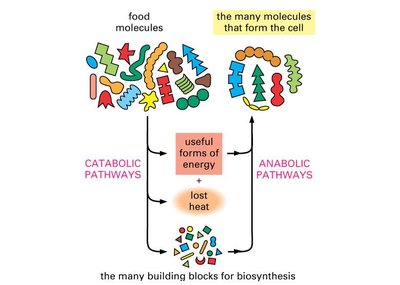
Catabolic pathways break down food molecules, releasing useful forms of energy and building blocks for biosynthesis.
Anabolic pathways use these building blocks and energy to synthesize the many molecules that form the cell.
Catabolism: Energy and Carbon Acquisition
Major Metabolic Types
Microorganisms utilize a variety of strategies to obtain energy (for ATP synthesis) and carbon (for biosynthesis). These strategies are classified based on the source of energy and the source of carbon:
Phototrophs: Use light as an energy source.
Chemotrophs: Use chemicals as an energy source, subdivided into:
Chemoorganotrophs: Oxidize organic compounds (e.g., glucose).
Chemolithotrophs: Oxidize inorganic compounds (e.g., H2, Fe2+).
Autotrophs: Use CO2 or other simple molecules as a carbon source.
Heterotrophs: Use organic molecules as a carbon source.
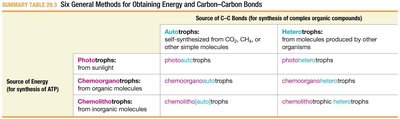
Table Purpose: This table classifies organisms by their energy and carbon sources, showing the diversity of metabolic strategies in prokaryotes.
Metabolic Diversity in Prokaryotes
Prokaryotes can combine these strategies in six observed ways, while eukaryotes are limited to two.
Examples include photoautotrophs (e.g., cyanobacteria), chemoorganoheterotrophs (e.g., most bacteria), and chemolithoautotrophs (e.g., nitrifying bacteria).
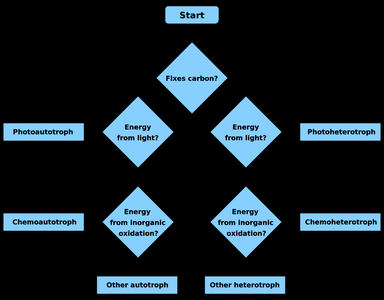
Phototrophy, Chemolithotrophy, and Chemoorganotrophy
Phototrophy: Light energy is converted to chemical energy. Includes oxygenic (produces O2) and anoxygenic (does not produce O2) photosynthesis.
Chemolithotrophy: Energy from oxidation of inorganic compounds. Specialized groups oxidize specific substrates.
Chemoorganotrophy: Energy from oxidation of organic compounds. Oxygen requirements vary.
Summary Table: Metabolic Pathways
Type | Energy Source | Carbon Source | Example |
|---|---|---|---|
Photoautotroph | Light | CO2 | Cyanobacteria |
Photoheterotroph | Light | Organic compounds | Rhodobacter |
Chemoorganoautotroph | Organic compounds | CO2 | Some archaea |
Chemoorganoheterotroph | Organic compounds | Organic compounds | Most bacteria |
Chemolithoautotroph | Inorganic compounds | CO2 | Nitrosomonas |
Chemolithoheterotroph | Inorganic compounds | Organic compounds | Some sulfur bacteria |
Enzyme Catalysis and Reaction Coupling
Role of Enzymes in Metabolism
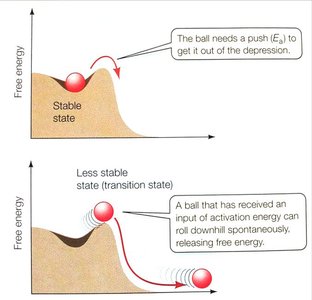
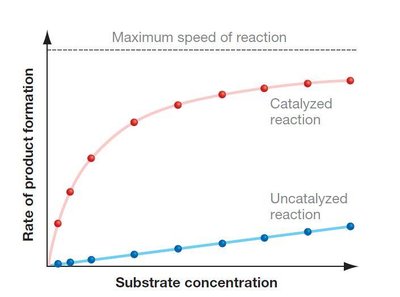
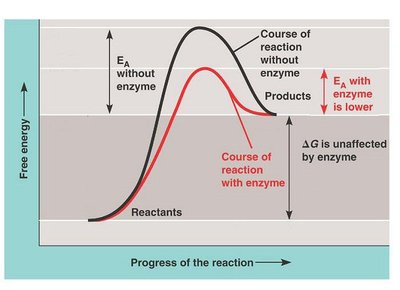
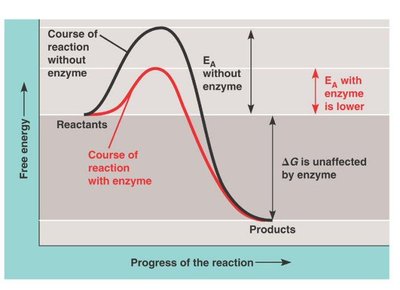
Enzymes are biological catalysts that accelerate chemical reactions by lowering the activation energy (EA) required. They do not alter the overall free energy change (ΔG) of a reaction, but allow reactions to proceed rapidly enough to sustain life.
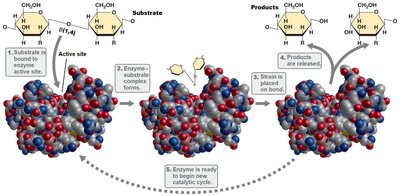
Enzymes bind substrates at their active site, facilitating the conversion to products.
Enzyme-catalyzed reactions are essential for both catabolic and anabolic pathways.
Reaction Coupling
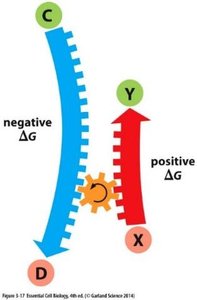
Cells drive energetically unfavorable (endergonic) reactions by coupling them to favorable (exergonic) reactions, often using ATP hydrolysis as the energy source.
Exergonic reactions release energy (ΔG < 0).
Endergonic reactions require energy input (ΔG > 0).
ATP acts as an activated carrier, linking catabolism and anabolism.
Energy-Rich Compounds and Redox Reactions
ATP and Electron Carriers
Energy-rich compounds such as ATP and electron carriers (e.g., NAD+/NADH, NADP+/NADPH) store and transfer energy within the cell. These molecules facilitate the transfer of high-energy electrons during metabolic reactions.
ATP stores energy in its phosphate bonds.
NAD+ and NADP+ shuttle electrons between metabolic pathways.
Redox Reactions in Metabolism
Redox (reduction-oxidation) reactions are central to energy conservation in cells. Electrons are transferred from electron donors (oxidized) to electron acceptors (reduced), releasing energy that can be harnessed for ATP synthesis.
Reduction potential (E0') measures a molecule's tendency to donate or accept electrons (in volts).
Electron flow from a donor with a more negative E0' to an acceptor with a more positive E0' releases energy.
Glycolysis and Fermentation
Glycolysis
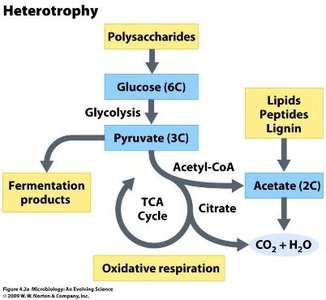
Glycolysis is a central metabolic pathway that converts glucose (6C) into pyruvate (3C) through a series of 10 enzyme-catalyzed reactions in the cytoplasm. It operates in both the presence and absence of oxygen and provides precursors for further energy extraction.
Consumes 2 ATP in the energy-investment phase.
Produces 4 ATP and 2 NADH in the energy-harvesting phase.
Net gain: 2 ATP and 2 NADH per glucose molecule.
ATP is produced by substrate-level phosphorylation.
Fate of Pyruvate: Respiration vs. Fermentation
After glycolysis, cells must regenerate NAD+ to continue ATP production. The fate of pyruvate depends on the availability of terminal electron acceptors:
Aerobic respiration: O2 is the final electron acceptor.
Anaerobic respiration: Other inorganic molecules (e.g., NO3-, SO42-) serve as electron acceptors.
Fermentation: Organic molecules act as electron acceptors, regenerating NAD+ without an electron transport chain.
Fermentation is diverse among microbes, producing various end products (e.g., ethanol, lactic acid) that can be beneficial or detrimental depending on the context.
Summary Table: Catabolic Pathways in Microbes
Pathway | Electron Acceptor | ATP Yield | Example Organisms |
|---|---|---|---|
Aerobic Respiration | O2 | High | Most bacteria, eukaryotes |
Anaerobic Respiration | NO3-, SO42-, etc. | Moderate | Denitrifying bacteria |
Fermentation | Organic molecules | Low | Yeast, lactic acid bacteria |
Additional info: The diversity of metabolic strategies in prokaryotes underpins their ecological success and ability to colonize extreme environments. Understanding these pathways is fundamental to microbiology, biotechnology, and environmental science.
