 Back
Methods in Microbial Ecology: Culture-Based and Culture-Independent Approaches Ch 19
Study Guide - Smart Notes
 Tailored notes based on your materials, expanded with key definitions, examples, and context.
Methods in Microbial Ecology Ch 19
Cultural-Based Methods
Cultural-based methods are traditional approaches in microbial ecology that involve growing microorganisms from environmental samples on selective media.Isolate collonies from environmental samples. These techniques allow for the isolation and study of specific microbes, but are limited by the fact that only a small fraction of environmental microbes can be cultured in the laboratory.
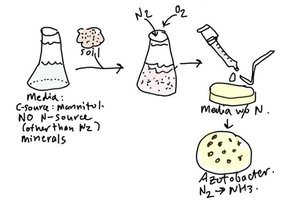
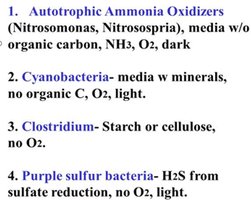
Enrichment Cultures: Consider what group of mircobes you are looking for. then make an isolation medium. Environmental samples are incubated with selective media to recover low-abundance microbes with specific metabolic capabilities. This method is useful for isolating microbes such as Azotobacter, which fix nitrogen. for autotrophic Ammonia Oxidizers you need organic carbon, NH3, O2, and dark. For Cayonbacteria you ned a media with no organic minerals, C, O2, and dark. For Colstridium you need starch or celluslose, no O2. For purple sulfur bacteria- you need H2S, no O2, and light
Plate Count Anomaly: Only 1-5% of microbes can be cultured on standard chemoheterotrophic lab media, highlighting the limitations of culture-based methods.
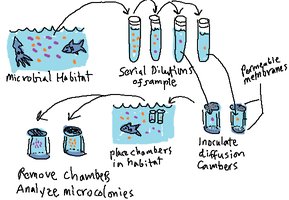
Diffusion Chambers: Some microbes can be cultured on a small scale in chambers permeable to small molecules, placed in their natural habitats (soil, water), allowing for the growth of otherwise uncultivable species.
Co-Culturing: Microbes in obligate mutualistic relationships may require co-culturing with their partner species for successful growth in the lab. tightly associated one cell by another, one metabolism what the other one needs.
Below is the picture on right of enrichment culture isolating N2-fixing bacteria. like Azotobacter. On left is diffusion chambers.
Examples of Selective Media for Microbial Isolation
Autotrophic Ammonia Oxidizers: Media without organic carbon, containing NH3, O2, and kept in the dark. Example genera: Nitrosomonas, Nitrospira.
Cyanobacteria: Media with minerals, no organic carbon, O2, and light.
Clostridium: Starch or cellulose as carbon source, no O2.
Purple Sulfur Bacteria: H2S from sulfate reduction, no O2, light.
Culture-Independent Methods
Culture-independent methods revolutionized microbial ecology by enabling the detection and analysis of uncultivable microbes. Detect a presence of microbial DNA. These techniques rely on molecular approaches, such as DNA extraction and sequencing, to characterize microbial communities directly from environmental samples. 16s gene is found in all living things without exception.
Environmental DNA Analysis: The presence of microbial genes in environmental DNA allows for the detection of uncultivable microbes.
16S rRNA Gene Sequencing: The small subunit ribosomal RNA gene (16S rDNA) is found in all life forms, mutates slowly, and contains regions unique to each genus, making it ideal for taxonomic identification.
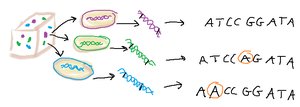
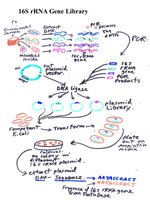
Sanger Sequencing and 16S rRNA Gene Libraries: Early culture-independent techniques involved cloning amplified 16S rRNA genes into plasmids, transforming E. coli, and sequencing the plasmid DNA to identify community members.
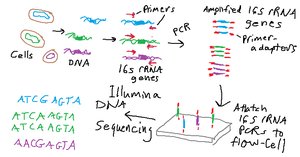
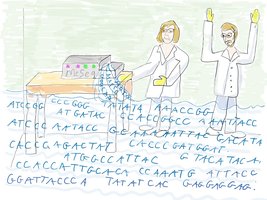
High-Throughput Sequencing (Illumina): Modern methods use Illumina sequencing to obtain millions of short 16S rRNA gene sequences, allowing for the detection of rare community members and comprehensive diversity analysis.
Operational Taxonomic Units (OTUs) and Community Analysis
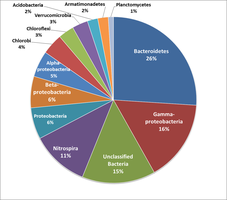
Sequencing results are grouped into operational taxonomic units (OTUs), which represent distinct microbial taxa. Rarefaction and Chao analysis estimate the diversity and sampling completeness of microbial communities. 21.1% Spingobacteriales
Fluorescence In Situ Hybridization (FISH)
FISH is a microscopy-based technique that uses fluorescent DNA probes to hybridize to specific DNA sequences within cells, allowing for the visualization and identification of microbial taxa in environmental samples. You can see what present taxonomic groups are present under a microscope.
FISH-MAR: Combines FISH with labeling using radioactive compounds (raido isotopes) to detect cells assimilating specific substrates, followed by autoradiography and taxonomic identification.
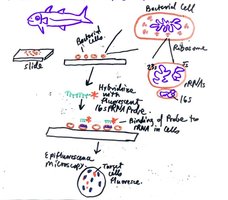
Illumina High-Throughput Sequencing of Amplified Environmental 16s rRNA genes
16s rRNA gene libraries from environmental DNA can also be prepared by PCR using Illumina DNA sequencing. Though resulting sequences short (400 base pairs) number of sequences obtained is much larger. No cloning step, millions of sequences
can detect rare members of microbial community
Method of choice now (2025)
Metagenomics
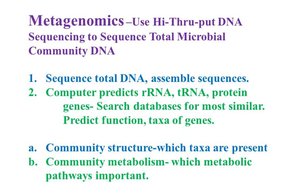
Metagenomics involves sequencing the total DNA from a microbial community, assembling sequences, and using computational tools to predict gene functions and taxonomic assignments. This approach provides insights into both community structure and metabolic potential. You can assemble the short reads into thousands of base pairs long. Once the long sequences of dNA are assembled you can have the computer make protein coding sequences, and identify the probale taxa involved, and what each gene 's function is.
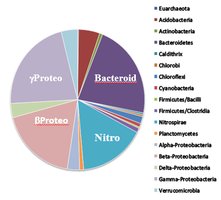
Community Structure: Determines which taxa are present in the sample.
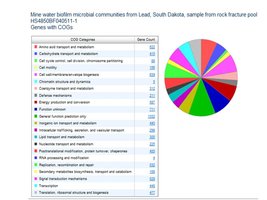
Community Metabolism: Identifies which metabolic pathways are important for survival and function within the community.
Figure on the top right and bottom left was the Mine Rock Pool Biofilm Metagenome (Metagenomes- determine which protein genes are important for survival-kind of metabolism in community)
Figure on bottom right-take cells from environment, separate them by flow celltromity, and label them with FISH and make a isolated cell and extract and amplify the DNA. then the bits of DNA amplified and do the Illumina DNA sequency, you get short bits of DNA and the computer sorts them together and assembles them, and basically sequence the entire genome of a cell using this sequence.
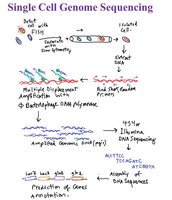
Single Cell Genome Sequencing
Single cell genome sequencing allows for the amplification and sequencing of the genome from an individual microbial cell, enabling the study of uncultivable microbes at the genomic level.
Multiple Displacement Amplification: Uses phi29 DNA polymerase to amplify genomic DNA from a single cell.
High-Throughput Sequencing: Sequencing technologies such as Illumina and 454 are used to assemble and annotate single cell genomes.
Challenges in Metagenomic Data Analysis
Analyzing metagenomic data from complex microbial communities presents several challenges:
High Diversity: Many species and strains may be present, making assembly and annotation difficult.
Short Reads: Sequencing technologies often produce short reads, complicating genome assembly.
Database Limitations: Functional and taxonomic predictions rely on existing databases, which may not cover all environmental microbes.
Bioinformatics Complexity: Requires advanced computational tools and expertise for data processing and interpretation.
Summary Table: Culture-Based vs. Culture-Independent Methods
Method | Principle | Advantages | Limitations |
|---|---|---|---|
Culture-Based | Grow microbes on selective media | Isolate and study physiology | Only small fraction culturable |
Culture-Independent | DNA extraction and sequencing | Detect uncultivable microbes, high diversity | Requires molecular tools, bioinformatics |
FISH | Fluorescent probes hybridize to DNA | Visualize taxa in situ | Requires probe design, microscopy |
Metagenomics | Sequence total community DNA | Functional and taxonomic analysis | Complex data analysis |
Single Cell Sequencing | Amplify genome from single cell | Study uncultivable microbes | Technical challenges, contamination |
Key Terms and Definitions
Enrichment Culture: A method to selectively grow microbes with specific metabolic traits from environmental samples.
Operational Taxonomic Unit (OTU): A group of closely related individuals used to classify microbes based on sequence similarity.
Metagenomics: The study of genetic material recovered directly from environmental samples.
16S rRNA Gene: A highly conserved gene used for phylogenetic analysis and identification of bacteria and archaea.
FISH: Fluorescence In Situ Hybridization, a technique for visualizing specific microbial taxa using fluorescent probes.
Example Applications
Enrichment of Diazotrophs: Isolating nitrogen-fixing bacteria such as Azotobacter from soil using media lacking nitrogen sources other than N2.
Illumina Sequencing: High-throughput sequencing of environmental 16S rRNA genes to assess microbial diversity in water samples.
Metagenomic Analysis: Determining the metabolic pathways and taxonomic composition of microbial communities in mine water biofilms.
