 Back
BackMicrobe-Human Ecosystem: The Human Microbiome and Its Role in Health
Study Guide - Smart Notes
 Tailored notes based on your materials, expanded with key definitions, examples, and context.
The Microbe-Human Ecosystem
Microbiome and Microbiota
The microbiome refers to all the microbes that share our body space, including bacteria, archaea, fungi, and viruses. Each person harbors a unique set of microbes, influenced by environment, diet, medications, and other factors. The human microbiota consists of 10-100 trillion symbiotic microbial cells, primarily bacteria in the gut and skin. The human microbiome is the collection of genes these microbes harbor. Global microbiome projects aim to understand the roles and impacts of these symbionts on human health.
Holobiont Concept
A holobiont includes the host, virome, microbiome, and any other organisms contributing to the functioning of the whole. Humans and their microbes live and evolve together, with microbial cells outnumbering human somatic cells. Microbes contribute over 8 million protein-encoding genes, compared to roughly 22,000 human genes.
Metagenomics and OTUs
Metagenomics originally referred to shotgun characterization of total DNA, now also includes studies of marker genes such as the 16S rRNA gene. Researchers study the stability of an individual's microbiome by analyzing Operational Taxonomic Units (OTUs), which are groups of bacteria with ≥97% sequence similarity in the 16S marker gene, used to classify bacteria at the genus level.
Normal Microbiota
Normal microbiota are microbes commonly associated with the human body, influenced by nutrition, age, body location, gender, and environment. Some microbes, such as Clostridium and Bacteroidales, survive only in anoxic and nutritionally unique environments in or on the human host.
Microbiome Development from Birth to Adulthood
Factors Influencing Microbial Diversity
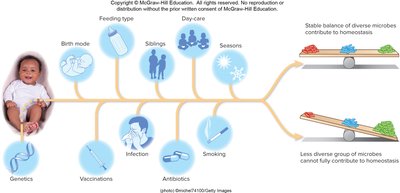
The normal community of mutualistic and commensal microbiota begins developing at birth and changes as we age. By age 3, we develop an adult-like community of microbes. Diversity is important for a stable microbiome.
Birth mode (vaginal vs. cesarean)
Feeding type (breastfed vs. formula)
Genetics
Vaccinations
Antibiotics
Day-care, siblings, seasons, infection, smoking
Bifidobacteria in the Infant Microbiome
Bifidobacteria are found in breastfed babies.
Can synthesize all amino acids and growth factors from simple carbohydrates.
Surface proteins bind sugars, fermenting them to provide calories and lower gut pH, limiting pathogen growth.
Microbiome Composition and Variation
Adult Human Microbiota
The adult microbiota is relatively stable but highly variable between individuals and body sites. Five major bacterial phyla are common:
Actinobacteria
Bacteroidetes
Firmicutes
Fusobacteria
Proteobacteria
Archaea, fungi, and viruses are also present. The average adult has 500-1000 different microbial species.
Microbiome by Body Site
Internal tissues (brain, blood, cerebrospinal fluid, muscles): normally free of microorganisms.
Surface tissues (skin, mucous membranes): colonized by various microbes.
Skin Microbiome
The skin is an inhospitable environment due to slightly acidic pH, high NaCl, low moisture, and antimicrobial peptides. Three environmental niches exist:
Dry (greatest microbial diversity)
Moist
Sebaceous (oil-containing sebum; lowest diversity)
Most skin bacteria are found on superficial cells, dead cells, or associated with oil and sweat glands. S. epidermidis is a resident bacterium, and Cutibacterium acnes degrades lipids in oil glands, contributing to acne vulgaris.
Acne Vulgaris
Caused in part by activities of Cutibacterium acnes.
Converts lipids to unsaturated fatty acids; some are volatile and odorous.
Sebum accumulates, providing a hospitable environment for C. acnes.
Respiratory Tract Microbiome
Upper respiratory tract (nostrils, sinuses, pharynx, oropharynx): colonized by diverse microbes.
Lower respiratory tract (larynx, trachea, bronchi, lungs): not sterile as previously thought.
Eye and External Ear Microbiome
Eye: Small numbers of bacteria, mainly Staphylococcus epidermidis, found on the conjunctiva.
External ear: Similar to skin flora, with negative staphylococci and Corynebacterium spp.
Mouth Microbiome
Colonized within hours of birth.
Anaerobes dominate due to anoxic spaces between teeth and gums.
Streptococcus spp. attach to enamel; S. salivarius colonizes cheeks and gums.
Produce adherence factors, contributing to dental plaque, caries, gingivitis, and periodontal disease.
Stomach Microbiome
Most microbes killed by acidic conditions.
Some bacteria and yeasts survive if they pass quickly or are resistant to gastric pH.
Large Intestine (Colon) Microbiome
Largest microbial population in the body.
Core genera include Bacteroides, Faecalibacterium, Clostridia, Prevotella, Coprococcus, and Ruminococcus.
Genitourinary Tract Microbiome
Kidneys, ureter, bladder: normally free of microbes.
Distal urethra: few microbes (S. epidermidis, E. faecalis, Corynebacterium spp.).
Female genital tract: complex microbiota, acid-tolerant lactobacilli predominate.
Functional Core Microbiome and Human Homeostasis
Functional Core Microbiome
Microbes that provide essential activities for health and homeostasis, such as vitamin K production by E. coli, production of essential amino acids, and emerging roles in human behavior.
Host Metabolism and Microbiome
Gut microbiota convert food into usable calories.
Obese individuals have higher concentrations of Firmicutes compared to Bacteroidetes.
Bacteria ferment complex polysaccharides into short-chain fatty acids, some promoting weight gain.
Germ-Free (GF) Mice Studies
GF mice are born by cesarean section and raised in sterility.
GF mice eat more but gain less weight than conventional mice.
Fecal microbiome transplant causes GF mice to become obese, showing the microbiome's role in metabolism.
Gut-Brain Axis
The gut microbiota can influence the central nervous system (CNS) through three main routes:
Effects on the immune system
Via the enteric nervous system, connected to the CNS by the vagus nerve
Through soluble microbial products like short-chain fatty acids
Microbiome Diversity, Dysbiosis, and Disease
Loss of Microbiome Diversity and Dysbiosis
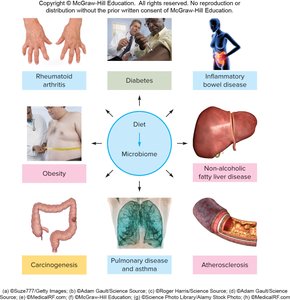
Loss of microbiome diversity leads to dysbiosis, which is associated with a variety of diseases involving inflammation, such as rheumatoid arthritis, diabetes, inflammatory bowel disease, obesity, non-alcoholic fatty liver disease, carcinogenesis, pulmonary disease, asthma, and atherosclerosis.
Metabolic Syndrome and Endotoxemia
Metabolic syndrome is characterized by large waist circumference, high triglycerides, high blood pressure, elevated LDL and fasting glucose.
Associated with chronic, low-level inflammation linked to the microbiome.
Metabolic endotoxemia is a persistent, low-grade inflammation due to increased circulating endotoxins, especially bacterial lipopolysaccharide (LPS).
High-fat diets increase plasma LPS, triggering metabolic endotoxemia and contributing to insulin resistance, obesity, and diabetes.
Probiotics and Synbiotics
Probiotics
Probiotics are live microorganisms that, when administered in adequate amounts, confer a health benefit to the host. The U.S. FDA does not regulate probiotic foods and supplements, so claimed health benefits are not rigorously tested.
Synbiotics
Synbiotics are foods or supplements that include both a prebiotic and a probiotic. Prebiotics are compounds added to enhance colonization and positive health benefits of probiotic microbes.

Summary Table: Microbiome by Body Site
Body Site | Microbial Characteristics | Common Genera |
|---|---|---|
Skin | Acidic, high NaCl, low moisture | S. epidermidis, Cutibacterium acnes |
Respiratory Tract | Diverse in URT, LRT not sterile | Streptococcus, Staphylococcus |
Eye | Low numbers, conjunctiva | S. epidermidis |
Mouth | Anaerobic, plaque formation | Streptococcus, Fusobacterium |
Stomach | Acidic, few survivors | Streptococcus, Lactobacillus, Candida |
Large Intestine | Largest population | Bacteroides, Faecalibacterium, Clostridia |
Genitourinary Tract | Acid-tolerant, flux | Lactobacilli, S. epidermidis |
Key Terms and Definitions
Microbiome: The collection of microbes and their genes in a particular environment.
Microbiota: The microbial taxa associated with humans.
Holobiont: The host and all its associated microorganisms.
Metagenomics: Study of genetic material recovered directly from environmental samples.
OTU: Operational Taxonomic Unit, a group of organisms classified together based on DNA sequence similarity.
Dysbiosis: Disruption of the normal microbiome, often associated with disease.
Probiotic: Live microorganisms conferring health benefits.
Synbiotic: Combination of prebiotics and probiotics.
