 Back
BackMicrobial Biosynthesis and Metabolic Pathways
Study Guide - Smart Notes
 Tailored notes based on your materials, expanded with key definitions, examples, and context.
Biosynthesis and Metabolism in Microorganisms
Overview of Microbial Metabolism
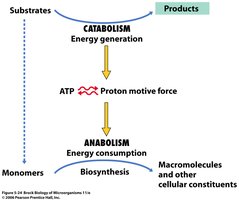
Microbial metabolism encompasses the biochemical reactions that allow microorganisms to generate energy and synthesize cellular components. These processes are divided into catabolism (energy generation) and anabolism (biosynthesis and energy consumption).
Catabolism: Breakdown of substrates to generate energy, typically in the form of ATP and proton motive force.
Anabolism: Utilization of energy to synthesize macromolecules and cellular constituents from monomers.
Acetogenesis in Acetobacterium woodii
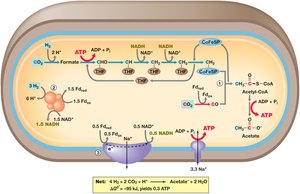
Acetogenesis is a microbial process where acetate is produced from hydrogen and carbon dioxide. This pathway is significant in anaerobic environments and involves complex electron transfers and ATP generation.
Key Steps: Reduction of CO2 to formate, then to acetyl-CoA, and finally to acetate.
Energy Conservation: ATP is generated via substrate-level phosphorylation and sodium ion gradients.
Applications: Important in carbon cycling and bioenergy production.
Biosynthesis of Sugars and Polysaccharides
Hexose and Pentose Formation
Microorganisms synthesize hexoses (e.g., glucose) and pentoses (e.g., ribose) through various metabolic pathways. These sugars are essential for energy storage and nucleic acid synthesis.
Hexoses: Obtained from the environment or synthesized via gluconeogenesis, using intermediates from glycolysis and the citric acid cycle.
Pentoses: Produced by decarboxylation of hexoses, primarily through the pentose phosphate pathway.
Pentose Phosphate Pathway
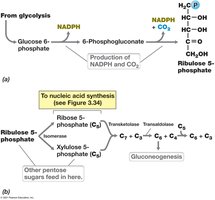
The pentose phosphate pathway is crucial for generating ribose-5-phosphate for nucleic acid synthesis and NADPH for reductive biosynthetic reactions.
Key Steps: Conversion of glucose-6-phosphate to ribulose-5-phosphate, producing NADPH and CO2.
Importance: Supplies precursors for nucleotide biosynthesis and reducing power for anabolic reactions.
Polysaccharide Biosynthesis
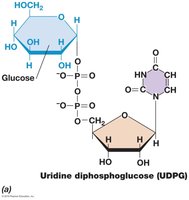
Polysaccharides such as glycogen, starch, peptidoglycan, and lipopolysaccharide are synthesized from activated glucose derivatives like UDP-glucose (UDPG) or ADP-glucose (ADPG).
Activation: Glucose is activated by attachment to nucleotide diphosphates.
Polymerization: Activated glucose units are added to growing polysaccharide chains.

Biosynthesis of Amino Acids
Sources of Carbon Skeletons and Amino Groups
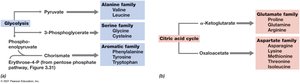
Amino acids are synthesized from carbon skeletons derived from glycolysis or the citric acid cycle, and their amino groups are incorporated from inorganic nitrogen sources such as ammonia.
Carbon Skeletons: Intermediates like pyruvate, phosphoenolpyruvate, and oxaloacetate serve as precursors.
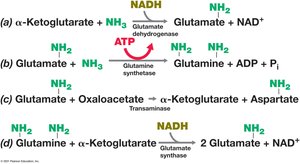
Amino Group Incorporation: Enzymes such as glutamate dehydrogenase and glutamine synthetase facilitate ammonia assimilation.
Ammonia Incorporation in Bacteria
Bacteria assimilate ammonia through two main pathways: the glutamate dehydrogenase pathway and the glutamine synthetase pathway.
Glutamate Dehydrogenase: Converts α-ketoglutarate and NH3 to glutamate.
Glutamine Synthetase: Converts glutamate and NH3 to glutamine, using ATP.
Transaminases: Transfer amino groups to other carbon skeletons to form various amino acids.
Citric Acid Cycle in Biosynthesis
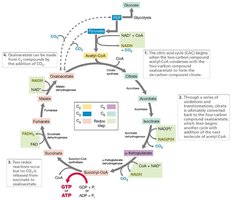
The citric acid cycle provides key intermediates for biosynthetic pathways, including amino acid and nucleotide synthesis.
Intermediates: Oxaloacetate, α-ketoglutarate, and succinyl-CoA are used for biosynthesis.
Link to Energy Metabolism: The cycle also generates ATP, NADH, and FADH2.
Biosynthesis of Nucleotides
Purine and Pyrimidine Synthesis
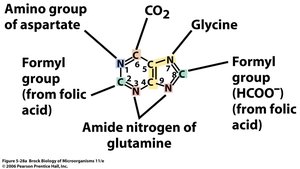
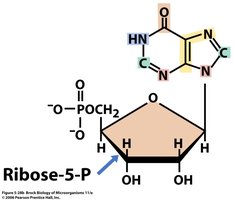
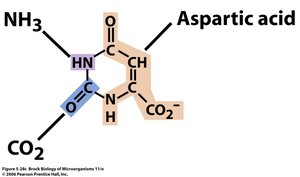
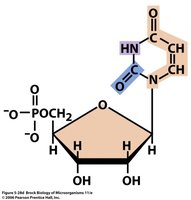
Nucleotide biosynthesis involves assembling carbon and nitrogen atoms from various sources. Inosinic acid is the precursor for purines, while uridylate is the precursor for pyrimidines.
Purines: Adenine (A) and guanine (G) are synthesized from inosinic acid.
Pyrimidines: Cytosine (C), thymine (T), and uracil (U) are synthesized from uridylate.
Key Sources: Carbon from CO2, glycine, and formyl groups; nitrogen from glutamine and aspartate.
Biosynthesis of Fatty Acids and Lipids
Fatty Acid Synthesis
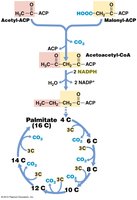
Fatty acids are synthesized by the sequential addition of two-carbon units (acetyl groups) to a growing chain, which is held by an acyl carrier protein (ACP). Lipids are formed by combining fatty acids with glycerol, phosphate, and various sugars.
Key Steps: Acetyl-ACP and malonyl-ACP are condensed, and the chain is elongated by repeated cycles.
Energy Requirement: NADPH is used for reduction steps during fatty acid synthesis.
Lipid Formation: Fatty acids are esterified to glycerol and modified with phosphate or sugars to form complex lipids.
Additional Metabolic Pathways
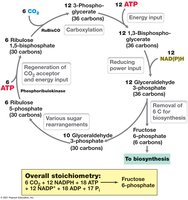
The Calvin-Benson Cycle
The Calvin-Benson cycle is the primary pathway for carbon fixation in autotrophic microorganisms, converting CO2 into organic compounds.
Key Steps: Carboxylation of ribulose-1,5-bisphosphate, reduction of 3-phosphoglycerate, and regeneration of ribulose-5-phosphate.
Energy Requirement: ATP and NADPH are consumed during the cycle.
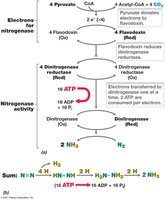
Biological Nitrogen Fixation
Nitrogen fixation is the process by which atmospheric nitrogen (N2) is converted to ammonia (NH3) by the enzyme nitrogenase. This process is essential for providing bioavailable nitrogen for biosynthesis.
Key Steps: Electron transfer to nitrogenase, ATP consumption, and reduction of N2 to NH3.
Importance: Supports growth in nitrogen-limited environments.
Summary Table: Key Biosynthetic Pathways
Pathway | Main Products | Key Precursors | Energy Requirement |
|---|---|---|---|
Pentose Phosphate Pathway | Ribose-5-phosphate, NADPH | Glucose-6-phosphate | None (produces NADPH) |
Gluconeogenesis | Glucose | Phosphoenolpyruvate, oxaloacetate | ATP, GTP |
Amino Acid Biosynthesis | Amino acids | Glycolysis/citric acid cycle intermediates, NH3 | ATP, NADPH |
Nucleotide Biosynthesis | Purines, pyrimidines | Ribose-5-phosphate, amino acids | ATP, NADPH |
Fatty Acid Synthesis | Fatty acids | Acetyl-CoA, malonyl-CoA | NADPH |
Conclusion
Microbial biosynthesis is a complex, highly regulated process that enables microorganisms to produce essential cellular components. Understanding these pathways is fundamental to microbiology, biotechnology, and environmental science.
