 Back
BackMicrobial Biosynthesis, Carbon Fixation, and Nitrogen Metabolism
Study Guide - Smart Notes
 Tailored notes based on your materials, expanded with key definitions, examples, and context.
Biosynthesis and Anabolism in Microbes
Overview of Biosynthesis
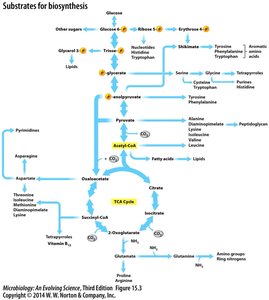
Biosynthesis, also known as anabolism, is the process by which cells build complex biomolecules from simpler substrates. This process is essential for cell growth, maintenance, and reproduction. - Key Point 1: Biosynthesis requires essential elements (C, H, O, N, and others), reducing agents (such as NADPH), and energy (from ATP hydrolysis, NADPH oxidation, or ion gradients). - Key Point 2: Many biosynthetic substrates are derived from glycolysis and the TCA cycle. - Key Point 3: Microbes regulate biosynthesis to conserve energy and resources, employing strategies such as regulation, competition, predation, genome loss, and cooperation. 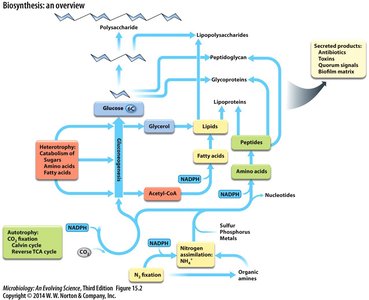
Biosynthesis Spends Energy
The synthesis of biomolecules is energetically costly. Enzymes couple biosynthetic reactions to energy-releasing reactions to drive the process forward. - Key Point: The energetic and genomic costs of biosynthesis have led microbes to evolve regulatory mechanisms to optimize resource use.
Carbon Fixation Pathways
Overview of Carbon Fixation
Carbon fixation is the process by which inorganic carbon (CO2) is converted into organic compounds. This is a fundamental process in autotrophic organisms, including many bacteria and archaea. - Key Point 1: The Calvin cycle is the most common carbon fixation pathway in photoautotrophs and chloroplasts. - Key Point 2: Other pathways include the reductive (reverse) TCA cycle and the reductive acetyl-CoA pathway, which are used by certain bacteria and archaea.
Pathway | Bacteria | Archaea | Eukaryotes |
|---|---|---|---|
Calvin cycle | Cyanobacteria, purple phototrophs, lithotrophs | Rubisco homologs appear, function unclear | Chloroplasts |
Reductive (reverse) TCA cycle | Green sulfur phototrophs, lithotrophs | Hyperthermophilic sulfur oxidizers, Thermoproteus, Pyrobaculum | Anaplerotic reactions fix CO2 to regenerate TCA intermediates |
Reductive acetyl-CoA pathway | Acetogenic bacteria, methanogens | Methanogens, acetogens | None known |
3-Hydroxypropionate cycle | Green phototrophs | Sulfur oxidizers | None known |
The Calvin Cycle
The Calvin cycle is the primary pathway for carbon fixation in many autotrophic organisms. It consists of three main phases: carboxylation and splitting, reduction, and regeneration. - Phase 1: Carboxylation and Splitting Ribulose 1,5-bisphosphate condenses with CO2 and H2O to form a 6C molecule, which immediately splits into two 3-phosphoglycerate (PGA) molecules. This reaction is catalyzed by the enzyme Rubisco. - Phase 2: Reduction PGA is phosphorylated by ATP and reduced by NADPH to form glyceraldehyde 3-phosphate (G3P). - Phase 3: Regeneration Most G3P molecules are used to regenerate ribulose 1,5-bisphosphate; one out of six is used for biosynthesis. 
Rubisco: The CO2-Fixing Enzyme
Rubisco (ribulose-1,5-bisphosphate carboxylase/oxygenase) is a highly conserved enzyme found in bacteria and chloroplasts. - Key Point: Rubisco consists of large (L) and small (S) subunits; the large subunit contains the catalytic site. - Key Point: Rubisco catalyzes the condensation of CO2 to ribulose 1,5-bisphosphate and the splitting of the unstable 6C intermediate into two 3C PGA molecules. 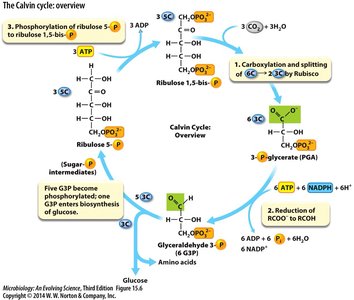
Calvin Cycle in Detail
The Calvin cycle involves a series of enzymatic reactions that regenerate ribulose 1,5-bisphosphate and produce sugars for biosynthesis. 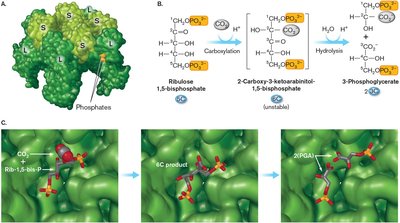
Alternative Carbon Fixation Pathways
Reverse (Reductive) TCA Cycle
Some anaerobic bacteria and archaea use the reverse TCA cycle to fix CO2. - Key Point: The reverse TCA cycle uses ATP and reducing agents (NADPH, NADH, ferredoxin) to convert CO2 into acetyl-CoA and other intermediates. - Key Point: Anaplerotic reactions regenerate TCA cycle intermediates, allowing small amounts of CO2 fixation. 
Reductive Acetyl-CoA Pathway
This pathway is used by certain anaerobic bacteria and archaea to fix CO2 into acetyl-CoA. - Key Point: The pathway involves formic acid, carbon monoxide, and acetyl-CoA synthase complex. 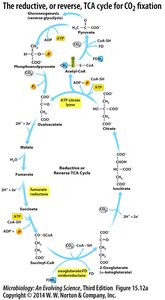
Nitrogen Metabolism
Nitrogen Assimilation
Nitrogen is an essential element for all living organisms, required for the synthesis of amino acids, nucleotides, and other biomolecules. - Key Point: Microbes assimilate nitrogen from various sources, including ammonium (NH4+), nitrate (NO3-), and atmospheric N2. 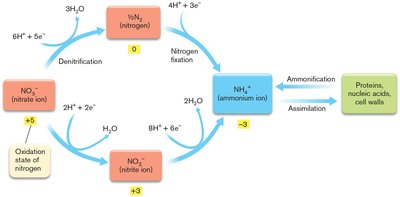
Nitrogen Fixation
Nitrogen fixation is the conversion of atmospheric nitrogen (N2) into ammonia (NH3), a form usable by living organisms. - Key Point: Nitrogen fixation is catalyzed by the enzyme nitrogenase and is highly energy-intensive. - Key Point: The overall reaction is: - Key Point: About 28 ATPs are consumed per N2 fixed. 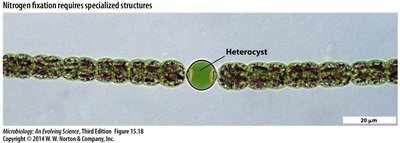
Mechanism of Nitrogen Fixation
Nitrogen fixation requires four reduction cycles through nitrogenase: 1. Fe protein acquires 2e- from an electron transport protein and transfers them to the FeMo center. 2. The FeMo center binds 2H+, which are reduced to H2 gas. 3. N2 binds to the active site, displacing H2. 4. Successive pairs of H+ and e- reduce N2 to NH3. 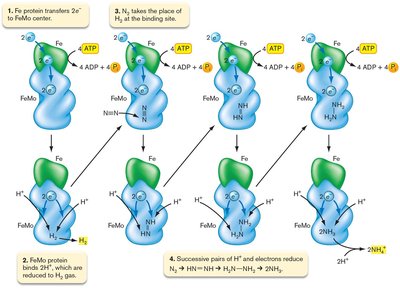
The Nitrogen Cycle
The nitrogen cycle describes the movement of nitrogen through the environment, including fixation, nitrification, and denitrification. - Key Point: Both reduced and oxidized forms of nitrogen are assimilated into biomass. - Key Point: Nitrification converts NH3 to NO2- and NO3-; denitrification returns N2 to the atmosphere. 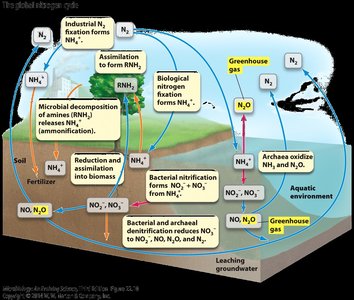
Rhizobium-Legume Symbiosis
The most important N2-fixing symbiosis is between rhizobia and legumes. - Key Point: Legumes (peas, beans, peanuts, clover, alfalfa) form root nodules containing rhizobium bacteria, which fix nitrogen. - Key Point: When the plant dies, its tissues decompose, enriching the soil with nitrogen. 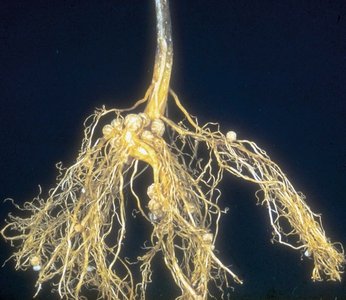
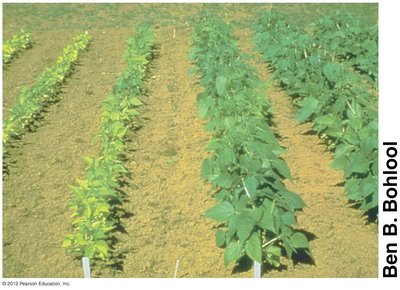
Metabolic Exchange in Root Nodules
Within root nodules, plant cells and rhizobia exchange metabolites to facilitate nitrogen fixation. - Key Point: Plant cytoplasm provides sugars and organic acids; rhizobia use these to generate energy and fix nitrogen. - Key Point: Leghemoglobin regulates oxygen levels to protect nitrogenase activity. 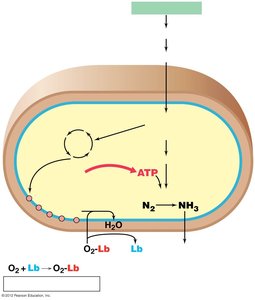
Summary Table: Key Pathways and Enzymes
Process | Key Enzyme | Energy Requirement | Microbial Groups |
|---|---|---|---|
Calvin Cycle | Rubisco | ATP, NADPH | Cyanobacteria, chloroplasts |
Reverse TCA Cycle | Citrate synthase, others | ATP, NADPH, FdH2 | Green sulfur bacteria, archaea |
Reductive Acetyl-CoA Pathway | Acetyl-CoA synthase | ATP | Acetogenic bacteria, methanogens |
Nitrogen Fixation | Nitrogenase | ATP | Rhizobia, cyanobacteria |
Additional info: These notes expand on the original content by providing definitions, context, and examples for each pathway and process, ensuring completeness and academic quality for exam preparation.
