 Back
BackMicrobial Cell Structure and Function: Study Guide
Study Guide - Smart Notes
 Tailored notes based on your materials, expanded with key definitions, examples, and context.
Microbial Cell Structure and Function
Overview of Microbial Cell Structures
Microbial cells possess a variety of structural components that enable them to interact with their environment, maintain integrity, and perform essential functions. The cell envelope is a key feature, providing protection and mediating exchanges with the surroundings.
Cytoplasmic (Cell) Membrane: Selective permeability, energy metabolism, protein anchoring.
Cell Wall: Provides shape, rigidity, and prevents osmotic lysis.
Outer Membrane (Gram-negative only): Offers additional protection and contributes to virulence.
Capsule: Enhances virulence and immune evasion.
Fimbriae: Facilitates attachment to surfaces.
Pili: Enables DNA transfer (conjugation).
Flagella: Responsible for motility.
Inclusions: Stores nutrients and energy.
Endospores: Ensures survival under harsh conditions.
The Cell Envelope
The cell envelope is a layered system surrounding the cytoplasm, crucial for protection and environmental interaction. Its composition varies among microbial groups.
Cytoplasmic membrane: Present in all cells.
Cell wall: Found in most bacteria.
Outer membrane: Exclusive to Gram-negative bacteria.
S-layer: Present in some Bacteria and Archaea.
Cytoplasmic (Cell) Membrane
The cytoplasmic membrane is a phospholipid bilayer, typically 8–10 nm thick, with embedded proteins. It is essential for selective permeability, nutrient uptake, waste removal, energy metabolism, and protein anchoring.
Structure: Hydrophobic fatty acid tails face inward; hydrophilic phosphate heads face outward.
Membrane Proteins: Integral (transmembrane) proteins span the membrane; Peripheral proteins are loosely attached.
Membrane Differences Across Domains
Bacteria and Eukarya have membranes with ester-linked fatty acids, while Archaea possess ether-linked isoprenoid chains, which can form lipid monolayers for extreme stability.
Bacteria & Eukarya: Ester linkages, fatty acid chains.
Archaea: Ether linkages, isoprenoid chains, lipid monolayers.
Cell Wall
The cell wall prevents osmotic lysis and maintains cell shape. In bacteria, it is composed of peptidoglycan, a polymer of alternating N-acetylglucosamine (NAG) and N-acetylmuramic acid (NAM) linked by β-1,4 glycosidic bonds and cross-linked peptides.
Peptidoglycan: Unique to bacteria; absent in Archaea and Eukarya.

Gram-Positive vs Gram-Negative Bacteria
Bacteria are classified based on their cell wall structure, which affects their staining properties and susceptibility to antibiotics.
Gram-Positive: Thick peptidoglycan (20–35 nm), teichoic acids, no outer membrane. Example: Staphylococcus
Gram-Negative: Thin peptidoglycan, outer membrane with LPS, periplasmic space. Example: E. coli
Lysozyme & Antibiotics
Lysozyme and antibiotics target bacterial cell walls, leading to cell lysis.
Lysozyme: Breaks β-1,4 bonds in peptidoglycan.
Penicillin: Blocks peptide cross-linking in peptidoglycan.
Archaeal Cell Walls
Archaea lack peptidoglycan and often possess S-layers. Methanogens have pseudomurein, which is resistant to lysozyme and penicillin due to β-1,3 bonds and all L-amino acids.
S-layers: Protein shell found in some Archaea.
Pseudomurein: Peptidoglycan-like polymer in methanogenic Archaea.
Gram-Negative Outer Membrane (LPS)
The outer membrane of Gram-negative bacteria contains lipopolysaccharide (LPS), which is important for protection and pathogenicity.
LPS Components: O-polysaccharide (antigenic), core polysaccharide, lipid A (endotoxin).
Other Features: Porins (transport), Braun lipoprotein (anchors OM), periplasm (enzymes & proteins).
S-Layers
S-layers are protein or glycoprotein lattices that provide protection, shape, and adhesion. They are found in some Bacteria and Archaea.
Cell Surface Structures
Microbial cells may possess capsules, slime layers, pili, fimbriae, and hami, which aid in protection, attachment, and biofilm formation.
Capsules & Slime Layers: Polysaccharide coating prevents phagocytosis and aids in biofilms.
Pili & Fimbriae: Fimbriae for attachment; sex pili for conjugation; type IV pili for twitching motility.
Hami (Archaea): Grappling-hook structures for surface attachment.
Cell Inclusions
Cell inclusions are storage structures for nutrients and energy, and may also aid in buoyancy and navigation.
Types: PHB/PHA (carbon storage), glycogen, polyphosphate granules, sulfur granules, carbonate minerals, gas vesicles (buoyancy), magnetosomes (magnetotaxis).
Endospores
Endospores are highly resistant survival structures produced by certain Gram-positive bacteria, such as Bacillus and Clostridium. They contain dipicolinic acid and SASPs to protect DNA.
Stages of Germination: Activation, germination, outgrowth.
Resistance: Heat, radiation, chemicals.
Flagella & Motility
Flagella are motility structures powered by the proton motive force. Their arrangement varies among species.
Arrangements: Polar, lophotrichous, amphitrichous, peritrichous.
Energy Source: Proton motive force.
Surface Motility
Microbes can move across surfaces using twitching (type IV pili + ATP) or gliding (smooth movement without flagella).
Chemotaxis & Taxis
Chemotaxis is movement toward or away from chemicals, while other taxis include phototaxis, aerotaxis, osmotaxis, hydrotaxis, and magnetotaxis.
Run & Tumble: Characteristic movement in E. coli.
Endosymbiotic Theory
The endosymbiotic theory explains the origin of mitochondria and chloroplasts in eukaryotes, suggesting they evolved from bacteria inside host cells. Evidence includes circular DNA, bacterial-like ribosomes, and double membranes.
Mitochondria: Derived from bacteria.

Chloroplasts: Derived from cyanobacteria.

Microbial Morphology and Arrangement
Bacteria exhibit diverse shapes and arrangements, which can be distinguished microscopically. Pathogenicity cannot be determined by morphology alone.
Cocci: Spherical (e.g., Staphylococcus).
Rods (Bacilli): Elongated (e.g., E. coli).
Spirilla: Spiral-shaped.
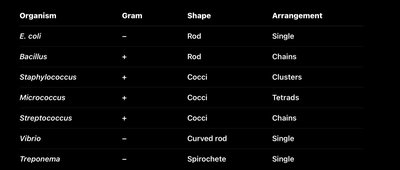
Table: Gram Reaction, Shape, and Arrangement of Common Bacteria
Organism | Gram | Shape | Arrangement |
|---|---|---|---|
E. coli | − | Rod | Single |
Bacillus | + | Rod | Chains |
Staphylococcus | + | Cocci | Clusters |
Micrococcus | + | Cocci | Tetrads |
Streptococcus | + | Cocci | Chains |
Vibrio | − | Curved rod | Single |
Treponema | − | Spirochete | Single |
Prokaryotic vs Eukaryotic Cells
Prokaryotes (bacteria, archaea) lack a nucleus and organelles, while eukaryotes (animals, plants, fungi) possess these structures.
Reproduction
Bacteria: Binary fission.
Fungi: Spores/budding.
Plants: Sexual & asexual.
Animals: Sexual.
Do Bacteria Have Cilia?
Bacteria do not possess cilia; cilia are exclusive to eukaryotic cells.

Endospores vs Fungal Spores
Endospores: Survival structures.
Fungal Spores: Reproductive structures.
Phototaxis
Phototaxis is the movement of organisms toward or away from light, an important behavior for optimizing energy acquisition.
Key Equations and Concepts
Peptidoglycan Structure: $\text{NAG} - \beta-1,4 - \text{NAM}$
Binary Fission: $\text{Cell} \rightarrow 2 \text{Cells}$
Summary Table: Unique Features of Gram-Positive and Gram-Negative Bacteria
Feature | Gram-Positive | Gram-Negative |
|---|---|---|
Teichoic acids | Present | Absent |
Outer membrane | Absent | Present |
LPS | Absent | Present |
Periplasm | Absent | Present |
Additional info: Academic context was added to clarify structural differences, functions, and examples for each microbial component.
