 Back
BackMicrobial Classification, Phylogeny, and the Three-Domain System
Study Guide - Smart Notes
 Tailored notes based on your materials, expanded with key definitions, examples, and context.
Classification and Nomenclature in Microbiology
Principles of Classification
Classification in microbiology involves organizing organisms into groups based on phenotypic similarity or evolutionary relationships. This hierarchical system allows scientists to understand relationships among organisms and to communicate about them effectively.
Classification: The systematic arrangement of organisms into groups based on shared characteristics or ancestry.
Nomenclature: The assignment of names to organisms, following standardized rules.
Binomial System: Prokaryotes are named using a two-part system (genus and species), regulated by the International Code of Nomenclature of Bacteria.
Species Concepts in Microbiology
Species definitions differ between eukaryotes and prokaryotes due to their modes of reproduction and genetic diversity.
Eukaryotic species: Groups of closely related organisms that breed among themselves.
Prokaryotic species: Populations of cells with similar characteristics.
Clone: A population of cells derived from a single cell.
Strain: Genetically distinct cells within a clone, often identified by numbers or letters.
Molecular Phylogeny and the Tree of Life
Foundations of Molecular Phylogeny
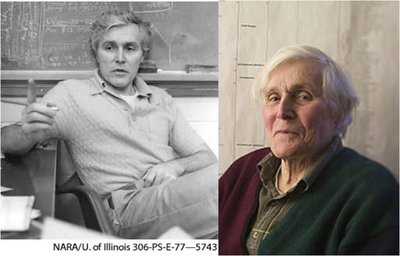
Molecular phylogeny uses genetic information to infer evolutionary relationships. Carl Woese pioneered the use of ribosomal RNA (rRNA) genes for this purpose, leading to the recognition of three domains of life: Bacteria, Archaea, and Eukarya.
Phylogeny: The evolutionary history of a group of organisms, often inferred from nucleotide sequence data.
Universal Phylogenetic Tree: Based on small subunit (SSU) rRNA genes, this tree represents the genealogy of all life on Earth.
Domains of Life: Bacteria, Archaea, and Eukarya.
Why Use Ribosomal RNA Genes?
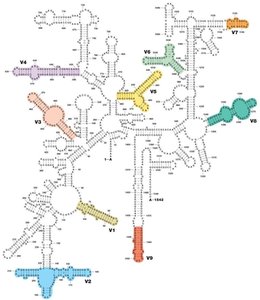
Small subunit rRNA genes (16S in prokaryotes, 18S in eukaryotes) are ideal for phylogenetic studies because they are universally present, functionally constant, highly conserved, and of sufficient length to provide evolutionary information.
16S rRNA: Used for prokaryotes.
18S rRNA: Used for eukaryotes.
Conserved and Variable Regions: Allow for both universal amplification and discrimination among taxa.
Steps in Molecular Phylogenetic Analysis
The process of constructing a phylogenetic tree from rRNA genes involves several key steps:
Isolate DNA from each organism.
Amplify the rRNA gene using PCR.
Sequence the DNA.
Align the rRNA gene sequences.
Generate a phylogenetic tree based on sequence similarities and differences.
The Three Domains of Life
The three-domain system divides all cellular life into Bacteria, Archaea, and Eukarya, each with distinct genetic and biochemical characteristics.
Bacteria: At least 80 major evolutionary groups (phyla), many known only from environmental sequences.
Archaea: Seven major phyla, including Crenarchaeota, Euryarchaeota, Nanoarchaeota, Korarchaeota, and Thaumarchaeota. Some phyla lack cultivatable species.
Eukarya: Includes plants, animals, fungi, and protists.
Comparative Characteristics of the Three Domains
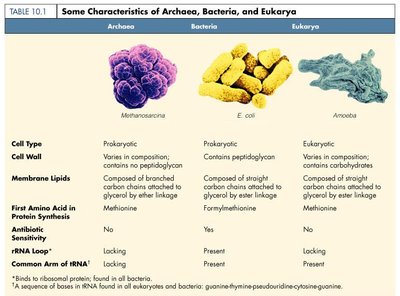
The following table summarizes key differences among Archaea, Bacteria, and Eukarya:
Archaea | Bacteria | Eukarya | |
|---|---|---|---|
Cell Type | Prokaryotic | Prokaryotic | Eukaryotic |
Cell Wall | Varies; no peptidoglycan | Contains peptidoglycan | Varies; contains carbohydrates |
Membrane Lipids | Branched carbon chains attached to glycerol by ether linkage | Straight carbon chains attached to glycerol by ester linkage | Straight carbon chains attached to glycerol by ester linkage |
First Amino Acid in Protein Synthesis | Met | Formylmethionine | Met |
Antibiotic Sensitivity | No | Yes | No |
rRNA Loop | Lacking | Present | Lacking |
Common Arm of tRNA | Lacking | Present | Present |
Prokaryotic Cells and Eukaryotic Organelles Compared
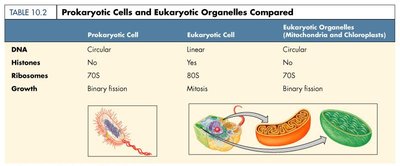
Some eukaryotic organelles, such as mitochondria and chloroplasts, share features with prokaryotic cells, supporting the endosymbiotic theory of their origin.
Prokaryotic Cell | Eukaryotic Cell | Eukaryotic Organelles (Mitochondria & Chloroplasts) | |
|---|---|---|---|
DNA | Circular | Linear | Circular |
Histones | No | Yes | No |
Ribosomes | 70S | 80S | 70S |
Growth | Binary fission | Mitosis | Binary fission |
Endosymbiotic Origin of Eukaryotes
Endosymbiosis Hypothesis
The endosymbiotic theory proposes that mitochondria and chloroplasts originated from symbiotic associations between ancestral prokaryotes and early eukaryotic cells. Two main hypotheses exist:
Eukaryotes began as a nucleus-bearing lineage that later acquired mitochondria and chloroplasts by endosymbiosis.
Eukaryotic cells arose from an intracellular association between an O2-consuming bacterium (future mitochondrion) and an archaeal host.
Both hypotheses suggest that eukaryotic cells are chimeric, with features derived from both Bacteria (lipids, energy metabolism) and Archaea (transcription and translation machinery).
Species Concept and Taxonomy in Microbiology
16S rRNA Gene as a Taxonomic Tool
The 16S rRNA gene is the "gold standard" for identifying and describing new bacterial species. A bacterium is considered a new species if its 16S rRNA gene sequence differs by more than 3% from any named strain, and a new genus if it differs by more than 5%.
Key Reference Works in Microbial Taxonomy
Bergey’s Manual of Determinative Bacteriology: Provides identification schemes for bacteria and archaea based on morphology, staining, and biochemical tests.
Bergey’s Manual of Systematic Bacteriology: Offers phylogenetic information based on rRNA sequencing.
Approved Lists of Bacterial Names: Lists all known prokaryotic species based on published articles.
Viruses vs. Cellular Life
How Are Viruses Different?
Viruses differ fundamentally from Bacteria, Archaea, and Eukarya. They are acellular, lack metabolism, and require host cells for replication. Viruses do not fit into the three-domain system of life.
Acellular: Not composed of cells.
No independent metabolism: Cannot generate energy or synthesize macromolecules without a host.
Obligate intracellular parasites: Require host machinery for replication.
